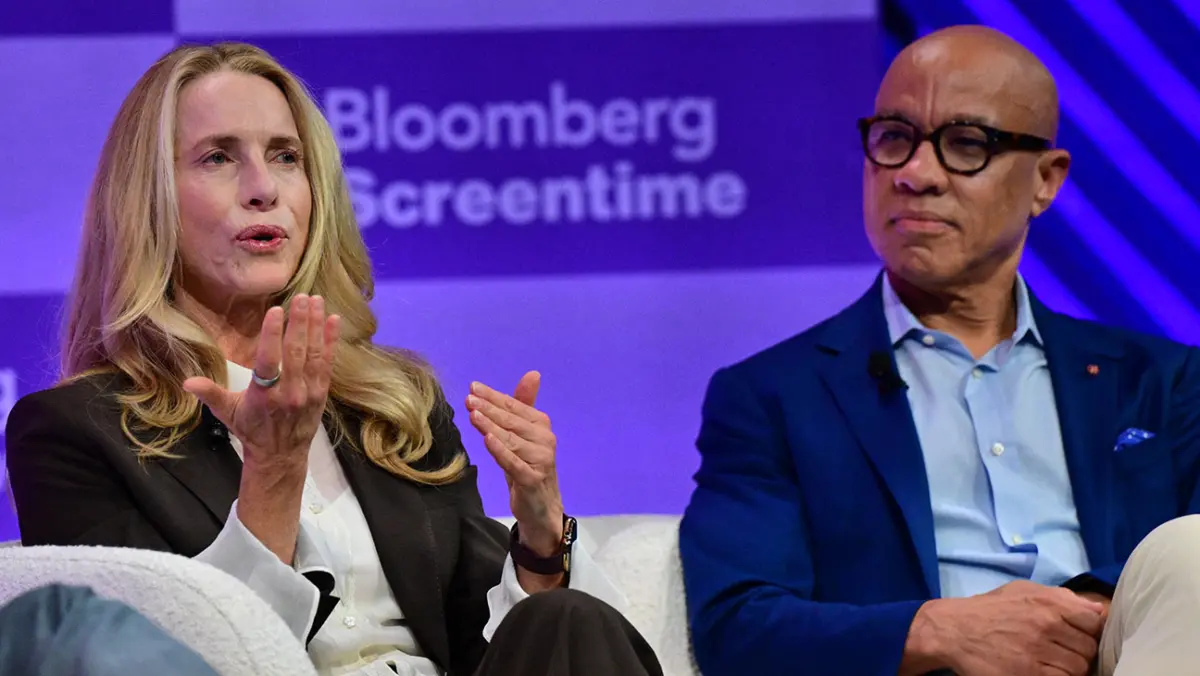
Anonymous Content, the storied production powerhouse behind critically acclaimed hits such as True Detective, Mr. Robot, and 13 Reasons Why, is undergoing a profound strategic transformation. After decades of operating primarily as a fee-for-hire service provider, the company is pivoting toward a self-sustaining financial model that will allow it to act as an equity investor and lead financier in the competitive film marketplace. This evolution, announced during the Bloomberg Screentime conference on Thursday, marks a departure from traditional service-based production and signals a long-term play for creative autonomy and increased intellectual property ownership.
The strategic shift is spearheaded by CEO Darren Walker, who joined the company in January following a distinguished tenure as the president of the Ford Foundation. Under Walker’s leadership, and with the robust backing of Laurene Powell Jobs’ Emerson Collective, the company is not only recalibrating its business model but also diversifying its creative footprint into live theater and Broadway, further expanding its reach into the cultural zeitgeist.
A New Chapter for Anonymous Content
For years, Anonymous Content has been a reliable engine for high-end television and film, delivering projects like the upcoming Netflix adaptation of East of Eden and the Emmy-winning Remarkably Bright Creatures. However, as the media landscape shifts, the company’s leadership has identified the limitations of a service-only model. According to CEO Darren Walker, the transition to becoming a financier is both a business necessity and a creative imperative.
“We have been a fee-for-hire production company. We have not invested for the most part,” Walker noted during the conference. “The board now and Emerson has made it possible for us to become a financier in the market, so we’ll be able to co-finance, finance, and take the lead in financing in film.”
Laurene Powell Jobs, whose Emerson Collective made a material investment in Anonymous Content earlier this year, echoed these sentiments, framing the change as an essential step toward long-term viability. “It is a slight, subtle change in priorities when you look for excellence, when you look for the highest quality, when you look for material that moves humans and touches us and stays inside us and reminds us of what we’re capable of,” she said. “If that’s your number one, and then making money is number two, then you actually end up making films that people really want to see.”
Strategic Projects and Creative Partnerships
As a testament to this new direction, Anonymous Content has unveiled its first major project under the revised model: a feature film adaptation of Nicholas Boggs’ Baldwin: A Love Story. The project represents a high-profile collaboration, with Boggs writing the script alongside his partner, the acclaimed novelist Marlon James (The Disappearers). The adaptation will be co-produced with Higher Ground, the production company founded by Barack and Michelle Obama, underscoring Anonymous Content’s intent to align itself with high-caliber, culturally significant storytelling.
Walker has committed to a production slate of at least eight films over the next twelve months, with expectations for that number to grow in subsequent years. By controlling the financing, the company intends to retain greater creative control and long-term upside on its intellectual property, a luxury rarely afforded to service-based production houses.
Leadership Restructuring and Governance
The pivot is supported by a comprehensive overhaul of the company’s governance. As part of the transition, the board of directors has been reconstituted to include key stakeholders who bring both financial expertise and deep-rooted industry influence. Laurene Powell Jobs has joined the board, joined by former HBO CEO Richard Plepler. Plepler’s involvement, in particular, is viewed as a signal of intent to focus on premium content, mirroring the high-quality, auteur-driven strategy he employed during his time at HBO.
This governance shift follows the appointment of Walker, who has spent the last several months analyzing the company’s operational silos. The inclusion of figures like Plepler suggests a focus on prestige content that has historically been the hallmark of Anonymous Content’s most successful ventures.
The Business Case for Financial Independence
The decision to move away from a “fee-for-service” model is rooted in the current economic realities of the entertainment industry. While service production provides a steady stream of revenue, it limits the upside for production companies. By shifting to a financier role, Anonymous Content aims to capture the value of the content it produces, rather than simply billing for the labor of production.
“Fee-for-service is a bad way to build a company,” Powell Jobs noted when asked about the sustainability of the previous model. While the company is not in a “rush” to achieve immediate returns, both Walker and Powell Jobs emphasized that the firm must be self-sustaining. This approach implies a more rigorous selection process for projects, prioritizing content that resonates on a human level—the type of material that sustains long-term cultural relevance and profitability.
Expansion into Live Events and Vertical Growth
Beyond film and television, the company is looking to extend its reach into live performance, including Broadway and other live event spaces. Walker expressed a desire to build “tentacles” in communities of creators that have historically been overlooked by traditional Hollywood studios. By diversifying into live theater, Anonymous Content aims to create a 360-degree ecosystem for creators, where a story can potentially live on screen and on stage simultaneously.
When questioned about the potential for further growth through mergers or acquisitions, Walker indicated a measured, calculated approach. He confirmed that the company would pursue “acquihires”—the practice of acquiring a company primarily to secure its talent—and that they are open to transactions that make strategic sense. However, he was cautious about the current market climate, noting that “valuations are so inflated” in the current media sector.
Addressing the AI Discourse
A notable aspect of the company’s future involves the intersection of technology and creativity. Given Emerson Collective’s substantial investment of over $1 billion in the artificial intelligence sector, the topic of AI in filmmaking was a point of focus. Despite fears within the creative community regarding the impact of AI on writing and production, Powell Jobs emphasized that the goal is to foster “human flourishing.”
“We actually want to be part of human flourishing and the positive momentum for our human race and our planet,” she stated. Regarding the specific integration of AI into the creative process, she argued for engagement rather than isolation. “It’s really important to have a seat at that table and understand how models are being trained, and perhaps speak to them as they’re learning and course-correcting along the way. Much better to be in the conversations than to be outside.”
Future Outlook and Implications
The transition of Anonymous Content from a production services provider to a lead financier represents a bellwether moment for independent media. As the industry grapples with the decline of traditional cable and the stabilization of the streaming market, production houses are increasingly looking to move upstream. By controlling the financing, firms can protect their projects from the shifting whims of network executives and ensure that their creative vision remains intact from development through to distribution.
The next year will be critical for the company as it executes its eight-film slate. If successful, this strategy could provide a blueprint for other production companies looking to navigate the complexities of modern media finance. With the financial backing of Emerson Collective and the strategic guidance of a leadership team composed of both industry veterans and institutional experts, Anonymous Content is positioning itself to be a formidable player in the next generation of global entertainment. The company’s focus on high-quality, human-centric storytelling—backed by a robust balance sheet—suggests that it is moving into an era characterized by both creative ambition and fiscal discipline.