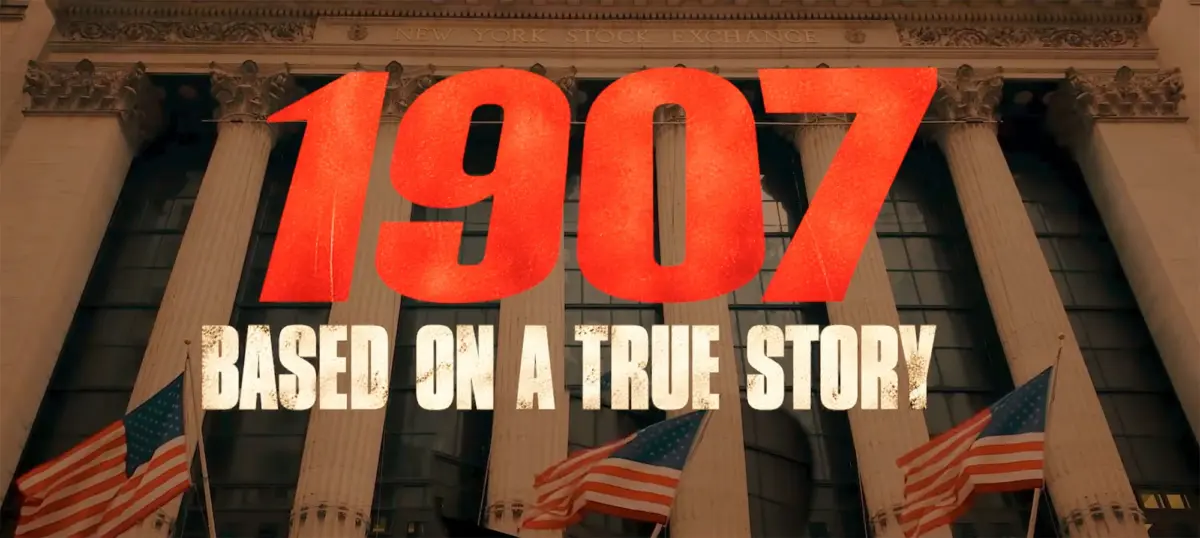
The Avenue has officially unveiled the trailer and promotional poster for The Panic, a historical drama and political thriller directed by independent filmmaker Daniel Adams. Set against the backdrop of the Panic of 1907—a severe financial crisis that predated both the Great Depression and the outbreak of the First World War—the film dramatizes the high-stakes power struggles among America’s early-twentieth-century industrial and banking elite. Scheduled for a theatrical release in select United States markets on January 22, 2027, the feature brings to the screen a lesser-known chapter of American economic history, charting how private financiers stepped into roles typically reserved for central banks to rescue a collapsing market.
The narrative centers on the intense rivalry between two towering figures of the era: Charles T. Barney, head of the Knickerbocker Trust Company, portrayed by Cary Elwes, and legendary financier J. Pierpont Morgan, played by Colm Meaney. As a failed market manipulation scheme triggers cascading bank runs and widespread panic across Wall Street, the nation edges perilously close to total financial ruin. While the public looks to Morgan as a savior capable of restoring liquidity and confidence to the banking system, the film explores the darker machinations behind closed doors, suggesting that the crisis provided Morgan with a strategic opportunity to neutralize a primary competitor, consolidate unprecedented financial control, and permanently alter the trajectory of American capitalism.
Historical Context of the Panic of 1907
To fully understand the premise of The Panic, one must examine the fragile economic architecture of the United States at the dawn of the twentieth century. Prior to the establishment of the Federal Reserve System in 1913, the American economy lacked a centralized lender of last resort. The nation’s monetary supply was decentralized, heavily dependent on a network of national banks, state-chartered institutions, and unregulated trust companies. Trusts, in particular, operated with lower reserve requirements than traditional commercial banks while increasingly engaging in speculative Wall Street investments.

In October 1907, an unsuccessful attempt by speculators F. Augustus Heinze and Charles W. Morse to corner the stock market in the United Copper Company collapsed. The failed corner sent shockwaves through the financial sector, rapidly eroding public confidence in institutions associated with the speculators. Depositors rushed to withdraw their funds, initiating a destructive wave of bank runs.
The epicenter of the crisis shifted to the Knickerbocker Trust Company, New York’s third-largest trust, after its president, Charles T. Barney, was linked to the failed copper scheme. Despite having substantial underlying assets, the Knickerbocker was overwhelmed by frantic crowds demanding cash withdrawals. Unable to secure emergency loans from other banking houses—largely due to a lack of coordinated support and underlying rivalries—the Knickerbocker Trust suspended operations on October 22, 1907. This closure acted as a catalyst, sparking widespread panic that threatened to bring down solvent banks and industrial enterprises alike across the nation.
Chronology of the Crisis and Morgan’s Intervention
With the federal government, under President Theodore Roosevelt, hesitant and legally unequipped to inject emergency capital directly into private financial institutions, leadership fell to the private sector. J.P. Morgan, aging but possessing unmatched financial dominance and global prestige, stepped into the vacuum.
Operating out of his private library on Madison Avenue, Morgan assumed the role of de facto central banker. He summoned the presidents of New York’s major banks and trust companies, locking them in a room until they agreed to pool their resources to rescue solvent institutions facing liquidity shortages.

Morgan’s intervention unfolded across several critical phases:
- October 22–24, 1907: The collapse of the Knickerbocker Trust triggers widespread panic. Morgan organizes committees of bank presidents to audit troubled trust companies and determine which institutions are fundamentally sound enough to warrant emergency financial rescue.
- October 25, 1907: The New York Stock Exchange faces imminent closure as cash reserves dwindle and brokerages fail to secure day loans. Morgan pressures bankers to raise $25 million within minutes, preventing the complete shutdown of the exchange.
- November 2, 1907: A major Wall Street brokerage house, Moore & Schley, faces bankruptcy due to heavy holdings of Tennessee Coal, Iron and Railroad Company stock pledged as collateral. Morgan engineers a buyout of the company by United States Steel, securing tacit approval from President Theodore Roosevelt to bypass antitrust concerns, thereby averting a broader collapse.
- Late November 1907: Through coordinated liquidity injections, importations of European gold, and the distribution of clearinghouse loan certificates, Morgan successfully stabilizes the monetary system, bringing the acute phase of the panic to a close.
Production Background and Cast
The film is written, directed, and produced within the independent film circuit by Daniel Adams, whose prior directorial credits include The Lightkeepers, The Golden Boys, and The Walk. Production backing comes from producers Michael Mailer, Eric Williams, and Mark Williams.
Alongside Cary Elwes and Colm Meaney in the central roles, The Panic features an expansive ensemble cast. The roster includes Cristiana Dell’Anna, Justin Chatwin, Anastasiya Mitrunen, Alberto Frezza, Ned Bellamy, alongside veteran actors Tim Daly and Malcolm McDowell.
The project initially appeared on the festival circuit with a screening at the 2025 Buffalo Film Festival. Following distribution agreements, The Avenue has slated the picture for a targeted theatrical rollout in the United States, positioning the historical drama for audiences interested in biographical and economic thrillers.

Broader Impact and Implications
The events dramatized in The Panic left a profound and lasting legacy on the American financial landscape. The severity of the 1907 crisis laid bare the inherent dangers of a banking system lacking federal oversight and liquidity management. Public outcry and congressional inquiries following the panic demonstrated that relying on the private intervention of a single billionaire financier was an unstable foundation for a modern industrial economy.
These realizations directly catalyzed legislative reform. In 1908, Congress passed the Aldrich-Vreeland Act, which established the National Monetary Commission to investigate banking reform. This commission’s findings ultimately led to the passage of the Federal Reserve Act of 1913, signed into law by President Woodrow Wilson, which established the Federal Reserve as the nation’s central bank designed to regulate monetary policy and prevent future panics.
By revisiting these historical events, The Panic examines the intersection of private ambition, systemic risk, and institutional power. As contemporary audiences continue to navigate debates surrounding financial regulation, income inequality, and the influence of corporate titans, the film offers a dramatic exploration of the foundational moments that shaped modern American economic structures.