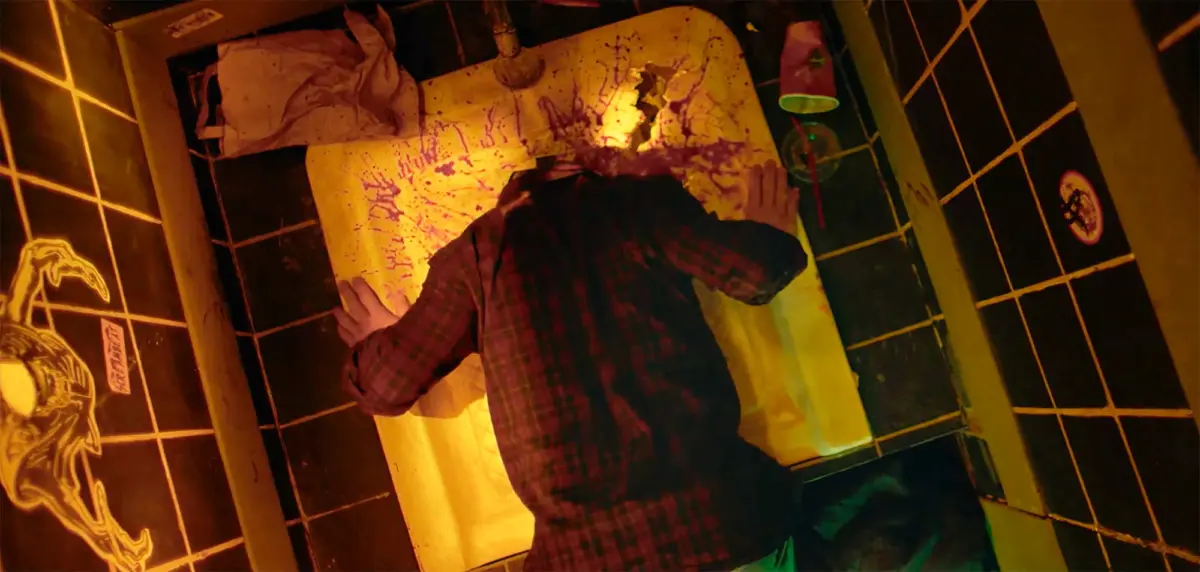
Dark Sky Films has officially released the trailer and promotional poster for Flush, an ambitious and deeply unconventional French horror-comedy directed by filmmaker Grégory Morin. Centered entirely within the claustrophobic and unsanitary confines of a public restroom, the film promises an unapologetically visceral viewing experience. The narrative follows a desperate middle-aged protagonist whose attempt to win back his former romantic partner at a gritty nightclub culminates in a catastrophic drug heist. Left for dead with his head wedged inside the porcelain basin of an infamous squat toilet, the character must navigate an escalating series of absurd, grotesque, and life-threatening hazards over the course of a single evening.
The feature stars R. Jonathan Lambert in the leading role of Luke, alongside a supporting cast featuring Élodie Navarre, Elliot Jenicot, and Rémy Adriaens. Following a successful international festival circuit run that began in 2025, North American distributor Dark Sky Films has scheduled Flush for a direct-to-VOD release on October 9, 2026. The film represents a bold entry into contemporary genre filmmaking, combining high-concept spatial limitation with extreme body-horror elements and dark comedic undertones.
Main Facts of the Production
Flush is produced by Kieran Clemow, Thomas Leterrier, and Jean-Michel Tari, drawing from a screenplay written by David Neiss. Director Grégory Morin, previously recognized for his work on genre projects such as Ultimate Zombie Feast and various horror short films, approaches the narrative with a distinct visual and structural challenge: maintaining a single-location perspective for the entirety of a feature-length runtime.

The plot’s inciting incident places Luke in a compromised physical and psychological state. After infiltrating a shady club environment to execute a misguided drug theft aimed at reclaiming his ex-girlfriend, Luke is ambushed and incapacitated. His entrapment in a notoriously filthy European-style squat toilet serves as the literal and figurative anchor of the film. Far from a standard hostage scenario, Luke’s predicament exposes him to a bizarre succession of threats, ranging from ruthless drug dealers searching for their lost inventory to unexpected biological hazards, most notably a surprisingly aggressive rodent population inhabiting the club’s plumbing infrastructure.
Chronology and Festival Circuit Journey
The trajectory of Flush from independent production to commercial distribution spans over a year of targeted festival screenings and industry showcases. The film celebrated its world premiere at the prestigious Fantasia International Film Festival in 2025, an event widely recognized as a premier launchpad for boundary-pushing international horror, sci-fi, and independent cinema.
Following its Fantasia debut, the film embarked on a selective international festival run, cultivating a reputation among genre critics and festival programmers for its sheer audacity and willingness to push the boundaries of physical comedy and gross-out horror. This early exposure allowed the production team to secure North American distribution through Dark Sky Films, a label renowned for acquiring and championing daring, unconventional, and provocative genre works. The rollout culminates on October 9, 2026, when the film becomes widely accessible to American audiences via video-on-demand platforms.
Context and Cinematic Precedents

Single-location thrillers are a time-tested staple of independent filmmaking, offering directors a method to maximize tension while minimizing production budgets. Films such as Buried, which confined Ryan Reynolds to a wooden coffin, or Phone Booth, which restricted Colin Farrell to a New York City payphone, have successfully utilized extreme spatial constraints to drive psychological narratives. However, Flush diverges sharply from these suspense dramas by anchoring its single-location premise in the realms of low-brow comedy, surrealism, and extreme body horror.
Industry analysts have drawn inevitable stylistic comparisons to iconic sequences in cinematic history, most notably the infamous "worst toilet in Scotland" sequence from Danny Boyle’s 1996 masterpiece Trainspotting. While that sequence provided a brief, hallucinatory descent into filth, Flush expands this specific nightmare scenario across an entire feature film. By merging the visceral revulsion of bodily waste with the heightened stakes of a criminal underworld thriller, Morin’s film taps into a specific lineage of transgressive European genre cinema that rejects traditional narrative comfort in favor of sensory overload.
Official Responses and Industry Reception
While traditional studio comedies and standard horror releases rely on familiar formulas, independent distributors like Dark Sky Films have increasingly leaned toward high-concept, polarizing genre experiments to capture the attention of digitally connected audiences. Representatives for the distributor have emphasized the film’s unique selling proposition: a completely singular viewing experience that defies easy categorization.
Although formal critical reviews remain tied to its festival screenings, early industry reactions have characterized Flush as a polarizing, midnight-movie crowd-pleaser. The film’s reliance on taboo-breaking humor and relentless physical discomfort ensures that it will provoke strong reactions, dividing audiences between those who appreciate its audacious commitment to the bit and those alienated by its explicit imagery.

Broader Impact and Implications for Independent Horror
The release of Flush highlights ongoing trends within the contemporary horror-comedy landscape, where creators utilize extreme concepts to stand out in an increasingly crowded streaming marketplace. With the barrier to entry for digital distribution lowering year over year, independent filmmakers are tasked with delivering high-concept hooks capable of generating immediate social media engagement and word-of-mouth visibility.
By anchoring a crime thriller inside a public sanitation fixture, Morin and his creative team have engineered a project that inherently defies conventional marketing norms. Whether Flush succeeds in establishing a broader commercial footprint or remains a cult curio for dedicated fans of transgressive cinema, its arrival underscores the continued viability of boundary-pushing, micro-genre experimentation within the modern distribution ecosystem. As North American audiences prepare for its October debut, Flush stands as a testament to the fact that horror continues to find new, unexpected spaces to explore the limits of audience endurance and comedic timing.