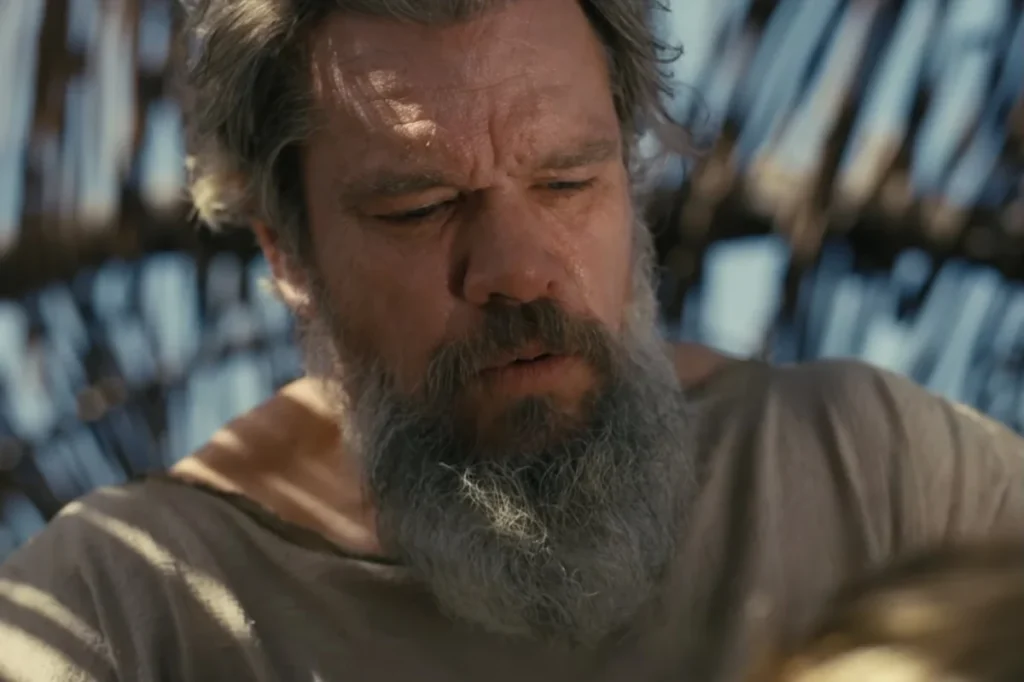
The halfway point of the science fiction thriller Disclosure Day features a pivotal monologue delivered by Hugo Wakefield, portrayed by Colman Domingo, to his former colleague Noah Scanlon, played by Colin Firth. In this scene, Wakefield confesses a profound shift in his perspective, attributing his past cynicism and self-imposed isolation to profound loss and grief. He expresses a desire to convince Scanlon that their decades-long effort to conceal "the truth" about extraterrestrial existence was a grave error, suggesting that what lies beyond their cover-up holds the potential for universal salvation. This moment is clearly intended as the emotional and thematic core of the film, a narrative apex meticulously built towards by the screenwriters. However, despite its central placement and thematic weight, the execution falls demonstrably short, failing to deliver the profound impact it aims for, leaving audiences with a sense of unfulfilled potential.
For many who grew up immersed in the wonder-filled narratives of filmmakers like Steven Spielberg, the initial allure of Disclosure Day is understandable. Works such as Close Encounters of the Third Kind, E.T. the Extra-Terrestrial, the Indiana Jones franchise, Jaws, Jurassic Park, and The Goonies have shaped a generation’s perception of the world and its boundless possibilities. The emotional resonance of these films, even their more polarizing entries, has left an indelible mark. Therefore, a film like Disclosure Day, which treads similar thematic ground, should ideally resonate with that same sense of awe and introspection. The expectation is for a compelling exploration of humanity’s place in the cosmos, yet the film struggles to transcend its ambitious premise.
Initial marketing for Disclosure Day was characterized by a deliberate vagueness in its trailers, which ultimately revealed the entire plot. The central narrative revolves around Daniel Kellner (Josh O’Connor) and Margaret Fairchild (Emily Blunt), individuals who, as children, were abducted and subsequently "activated" with a singular purpose: to reveal the existence of aliens to a world long deceived by governmental and corporate entities. The antagonists are identified as the Wardex corporation, led by Noah Scanlon, while the protagonists are spearheaded by Hugo Wakefield, a former Wardex employee who absconded with crucial extraterrestrial technology and a cadre of like-minded individuals. The film posits that humanity deserves this revelation, arguing for the inherent right to knowledge.
This assertion of a right to knowledge is explored through a dialogue between Daniel and his girlfriend, Jane (Eve Hewson), a former nun-in-training. Jane questions the wisdom of disseminating such earth-shattering information, expressing concern that it might lead humanity to abandon its faith. While this conversation attempts to delve into profound philosophical territory, the film’s script struggles to find a consistent balance in its dialogue. It oscillates between attempts at intimate character development and a more sparse, mood-driven approach, ultimately failing to commit to either. The dialogue often serves as exposition, explicitly dictating to the audience what they are meant to feel and comprehend, rather than allowing for organic interpretation.
The film’s exploration of faith, particularly Jane’s Christian perspective, feels somewhat anachronistic and out of step with contemporary societal trends. Jane’s apprehension that alien knowledge will supplant humanity’s need for a higher power overlooks the significant global decline in religious adherence over the past few decades. Pew Research Center data from 2026 indicates that in the United States alone, just over half of adults are absolutely certain of God’s existence, a figure that has steadily decreased. The film’s narrative, which hinges on a dramatic confrontation between faith and alien revelation, neglects to acknowledge the broader context of declining religiosity and the diverse spectrum of belief systems worldwide, beyond a singular Christian framework.
This disconnect between the film’s thematic concerns and current societal realities suggests a narrative that might have been more effectively situated in a different temporal setting. Had Disclosure Day been framed as an early 2000s narrative, or even a story set a few decades in the past, some of its thematic puzzles might have been more readily resolved. Instead, the film is ostensibly set in the near future, a period overshadowed by the looming specter of World War III. This backdrop, however, is treated with a surprising lack of gravitas, serving primarily as background noise that the audience is implicitly encouraged to disregard in favor of the central, extraordinary protagonists. The portrayal of the general populace as passive bystanders, reacting to impending global conflict with fleeting supermarket frenzies and background news reports, starkly contrasts with the ethos of classic Spielberg films. Those narratives often centered on ordinary individuals thrust into extraordinary circumstances, highlighting their resilience and resourcefulness without resorting to "chosen one" tropes.
In essence, Disclosure Day can be viewed as a modern reinterpretation of Close Encounters of the Third Kind. This comparison is particularly striking given the half-century gap between the two films. While Close Encounters remains a monumental achievement in cinematic storytelling, Disclosure Day struggles to capture that same magic, offering a less impactful successor. This tendency to revisit and reframe established narratives seems to be a growing trend, as seen with The Matrix Resurrections, which, while also a sequel, managed to engage with its themes of audience reception and narrative repetition more effectively. The core message of Disclosure Day, explicitly articulated by Hugo Wakefield, centers on empathy as the paramount evolutionary advantage, a concept the aliens supposedly intend to impart to humanity.
The film’s emphasis on empathy, however, is undermined by its rather simplistic and problematic definition. Daniel and Margaret’s childhood abductions, intended to imbue them with special abilities to aid humanity, are presented without addressing the inherent trauma and ethical implications of such actions by supposedly benevolent extraterrestrials. The plot dictates that they received different "gifts" due to a supposed biological constraint: Daniel, the capacity for understanding universal mathematical codes, and Margaret, the ability to understand people. This binary division, with the female protagonist embodying empathy and the male protagonist representing logic, relies on outdated gender-essentialist stereotypes.
Furthermore, the film appears to conflate empathy with telepathy. Margaret’s ability to "read minds" and discern what people need to hear is presented as a form of empathy, a concept that feels reductive and misapplied. This portrayal, intertwined with overt Christian allegory, creates a peculiar tonal dissonance, especially considering the film’s likely origin from a director with a Jewish background. The sheer exhaustion induced by grappling with these thematic and allegorical inconsistencies is palpable.
Despite these narrative shortcomings, the action sequences in Disclosure Day are competently executed. However, John Williams’s score, while familiar and often stirring, too frequently incorporates flourishes from his previous collaborations with Spielberg, leading to a distracting sense of repetition. The plot also suffers from contrived moments where characters inexplicably act with a lack of common sense to advance the narrative, such as paramilitary officers failing to look behind them or vehicles inexplicably failing to maneuver. These logical leaps detract from the film’s credibility.
Perhaps the most disheartening aspect of Disclosure Day is its impact on the performances. It is rare to witness such a wealth of talented actors, including Colman Domingo, Colin Firth, Emily Blunt, and Josh O’Connor, struggling to deliver their lines naturally or embody their characters with a lived-in authenticity. The script often fails them, forcing them to convey complex emotions through dialogue that feels stilted and unconvincing.
A particularly jarring instance involves Margaret’s reaction to a panic attack following a high-stakes action sequence. Her father had Parkinson’s disease and died from it, a detail introduced early in the film. During her panic attack, Margaret violently trembles and cries out, "The Parkinson’s, I can’t stop, like my father." This moment, intended to be emotionally resonant, feels deeply misguided and exploitative. For individuals with personal connections to Parkinson’s disease, witnessing such a ham-fisted and simplistic portrayal of fear and familial trauma is profoundly alienating. It evokes the exact opposite of feeling "seen" or understood. This contrasts sharply with the nuanced emotional beats found in classic Spielberg films, such as Lex Murphy’s breakdown in Jurassic Park, where emotional subtext and audience empathy were masterfully employed, even when written by the same screenwriter, David Koepp. Something vital appears to be lost in the transition to this new breed of filmmaking.
The film’s central thesis, that the revelation of alien existence would universally halt the world and initiate profound change, is delivered with the subtlety of a bulldozer. This optimistic outlook, however, feels disingenuous and out of touch with the complexities of human nature and societal reaction. The film fails to offer a truly hopeful vision, presenting a simplistic "magic solution" to the world’s problems. In an era that demands constant vigilance and collective effort to address global challenges, Disclosure Day offers an unrealistic and ultimately uninspiring message. The ending suggests that the mere knowledge of extraterrestrial life would be a panacea, a notion that fails to resonate as a plausible or hopeful fairy tale. The reality is that averting global crises requires sustained, collaborative effort, a message that Disclosure Day conspicuously fails to convey.
The experience of watching Disclosure Day leaves one with a potent reminder of the challenging state of global affairs, a sentiment that even a well-intentioned comedic interlude involving a firetruck cannot alleviate. The film, despite its ambitious premise and talented cast, ultimately falters in its execution, failing to deliver the wonder and awe that audiences have come to expect from its cinematic lineage, and leaving behind a sense of missed potential and unfulfilled promise.