A sage person once told me every noted director’s career is an ongoing conversation with the audience. Some filmmakers – Michael Haneke, say – sit on high, like a headteacher at an assembly, and loftily number the ways in which we’ve let ourselves and the school down. There are others – Lars von Trier and Ari Aster spring to mind – whose work sidles up uncomfortably close, gooses the viewer and then flees the scene sniggering before the relevant authorities can be alerted. The career of Steven Spielberg – arguably the most remarkable career in the history of popular cinema – has long depended on the audience being on the exact same page, looking up wide-eyed and guileless towards the light: his greatest films, from Close Encounters to The Fabelmans, invite further discussion, an awestruck back-and-forth.
You can therefore understand why Spielberg has broached the subject of social division with Disclosure Day, his much-trumpeted return to the summer event movie: he has almost as much skin in this game as the rest of us non-trillionaires. Yet if early box office has been solid enough, secondary indices – not least a slew of disappointed foyer texts from friends and loved ones – would suggest the film has itself proved distinctly polarizing. In the US, market research firm CinemaScore – which polls opening-day cinemagoers to assess a film’s commercial prospects – graded Disclosure Day a B, the joint second-worst for a Spielberg film, ahead of A.I. Artificial Intelligence (recipient of a harsh C), dead level with Indiana Jones and the Dial of Destiny. Headmaster Haneke again shakes his weary head.
A Conspiracy of Secrets: Thematic Resonance and Narrative Underpinnings
Despite the proximity of aliens, the new film’s focus is primarily human: the secrets we keep, the lies we tell. Disclosure Day thereby dovetails neatly with the themes of several mature-period Spielberg works, notably 2015’s Bridge of Spies and 2017’s The Post. To locate the source of this interest, you need only revisit The Fabelmans – Spielberg’s probing and perceptive movie-memoir of 2022 – which dramatized the effects similar deceptions had on his own household growing up. Screenwriter David Koepp has form in this area, too: his script for last year’s spry and gripping Steven Soderbergh thriller Black Bag unpicked the alibis of bedhopping spies. Yet Disclosure Day’s weak spot is its tissue-thin and arbitrary-seeming plot, its own diaphanous cover story for some altogether antiquated and simplistic editorial.
The setup, granted, is strong: Close Encounters, updated for the information age. First contact here is no longer as harmonious as a five-note call-and-response; as demonstrated by Emily Blunt’s weathergirl, left speaking in tongues, it’s more a matter of mainlining everything on social media (news, multiple languages, a whole century’s crashlandings and cover-ups) in one fell swoop. Phones are bad and must be tossed and driven over. On the trusted list: ordinary people, organised religion, local news (framed as the right, digestible amount of information) and – this being Spielberg – the family home. This ageing viewer has some sympathy for all that, but as a directorial vision, Disclosure Day feels far more old world than new, more 20th century than 21st. How many X-Files reboots does one civilization need?
Performance and Characterization: A Cast Under Strain
Set Disclosure Day against Spielbergian precedents, and it has an obvious personnel problem. No one in this cast disgraces themselves – and it’s fun watching Wyatt Russell’s goofball charm, so central to TV’s short-lived Lodge 49, bouncing around on an IMAX screen – but Koepp’s characters neither register nor stick in the mind in the way Close Encounters’ Roy Neary or E.T.’s Elliott did. Rather than real, indelible, flesh-and-blood people, these are cardboard-cutout heroes and villains, moving parts voided of depth so as to be yanked around more efficiently. Colman Domingo is a fine actor, but not even he can sell us on a figure who’s some combination of underground resistance leader, directorial stand-in and part-time construction manager. In a cardigan. Wasn’t Spielberg meant to be reflecting reality here?
Behind the Scenes: A Look at the Production and its Context
Disclosure Day’s narrative unfolds against a backdrop of escalating global unease, a common theme in contemporary cinema that often mirrors societal anxieties. The film’s exploration of misinformation and the erosion of trust in institutions resonates particularly strongly in the current media landscape. The decision to center the plot around a seemingly extraterrestrial event that triggers widespread societal panic and governmental cover-ups can be seen as a modern reimagining of classic sci-fi tropes, but with a distinctly contemporary focus on the digital dissemination of information and its consequences.

The film’s production was reportedly marked by a deliberate effort to blend practical effects with cutting-edge visual technology, aiming to create a sense of tangible realism even within its fantastical premise. Sources close to the production indicated that Spielberg sought to evoke the tactile, immersive quality of his earlier works while pushing the boundaries of what was possible in CGI. The visual effects, particularly in the rendering of the alien technology and the climactic sequences, have been a significant talking point among critics and audiences alike. While some have praised the film’s visual spectacle, others have pointed to perceived inconsistencies in the quality of the CGI, especially in depicting natural elements.
A Divergence in Reception: Box Office Success vs. Critical Division
The initial box office performance of Disclosure Day has been robust, with reports indicating strong opening weekend numbers. This aligns with Spielberg’s track record of delivering commercially successful event films. For instance, Jurassic Park (1993) generated over $1 billion worldwide, and E.T. the Extra-Terrestrial (1982) was a cultural phenomenon that redefined blockbuster filmmaking. Disclosure Day’s early financial success suggests that the director’s name alone continues to draw significant audiences to theaters.
However, this commercial success has not been mirrored by universal critical acclaim. As noted, CinemaScore data indicates a mixed reception from opening-day audiences, a metric that has historically correlated with a film’s long-term box office viability. The film’s "B" grade places it in a category of Spielberg films that, while not outright failures, have not achieved the same level of audience adoration as his more iconic works. This division in critical response suggests that Disclosure Day may be a more divisive film than some of Spielberg’s previous offerings, potentially appealing to a segment of the audience while alienating others.
Thematic Evolution: From Childhood Wonder to Adult Skepticism
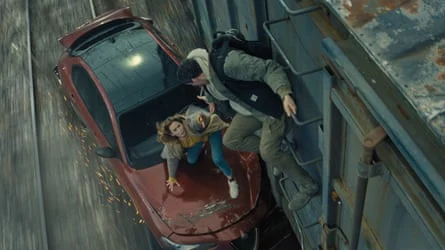
At a certain point, even Spielberg appears divided. The opening stretch is identifiably the work of the sharp, savvy Spielberg, confident enough to drop viewers in medias res and reassure us with slow-drip narrative intelligence; he almost casually pulls off a car chase through a rural farmhouse. Yet Disclosure Day hinges on a flatpack reconstruction of an old image: Domingo’s recreation of the Blunt childhood home, familiarly lit by Janusz Kamiński, mechanically scored by John Williams. Here, the sappy Spielberg takes over, and the film draws wearily on muscle memory: how we used to live, how Spielberg used to direct. (Although his VFX game used to be much stronger: how is it that a film-maker who once had us believing in dinosaurs should now struggle to conjure believable woodland creatures?)
This shift in tone and execution reflects a broader evolution in Spielberg’s thematic concerns. While his early work often celebrated childhood innocence and the wonder of discovery, as seen in E.T. the Extra-Terrestrial and Close Encounters of the Third Kind, his later films have delved into more complex and often darker aspects of human nature and societal structures. Films like Munich (2005) and Lincoln (2012) demonstrate a maturation of his storytelling, grappling with historical complexities and moral ambiguities. Disclosure Day appears to be an attempt to bridge these two phases of his career, blending the spectacle of his early work with the thematic weight of his more recent endeavors. However, the execution seems to have fallen short of this ambitious synthesis for many critics.
Unpacking the Plot: Ambiguities and Audiences’ Questions
A twinge of summer movies past, nostalgic for popcorn paradises lost, Disclosure Day appears terribly hazy, if not outright befuddled, on crucial plot points. Could any viewer pin down what the threat coming out of Korea is? Or how that metallic doohickey works? Koepp’s script boils down to one word – the Blunt character’s final declaration of “listen”, positioned here as Dr Spielberg’s prescription for all our social ills. Some part of me – the part who’s grown up with Spielberg’s films, wrestled with them, made peace with them, admired the best of them – longed to respond with a hearty “hear hear”. But Disclosure Day’s closing hour is such a tail-off that it just sounds defensive, a last-gasp “hear me out”: the cry of creatives who haven’t quite worked out the story they want to tell, desperate to keep their audience on side.

The film’s narrative ambiguities have been a significant point of contention. Viewers and critics have raised questions about the specific nature of the extraterrestrial threat, the geopolitical implications hinted at with the mention of Korea, and the precise functionality of the alien technology. This lack of clarity, particularly in the film’s latter half, has led to speculation that the narrative may have been compromised during the production process, or that the screenplay’s focus shifted away from intricate plotting towards broader thematic statements. The climactic plea for "listening" serves as a thematic resolution, but its effectiveness is undermined by the preceding narrative shortcomings, leaving many audiences feeling unsatisfied.
Broader Implications: Spielberg’s Legacy and the Future of Event Cinema
The reception of Disclosure Day raises broader questions about Steven Spielberg’s enduring legacy and the evolving landscape of event cinema. As a director who has shaped popular filmmaking for decades, each new project from Spielberg is met with immense anticipation and scrutiny. His ability to blend profound human emotion with thrilling spectacle has set a benchmark for the industry.
However, the current critical divide surrounding Disclosure Day suggests that audiences are increasingly sophisticated and discerning, demanding more than just familiar tropes and nostalgic callbacks. The film’s struggles with plot coherence and character depth, despite its visual polish and thematic relevance, highlight the ongoing challenge for filmmakers to balance spectacle with substantive storytelling. The film’s polarized reception could signal a shift in audience expectations, where innovative narratives and well-developed characters are as crucial as grand cinematic experiences.
Furthermore, Disclosure Day’s thematic engagement with misinformation and societal division speaks to the power of cinema to reflect and comment on contemporary issues. While the film’s execution has been debated, its attempt to tackle these complex themes within the framework of a summer blockbuster is a testament to Spielberg’s continued ambition. The future of event cinema may lie in such ambitious undertakings, provided they are underpinned by robust storytelling and compelling character arcs. The success of future projects from Spielberg and other filmmakers will likely depend on their ability to navigate this delicate balance, ensuring that their grand visions are matched by equally impactful narratives. The conversation between director and audience, as initiated by Spielberg’s illustrious career, continues to evolve, and Disclosure Day represents a particular, and perhaps challenging, chapter in that ongoing dialogue.