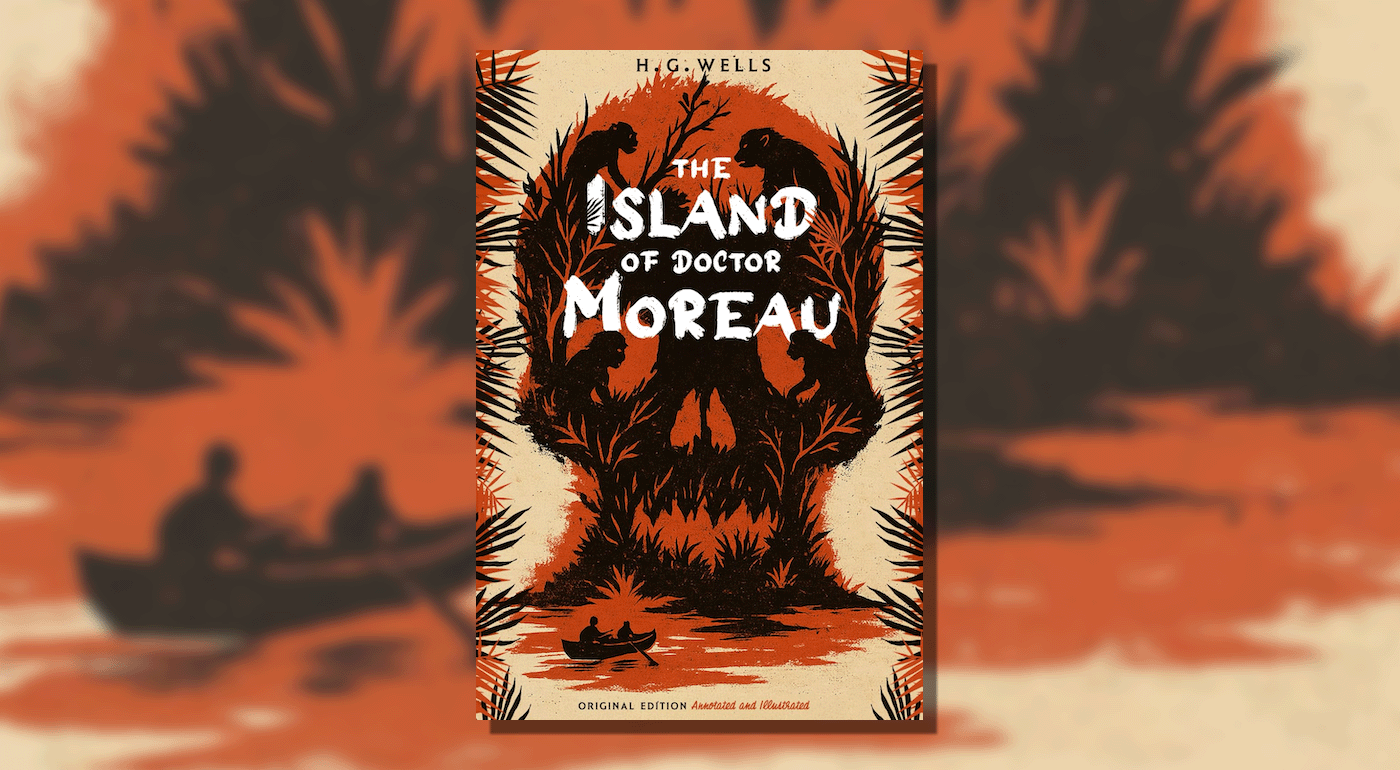
Published in 1896 by H.G. Wells, The Island of Doctor Moreau remains a foundational text in the canons of science fiction, cosmic horror, and early speculative literature. As part of an ongoing retrospective series examining the historical roots and branching evolutions of weird fiction, literary critics Ruthanna and Anne have recently turned their analytical lens toward Chapters 13 through 15 of the seminal novel. This middle section of the narrative shifts the focus from survival horror to profound philosophical and moral interrogation, tracking protagonist Edward Prendick’s terrifying confrontation with the novel’s titular antagonist and his grotesque biological creations.
The narrative arc of Chapters 13 through 15—encompassing "A Parley," "Doctor Moreau Explains," and "Concerning the Beast Folk"—depicts a critical turning point for Prendick. Fleeing across the isolated South Pacific island to escape the horrors of Moreau’s compound, Prendick finds his path blocked by Montgomery, Moreau, and several of the modified Beast Men. Facing what he perceives as a fate worse than death—mutilation and transformation into an animalistic state—Prendick wades into the ocean intending to drown himself. Instead, he turns to address the Beast Men directly, attempting to awaken their latent memories of humanity and convince them that their creators are inherently vulnerable due to their small numbers.
To Prendick’s astonishment, the engineered creatures hesitate, demonstrating a cognitive struggle that blurs the line between human and beast. This brief standoff dissolves when Moreau intervenes, employing a calm, rational demeanor and speaking in Latin to distance the entities from true humanity. Opting for a fragile truce, Moreau and Montgomery surrender their firearms, prompting Prendick to accept their "insurance" and follow them back to the enclosure to hear a full explanation of the experiments.
The Historical and Literary Context of Vivisection in 1896
To fully understand the weight of The Island of Doctor Moreau, modern readers must evaluate the socio-historical climate of the late Victorian era. Published just one year before the British parliamentary debates surrounding the cruelty to animals and the regulation of scientific experimentation, Wells’s novel taps directly into contemporary anxieties regarding the ethics of vivisection. During the late 19th century, the scientific community was deeply divided. Proponents of empirical research argued that animal experimentation was essential for medical progress, while emerging animal welfare organizations and anti-vivisection societies condemned the practice as cruel and morally corrupting.
When the 29-year-old H.G. Wells penned the novel, his personal stance on vivisection was famously ambivalent. While critics at the time—most notably zoologist P. Chalmers Mitchell—accused Wells of relying on melodramatic anti-vivisection tropes, subsequent analysis reveals a much more nuanced critique. Wells did not merely condemn the act of cutting live tissue; rather, he interrogated the psychological profile of the researcher. Decades later, in a 1927 article for The New York Times, Wells clarified his perspective, noting that the fundamental grievance of anti-vivisectionists lay not necessarily in the infliction of pain itself, but in the cold, methodical deliberation of the clean-handed scientist operating entirely outside traditional human empathy.
Chronology and Breakdown of Chapters 13-15
The sequence of events across these three chapters serves as a masterclass in pacing, moving swiftly from high-stakes physical action to claustrophobic intellectual debate, and finally to exhaustive anthropological observation of the island’s inhabitants.
- Chapter XIII (A Parley): Prendick attempts an escape along the shoreline, confronts Moreau and Montgomery, and nearly chooses drowning over capture. His impassioned speech to the Beast Men momentarily sparks their dormant human reasoning, leading to a temporary truce and the exchange of firearms.
- Chapter XIV (Doctor Moreau Explains): Transported back to the enclosure, Prendick listens to Moreau’s detailed physiological lecture. The doctor outlines his techniques—including skin grafting, blood transfusions, surgical modification of vocal cords, and neurological suppression via hypnotism—while defending his work through a twisted theological and philosophical lens.
- Chapter XV (Concerning the Beast Folk): Through conversations with Montgomery, Prendick learns the logistics of the island’s population. Out of approximately 120 subjects created over the years, roughly 60 survive, alongside numerous smaller, unhumanized monstrosities. Prendick catalogues the diverse array of hybrid creatures, observing how his initial stark terror gradually devolves into a desensitized, urban-style indifference reminiscent of Montgomery’s worldview.
Scientific Hubris, Pain, and Theological Implications
Central to Moreau’s defense is his revolutionary—and deeply disturbing—perspective on physical pain. Moreau posits that pain is merely a primitive evolutionary warning mechanism, a "mark of the beast" that rational beings are destined to outgrow. By operating without anesthetics, Moreau is not merely acting out of sadistic cruelty; rather, he operates from a place of radical detachment. Because he possesses a physiological or psychological makeup that does not register sympathetic pain, he views the agonizing cries of his subjects as irrelevant background noise, secondary to the "colorless delight" of pure intellectual discovery.
Literary analysts note striking parallels between Moreau and Victor Shelley’s Dr. Frankenstein, though with a crucial inversion. While Frankenstein’s ultimate failure stems from his abandonment of his creation—failing in his maternal/paternal duty—Moreau fails because he attempts to usurp divine creation while remaining entirely alienated from actual humanity. Moreau acts as a dark theologian, establishing "The Law" for the Beast Folk and expressing perpetual frustration when his artificial creations inevitably backslide into their base instincts. His compound functions as a microcosmic universe governed by an absentee, flawed deity whose laws are routinely broken in the dark.
Demographic and Cultural Themes Within the Island’s Ecosystem
The societal structure of the Beast Folk introduces complex sociological and racial subtexts that have drawn modern critical scrutiny. Wells’s narrative frequently employs contemporary racial comparisons to describe the hybrid creatures, reflecting the imperialist and colonialist anxieties of Victorian Britain. The population of roughly 60 surviving humanized animals includes a terrifying array of apex predators and bizarre pastiches—ranging from the Leopard-Man and the Hyena-Swine to the Sayer of the Law, M&Ling (a bear-ox-dog blend), and various bull and swine hybrids.
Over time, Prendick’s psychological conditioning shifts. The grotesque becomes normalized. He begins to view a Bull-Man not as an abomination, but as a weary laborer returning home, or a Fox-Bear hybrid as a shifty-faced individual encountered on a crowded city street. This gradual desensitization underscores one of the novel’s most chilling themes: the human capacity to adapt to horror, normalizing systemic cruelty until the underlying monstrosity is barely perceptible beneath the veneer of daily routine.
Broader Impact and Legacy in Modern Speculative Fiction
The enduring legacy of The Island of Doctor Moreau lies in its refusal to offer clean moral resolutions. By framing Moreau neither as a cening mustache-twirling villain nor as a misunderstood savior, Wells forced generations of readers to confront the ethical boundaries of scientific inquiry. The questions raised in Chapters 13 through 15—concerning the definition of humanity, the ethics of altering living flesh for knowledge, and the psychological toll of unchecked intellectual ambition—continue to resonate across modern bioethics, science fiction cinema, and weird fiction scholarship.
As the "Reading the Weird" retrospective series moves forward, exploring works like C.T. Muchemwa’s "The Inheritance," the foundational footprint of Wells’s island remains visible. The tension between cold, empirical methodology and visceral human empathy continues to serve as a vital crucible for testing the limits of imagination, morality, and what it truly means to be human.