The television landscape is increasingly defined by ambitious expansions of beloved literary and cinematic universes, transforming established narratives into multi-season sagas. This trend sees showrunners and directors delving deeper into the mythologies of iconic franchises, often with the blessing and active involvement of their original creators. Three prominent examples currently generating industry buzz and critical attention are The Testaments, a sequel to Hulu’s acclaimed The Handmaid’s Tale; HBO’s It: Welcome to Derry, a prequel to Stephen King’s terrifying epic; and FX’s Alien: Earth, an original series set within the chilling Alien universe. These projects exemplify the challenges and opportunities inherent in extending narratives that have already captivated millions, balancing faithfulness to source material with the demands of episodic storytelling and contemporary relevance.
The Enduring Resonance of Gilead: Expanding The Handmaid’s Tale
Margaret Atwood’s seminal 1985 dystopian novel, The Handmaid’s Tale, introduced readers to the terrifying Republic of Gilead, a totalitarian society where fertile women are enslaved as "handmaids" to bear children for the ruling elite. The novel’s stark warning about reproductive rights, religious extremism, and totalitarian control gained renewed cultural potency upon the premiere of Hulu’s television adaptation in 2017. Launched amidst a politically charged climate, the series, starring Elisabeth Moss as Offred/June Osborne, quickly became a critical and commercial phenomenon. Its evocative imagery, particularly the red cloaks and white bonnets worn by the handmaids, transcended the screen, becoming a powerful symbol of both subjugation and resistance in real-world protests globally. The show’s immediate success was underscored by its historic win as the first streaming offering to claim an Emmy for Best Drama Series, ultimately collecting 14 Emmys over its impressive run.
Showrunner Bruce Miller, who spearheaded the adaptation, initially felt a common sentiment among readers regarding Atwood’s original novel: a desire for more. "I was like, ‘Well, I hope there’s a sequel!’" Miller recounted, acknowledging the novel’s famously ambiguous ending. Two decades later, as Miller navigated the complexities of adapting the story for television, the idea of extending the narrative beyond the confines of the book began to take root in his mind. Unbeknownst to him, Atwood herself was also contemplating a continuation. Miller observed that the television series, and Atwood’s personal engagement with the cast, likely provided a fresh perspective on the "fun of television in terms of expanding stories."
As production for the second season of The Handmaid’s Tale commenced, Atwood revealed to Miller that she had begun writing a literary sequel. This culminated in the publication of The Testaments in 2019, set 15 years after the events of The Handmaid’s Tale. Atwood’s expanded vision directly influenced the television adaptation, giving Miller a crucial directive: "Don’t kill Aunt Lydia." The menacing figure, brilliantly portrayed by Emmy winner Ann Dowd, was slated for a significant role in The Testaments, necessitating her survival in the TV series. This collaborative dynamic between author and showrunner highlights a unique synergy, where the adaptation not only draws from the source but also influences its future literary development.
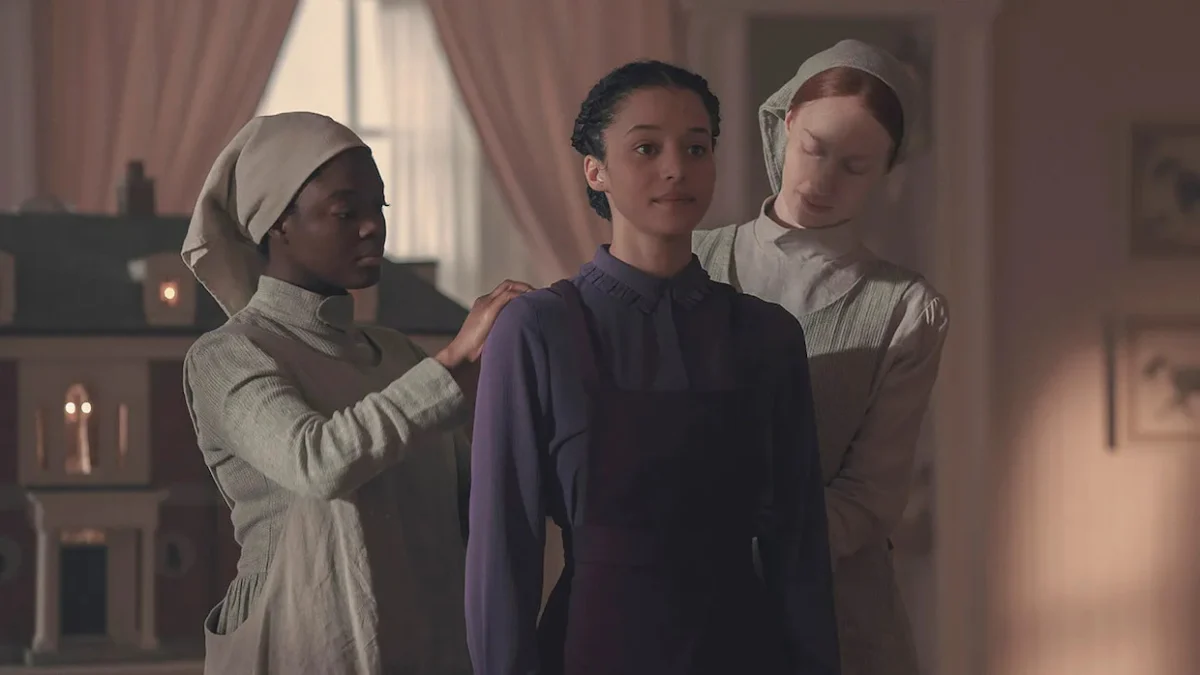
The Testaments television series picks up the narrative 15 years after June Osborne’s escape to Canada, a significant deviation from Atwood’s original novel where Offred’s fate after her capture remains ambiguous, and her story is presented as a historical document. Miller’s adaptation portrays June (Elisabeth Moss) as a survivor, actively working against Gilead from outside its borders. The sequel series then introduces Agnes (Chase Infiniti), a handmaid-in-training within Gilead who is unknowingly June’s daughter. This narrative thread allows Miller to bridge the gap between Atwood’s initial novel and its sequel, leveraging the creative freedom granted by the author. Miller admits his initial reluctance to alter The Handmaid’s Tale, one of his favorite novels, but recognized the necessity of evolving the story for the television medium. Atwood’s encouragement to "take the book and interpret it" fostered a fertile ground for adaptation, with Miller regularly consulting Atwood on his ideas throughout each season’s writing process. The knowledge of The Testaments‘ central premise allowed Miller to craft a more elaborate and triumphant arc for June, departing from her anonymous demise in the original novel but preserving the core themes of resistance, survival, and the fight for freedom. The series’ critical acclaim and Infiniti’s Gotham Award win for her lead performance further underscore the successful transition and expansion of this complex narrative.
Unmasking Pennywise: The Origins of It: Welcome to Derry
Stephen King’s monumental 1986 horror novel, It, has long terrified readers with its chronicle of the malevolent entity Pennywise the Dancing Clown, and the "Losers’ Club" who confront it across generations in Derry, Maine. The novel’s intricate narrative, spanning decades and delving into the psychological depths of its characters, has inspired multiple adaptations, including a 1990 miniseries and Andy Muschietti’s two-part cinematic rendition (2017 and 2019). The Muschietti films were box office successes, grossing over $1.1 billion worldwide, and cemented Bill Skarsgård’s portrayal of Pennywise as a modern horror icon.
The success of the films naturally sparked discussions about further exploration of King’s universe. Director Andy Muschietti, alongside his producing partner and sister Barbara Muschietti, found inspiration for a prequel series during the production of the films. Their on-set conversations with Bill Skarsgård about Pennywise’s motivations and enigmatic origins laid the groundwork for It: Welcome to Derry. "When you’re close to your actor and talking about character a lot, you go into depths that transcend the story you’re telling," Andy Muschietti explained. "Soon we were very excited about the potential exploration of Pennywise’s origins—when did the monster become the clown? It’s very enigmatic in the book, but intentionally cryptic."
HBO’s It: Welcome to Derry is set 27 years before the events of It: Chapter One, positioning it in the early 1960s. This temporal shift from the novel’s late 1950s setting for its initial timeline was a deliberate choice. The Muschietti siblings, who discovered King’s writing in the late 1980s, felt a personal connection to that era, but recognized the narrative potential of the earlier decade. Setting the series in the early ’60s allows for the integration of significant historical context, with the anxieties of the Cold War and the burgeoning Civil Rights Movement forming a tense backdrop for the supernatural horrors. The series introduces a new group of young outcasts, reminiscent of the original "Losers’ Club," who must confront the ancient evil lurking beneath Derry.
The prequel aims to flesh out the backstory of Pennywise’s human alter ego, Bob Gray, tracing his origins to the end of the Great Depression as a dancing clown on the carnival circuit, before his insidious transformation by the unnamed monstrous entity. This evocative use of vaudevillian imagery not only provides a unique aesthetic but also establishes a framework for future seasons to explore other historically significant periods within Derry’s cursed history. The challenge, as the Muschiettis acknowledge, is to explain an iconic horror villain’s motivations without sacrificing the mystery that makes him terrifying. Barbara Muschietti emphasizes their commitment to keeping Stephen King informed about any proposed changes, recognizing him as "the mastermind behind the whole enterprise." Andy Muschietti confidently stated, "Over the three seasons that we’re planning, we’re hitting the character’s motivation right in the face, and it’s very clear what he wants. It’s not something that people necessarily will expect, but it’s very exciting." This approach suggests a nuanced exploration that seeks to deepen, rather than diminish, Pennywise’s horror.
Venturing into the Unknown: Alien: Earth
The Alien franchise, initiated by Ridley Scott’s groundbreaking 1979 film, has etched itself into the annals of science fiction and horror. The original Alien, celebrated for its claustrophobic terror, innovative creature design by H.R. Giger, and Sigourney Weaver’s iconic portrayal of Ellen Ripley, birthed a sprawling cinematic universe that includes sequels, prequels, and numerous spin-offs across various media. The franchise has consistently explored themes of corporate greed, the dangers of unchecked scientific ambition, and humanity’s vulnerability in the face of cosmic horror.
FX’s Alien: Earth, created and showrun by Noah Hawley, known for his Emmy-winning anthology series adaptation of Fargo, represents a fresh take on this venerable universe. Unlike Miller or the Muschiettis, Hawley had no prior involvement with the Alien films, offering him a unique perspective. Set just before the events of Scott’s original film, Alien: Earth introduces Sydney Chandler as Wendy, a pioneering human-cyborg hybrid. Wendy leads a team of fellow hybrids to investigate the crash landing of a research vessel, where, predictably, a xenomorph is wreaking havoc after slaughtering the crew.
Hawley articulated that the expansive canvas of a 10-episode series allows him to delve into the broader, more philosophical themes that underpin the franchise and connect them to contemporary anxieties. "What is [the original] movie at its core?" Hawley pondered. "If it had just been a monster movie, I don’t know if there would be a television series there." His series amplifies the inherent corporate conflict present in Scott’s film. Wendy finds herself trapped between two monolithic corporations: Weyland-Yutani, which owns the ill-fated vessel and claims the alien specimen as its asset, and Prodigy, the tech company behind the hybrid program. This dynamic echoes the original film, where Ripley’s true enemy is not just the xenomorph but also the Weyland-Yutani corporation, which prioritizes the alien specimen over human life, as personified by Ian Holm’s duplicitous android, Ash. Hawley succinctly captures this modern resonance: "You realize she’s trapped between nature and technology, and they’re both trying to kill her. That seems pretty on point with our moment on Earth right now."
A significant aspect of Hawley’s creative freedom is the introduction of new extraterrestrial life forms. While some are lethally hostile, others are surprisingly benign. "It’s called Alien. It’s not called Xenomorph, right?" Hawley quipped, emphasizing the scope for diversity in alien life. This allows him to "introduce a bunch of new characters, basically, where you don’t know what they eat or how they reproduce. We get to make it fresh again for the audience." This strategy aims to reignite a sense of wonder and terror, moving beyond the familiar xenomorph to explore the broader implications of encountering unknown life. Hawley’s ambition is to create something "additive" to the existing lore, reassuring fans that while the series innovates, it remains deeply rooted in the core premise and atmosphere that made the franchise iconic. "If you say, ‘Here’s the world of Alien, here’s the creatures and premise that you love, and let me see if I can do something additive to it,’" Hawley explained, "the hope is that people will feel happy about that."
The Broader Landscape of Franchise Expansion in Television
The proliferation of these high-profile television series—sequels, prequels, and spin-offs of established properties—is indicative of a broader industry trend. In the highly competitive streaming era, intellectual property (IP) holds immense value. Franchises like The Handmaid’s Tale, It, and Alien come with built-in fanbases, brand recognition, and a proven track record of engagement, making them attractive investments for networks and streamers. This approach mitigates some of the risks associated with entirely original content, offering a degree of guaranteed audience interest.
However, expanding on beloved narratives is a delicate balancing act. Showrunners act as custodians of these universes, tasked with respecting the source material while simultaneously innovating to justify the extension. The collaboration seen with Margaret Atwood and Bruce Miller, and Stephen King’s involvement with the Muschiettis, underscores the importance of the original creators’ blessings and input. Their participation lends authenticity and credibility to these new ventures, helping to assuage fan concerns about potential misinterpretations or deviations.
The format of episodic television offers unique advantages for such expansions. Unlike films, which often require condensing complex narratives, a multi-season series provides ample space for character development, intricate world-building, and a more thorough exploration of themes. This allows creators to delve into backstories, explore peripheral characters, and flesh out the sociopolitical or scientific contexts that might only be hinted at in the original works. The ability to weave in historical context, as seen in Welcome to Derry, or to update core themes for contemporary relevance, as in Alien: Earth, demonstrates the flexibility of the medium.
Ultimately, these ambitious television projects reflect a creative confidence in the enduring power of these stories and their capacity to resonate with new generations. By expanding their universes, these series not only offer new narratives to existing fans but also invite fresh audiences to discover the rich, complex worlds first conceived in novels or films. The success of The Testaments, It: Welcome to Derry, and Alien: Earth will undoubtedly shape the future of franchise storytelling on the small screen, cementing television’s role as a primary vehicle for deepening and reinterpreting our most cherished cultural narratives.