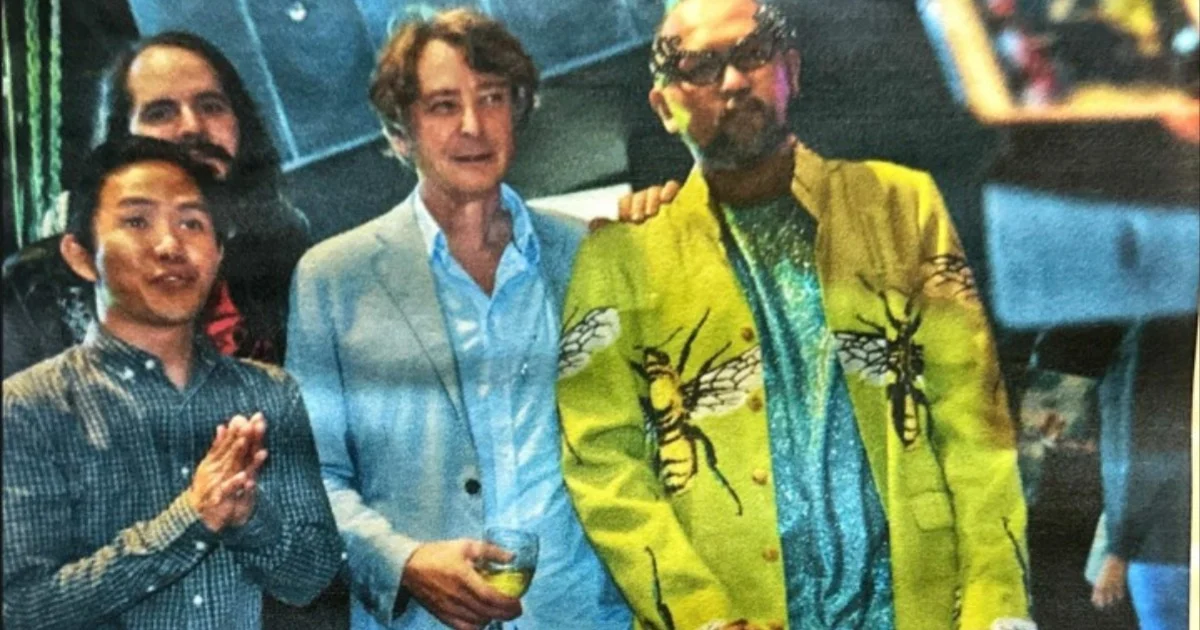
The landscape of international independent cinema, particularly that of Southeast Asia, bears the indelible mark of Gertjan Zuilhof, a figure whose profound influence as a programmer at the International Film Festival Rotterdam (IFFR) spanned over two and a half decades. Far beyond the conventional role of film selection, Zuilhof was an indefatigable discoverer, a relentless researcher who traversed continents, cultivated deep, lasting relationships with artists, and shone a spotlight on filmmakers and national cinemas that, without his advocacy, might have remained largely unknown beyond their countries of origin. His recent passing in 2025 prompted a unique and deeply personal act of remembrance: a striking handmade fanzine, a testament to his life, work, and an extraordinary friendship with Filipino experimental filmmaker Khavn.
Zuilhof’s enthusiasm for Southeast Asian cinema was pivotal in propelling directors such as Lav Diaz and Khavn onto the global stage, earning them critical acclaim and international recognition. His programming initiatives were instrumental in fostering the nascent independent film movement in Malaysia and drawing crucial attention to the innovative moving-image work emerging from Myanmar. His curatorial gaze, however, was not confined to Asia; it extended broadly to African cinema, visual art, installations, and various interdisciplinary projects that boldly challenged conventional distinctions between cinematic presentation, gallery exhibitions, and public events. The IFFR itself has consistently acknowledged him as one of its most influential programmers, a visionary who persistently expanded the festival’s horizons, ensuring that fresh, unconventional voices reached Rotterdam’s screens and, by extension, a global audience.
A Unique Tribute: The Fanzine’s Genesis and Artistry
The fanzine, primarily assembled by zinemaker Daniel Palisa in close collaboration with Khavn and other contributors, is more than a mere collection of memorabilia; it is an artistic artifact designed to reflect the very spirit of Zuilhof’s adventurous programming. Combining an eclectic mix of photographs, original drawings, historical festival texts, archival program notes, and intimate personal interventions, the publication offers a multi-layered exploration of Zuilhof’s impact. It is a vibrant, tactile celebration, intentionally crafted to avoid the polished formality of an institutional memorial, instead preserving the raw, unruly spirit that characterized both Zuilhof’s curatorial approach and Khavn’s filmmaking.
The relationship between Zuilhof and Khavn forms the central narrative thread of this fanzine. Its pages meticulously revisit the programmer’s initial encounters with Khavn’s distinctive oeuvre and his subsequent tireless efforts to introduce it to international audiences. Zuilhof began screening Khavn’s films at IFFR in 2004, integrating them into a broader program dedicated to showcasing the burgeoning talents of Southeast Asian cinema. From the outset, Zuilhof recognized Khavn as a singular, prodigious figure whose immense output was consistently matched by an unmistakable and often challenging originality. The fanzine reproduces Zuilhof’s insightful writings on key works such as "The Family That Eats Soil," "Bahag Kings," "Squatterpunk," and "Philippine Bliss," effectively tracing a pivotal period when Khavn’s cinema, despite its brilliance, remained largely unfamiliar outside specialized festival circuits.
What makes these reproduced texts particularly invaluable is Zuilhof’s refusal to categorize Khavn’s work into convenient critical boxes. He possessed a profound understanding of its inherent contradictions, perceiving not just the apparent wildness, violence, humor, and formal disorder, but also recognizing the underlying discipline and acute historical awareness that underpinned them. This nuanced appreciation is emblematic of Zuilhof’s curatorial genius. A handwritten passage included in the publication vividly captures the mutual understanding and affectionate irreverence that defined the relationship between programmer and filmmaker: "You say you stop filmmaking like Béla Tarr and bring out the super box set of complete Khavn. After that you make the first film after the break." This remark, imbued with humor, simultaneously reveals Zuilhof’s intimate familiarity with Khavn’s personality and his astute understanding that, for Khavn, any declaration of retirement would likely be merely a prelude to a new creative beginning.
Visually, the fanzine eschews the idea of Zuilhof’s writings as untouchable archival material. Instead, it treats them as living documents. Printed texts are dynamically surrounded by painted skulls, stylized animals, intricate spirals, distorted portraits, and fragmented photographs. Bold markings in red, purple, blue, and black energetically run across the pages, at times partially obscuring the original material, yet simultaneously infusing it with renewed energy and a rebellious vitality. This aesthetic choice underscores the publication’s intent to celebrate a dynamic, evolving legacy rather than to merely archive a static past.
A Philosophy of Active Discovery: Revisiting the 2020 Interview
A significant section of the fanzine is dedicated to reproducing an interview conducted with Gertjan Zuilhof by Panos Kotzathanasis for Asian Movie Pulse on May 15, 2020. This discussion, part of "The Khavn Project," offers invaluable insights into Zuilhof’s career as an art curator and programmer, his extensive tenure at IFFR, his specialized interest in Asian cinema, the evolving nature of festival selection, and his enduring association with Khavn. Notably, the interview took place during the initial, uncertain months of the global pandemic, a period when the future trajectory of international festivals appeared unusually precarious.
Zuilhof explained that his deep engagement with Asian cinema began following the departure of IFFR director Simon Field. He embarked on extensive research into Southeast Asian cinema precisely because, as he candidly put it, "nobody else was doing it." This initial research gradually evolved into immersive travel, which in turn deepened into a profound affection for the cinema, the people, and the diverse geography of the region. This anecdote highlights Zuilhof’s proactive approach, a stark contrast to the more passive, submission-dependent models increasingly adopted by many festivals.
He voiced significant concerns about a growing tendency among festivals to rely heavily on unsolicited submissions rather than investing in independent research and active discovery. While acknowledging that digital technology had streamlined the process of receiving thousands of films from across the globe, Zuilhof firmly believed that mere convenience could never replace the critical importance of genuine curiosity, hands-on travel, and direct, personal contact with local film communities. His comments resonate even more powerfully today, serving as a prescient critique of contemporary festival practices. Zuilhof belonged to a revered tradition of programming rooted in active discovery—he did not passively await identification of important work by established sales agents, producers, or other festivals; he actively sought it out himself, venturing into uncharted cinematic territories.
During the interview, Zuilhof memorably characterized Khavn as a filmmaker without a singular style, asserting that he had produced "around 100 movies in 100 different styles," often interweaving multiple approaches within a single work. He described Khavn as possessing "an encyclopaedia of visual, verbal and musical expression," a testament to the Filipino director’s boundless creativity and formal audacity. Zuilhof also drew a clear distinction between Khavn’s often deliberately wild and excessive public persona and the person he knew privately, revealing a loyal friend, an organized filmmaker, and a warm father behind the artistic provocations.
Reading this interview anew within the context of the fanzine imbues it with a significance it could not possess when it was first published. What began as a focused conversation about programming, film festivals, and an extraordinary filmmaker has now become an integral part of a larger, collective record of Zuilhof’s ideas, his cherished friendships, and his enduring cultural legacy. The original interview, a vital component of this remembrance, remains accessible in the Asian Movie Pulse archive, serving as a primary source for understanding his unique perspective.
"One Drawing a Day": An Extension of Curatorial Practice
The fanzine itself was printed with Khavn’s permission specifically for "One Drawing a Day: A Retrospective Exhibition of Auto Cartoons by Gertjan Zuilhof," an event presented during IFFR 2026. This exhibition unveiled another fascinating dimension of Zuilhof’s creative life. Drawing became an increasingly important practice in his later years, a daily ritual he meticulously maintained. He frequently worked on discarded materials—envelopes, newspaper fragments, hotel notepads—transforming ephemeral surfaces into canvases for his observational and expressive "auto cartoons." The retrospective presented these works not as a mere incidental pastime, but as another profound extension of his keenly observational and curatorial practice, revealing a holistic artistic sensibility that permeated every aspect of his life.
The fanzine masterfully complements this exhibition by narrowing its focus to his foundational relationship with Khavn and the compelling cinema that forged their bond. It stands as a deeply personal document, yet simultaneously serves as a crucial fragment of contemporary festival history. Through Zuilhof’s original program notes, his astute observations, and his personal recollections, the fanzine meticulously records how truly adventurous and dedicated programming could not only introduce a groundbreaking filmmaker to international audiences but also gradually help to construct an entirely new and nuanced critical context around their work.
A Collective Act of Remembrance
The creation of this fanzine was a collaborative endeavor, brought to fruition by main zinemaker Daniel Palisa, in concert with Khavn and numerous other contributors who shared a common desire to honor Zuilhof’s memory. Special acknowledgments are extended to key figures within the IFFR: Festival Director Vanja Kaludjercic and Head of Programme Operations Nina Rodriguez Lima, whose support facilitated this tribute. Crucially, the involvement of Gertjan Zuilhof’s daughters, Nikè Zuilhof and Daphne Zuilhof, underscores the deeply personal and familial dimension of this collective act of remembrance behind this profoundly moving publication.
Ultimately, this fanzine stands as a powerful demonstration that programming, at its highest expression, transcends mere administrative process. It is, at its very best, an act of profound curiosity, unwavering conviction, and genuine friendship. Gertjan Zuilhof’s expansive legacy lives on not only in the diverse filmmakers he championed, the previously overlooked regions he meticulously explored, and the global audiences he consistently challenged, but also vibrantly in the hearts and minds of the people who continue to remember him. This vivid, handmade publication by Khavn and his collaborators is a testament to that enduring memory, a living archive of a truly unique vision.
The complete fanzine can be viewed via the following link: https://drive.google.com/file/d/11Y8LeaZxyu3EzMGWqs0ItvVDAFy_rB9X/view