A Narrative of Late-Life Redirection
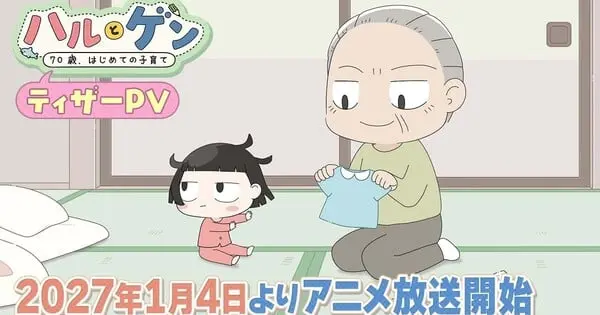
At the core of the adaptation is the poignant story of Gen, a 70-year-old man who has spent much of his later years in relative isolation. Following a divorce years ago that led to a complete estrangement from his wife and daughter, Gen’s life was defined by the silence of his past choices. The trajectory of his life shifts abruptly following the death of his daughter, an event that forces him into the role of primary caregiver for his three-year-old granddaughter, Haru.
The narrative, which resonates with themes of redemption, intergenerational connection, and the unexpected challenges of parenting in one’s golden years, offers a grounded departure from traditional genre tropes. As Gen navigates the daily realities of raising a toddler—from the physical demands of childcare to the emotional hurdle of reconciling with his past—the story explores the possibility of personal growth at any age. The adaptation aims to capture the specific aesthetic of the TATESC Comic format, known for its vibrant, full-color vertical panels that emphasize character expressions and intimate domestic settings.
Production and Creative Leadership
The transition of Haru and Gen from the digital screen to television is being spearheaded by a seasoned production team. Kōdai Satō, noted for his work on Tom to Jerry Gokko, has been tapped to direct the project. The production is a collaborative effort between IMAGICA Infos and Imageworks Studio, working in tandem with Studio Nanahoshi. This tripartite collaboration suggests a high level of technical oversight, particularly given the specialized nature of short-format anime, which requires precise pacing and high-quality visual density to maintain audience engagement within a limited timeframe.
The technical crew further reinforces the production’s commitment to atmosphere. Taeko Miura, whose portfolio includes Kanagawa Elves and Hyakki Yakou Shou, will oversee the sound direction. Sound design is being handled by Maki Takuma, a veteran of After-School Hanako-kun and Love Live! Nijigasaki High School Idol Club, while the musical score is composed by bermei.inazawa, known for their work on Potion, Waga Mi o Tasukeru. Kazuya Takahashi, recognized for his contributions to Love and Lies and Saiyuki Reload Blast, serves as the executive producer, providing the necessary industry oversight to ensure the adaptation maintains the emotional integrity of the original source material.
The Evolution of the Source Material
Yuka Ōshima first launched the manga on Kadokawa’s TATESC Comic platform in December 2022. The TATESC label represents Kadokawa’s strategic expansion into the burgeoning market of vertical-scrolling webcomics, a format popularized by platforms like Webtoon and KakaoPage. Unlike traditional manga, which follows a right-to-left print orientation, these titles are designed specifically for mobile devices, allowing for a cinematic, scrolling reading experience.
The success of the digital serialization led to a physical compiled book volume published by Kadokawa in March 2024. The decision to adapt the property into an anime just over a year after its first print volume signifies a strong vote of confidence from the publisher. Industry analysts note that this rapid green-lighting of an anime project is indicative of the growing synergy between webcomic platforms and traditional media production houses, where digital engagement metrics—such as reader retention and social media traction—are increasingly used to gauge the viability of an animated series.

Chronology of Development
The path to the screen for Haru and Gen has been relatively brisk by industry standards:
- December 2022: The manga series is launched on Kadokawa’s TATESC Comic label.
- March 2024: Kadokawa publishes the first compiled print volume, marking the series’ successful crossover into traditional publishing.
- September 15, 2026: The official announcement confirms that an anime adaptation is in active development.
- October 21, 2026: The production committee releases a teaser promotional video and confirms the January 4, 2026, broadcast premiere.
- January 4, 2026: Scheduled broadcast premiere on TV Kanagawa (tvk).
Industry Context and Market Implications
The production of short-format anime serves a distinct niche in the Japanese television landscape. These series, often ranging from three to ten minutes in length, are frequently used to fill specific programming slots or to serve as a gateway for viewers to discover new IP. By focusing on domestic, character-driven narratives, Haru to Gen stands out in a market heavily saturated with high-action fantasy and science fiction.
The choice of TV Kanagawa as the primary broadcast outlet is notable. As a regional broadcaster with a reputation for supporting niche and experimental programming, TV Kanagawa provides a stable environment for the series to find its target demographic. From a broader perspective, the involvement of Kadokawa—a titan in the multimedia sector—highlights a concerted effort to leverage their intellectual property across multiple platforms simultaneously.
The collaboration between multiple studios, including the specialized sound production of RD, suggests that the project is prioritizing high-fidelity production values despite the "short-format" designation. This is a recurring trend in the contemporary anime industry, where the distinction between "short" and "feature" length is becoming less indicative of quality and more reflective of the intended viewing experience—specifically, the "snackable" content model favored by modern streaming audiences.
Socio-Cultural Relevance
The subject matter of Haru to Gen is particularly relevant in the context of Japan’s demographic landscape. With one of the world’s highest proportions of elderly citizens, stories that explore themes of late-life parenting, intergenerational care, and the reconfiguration of family structures are increasingly resonant. The series does not shy away from the harsh reality of Gen’s past neglect, framing his current journey as one of atonement.
By centering a 70-year-old protagonist, the anime challenges the youth-centric bias that often permeates the medium. It provides a rare, grounded look at the complexities of the human experience, moving beyond the sensationalist elements often found in commercial media. As the series approaches its January premiere, industry observers will likely be monitoring not just the viewership numbers on TV Kanagawa, but also the engagement on digital platforms, which will serve as a bellwether for the continued popularity of "slice-of-life" dramas centered on the elderly population.
As the production team gears up for the January 4 debut, the industry awaits further details regarding the full voice cast and any additional promotional material. For now, the teaser trailer serves as a testament to the emotional tone the production hopes to achieve, blending the quiet, often melancholic reality of an aging man with the vibrant, chaotic, and heartwarming presence of a young child. For fans of the original manga, the announcement represents a milestone, confirming that the story of Gen’s unexpected second chance at fatherhood is set to reach a much wider audience.