Released in the summer of 2005, director Neil Marshall’s sophomore feature film, The Descent, fundamentally altered the landscape of contemporary horror cinema. Operating on a modest budget relative to studio blockbusters, the British psychological creature feature achieved critical acclaim and commercial success, grossing over $57 million worldwide against a budget estimated at roughly $3.5 million to $5 million. Beyond its financial return, the picture earned a coveted 86% approval rating on Rotten Tomatoes and is widely credited with revitalizing the creature-feature subgenre while introducing complex, female-led action dynamics seldom seen in mainstream horror during the mid-2000s. Two decades after its theatrical premiere, the collaborative efforts of its creators and cast continue to resonate within the film industry, serving as a masterclass in resourceful filmmaking, practical effects, and psychological tension.
The Genesis of the Project and Financial Constraints
The journey of The Descent began immediately following the commercial success of Marshall’s 2002 werewolf thriller, Dog Soldiers. Buoyed by that momentum, Marshall met with producer Christian Colson at Celador Films to pitch an expanded, feature-length adaptation of his student graduation film, which originally centered on a group of mercenaries facing a zombie outbreak on an offshore oil rig.
While executives expressed interest in the concept, the projected capital expenditure required to realize an oil-rig setting proved prohibitive for the studio’s financial parameters. Confronted with this setback during his train ride back to Newcastle, Marshall pivoted toward a fundamental filmmaking maxim: budgetary restrictions frequently breed profound creative innovation.
Seeking a premise that could inherently limit scale while maximizing atmospheric terror, Marshall considered environments defined by an absence of light. He recalled a childhood school trip to a lead mine where the tour guide instructed visitors to extinguish their lamps, plunging the group into an absolute, impenetrable darkness. Recognizing that claustrophobia and sensory deprivation universally trigger primal fears, Marshall crystallized his concept around cave exploration. This logistical pivot bypassed the need for expensive exterior locations and sprawling visual effects, anchoring the narrative entirely within the suffocating confines of subterranean tunnels.
Production Design and the Mechanics of Fear
To achieve the desired level of claustrophobia and verisimilitude, Marshall and director of photography Sam McCurdy engineered a rigorous lighting design. Rejecting conventional cinematic lighting that introduces artificial fill lights and ambient glows, the production mirrored the harsh realities of spelunking. The characters’ only illumination derived from the tools they carried—torches, glow sticks, flares, and simple wooden matches.
Consequently, substantial portions of the screen remained shrouded in pitch darkness. Viewers were deliberately kept in a state of sensory uncertainty until a character physically turned around and directed a beam of light into the shadows. Marshall meticulously storyboarded the film’s visual continuity around this constraint, assigning specific light sources to individual characters—such as Sarah utilizing fire and Juno wielding a high-powered torch—to maintain narrative logic and spatial geography.
Despite depicting an extensive underground cavern system, not a single scene in The Descent was filmed in a real cave. Production designer Simon Bowles constructed massive, intricate cave interiors on soundstages, complemented by matte paintings and a miniature set constructed by Leigh Took. To simulate cascading underground waterfalls without utilizing uncontrollable real water volumes that could damage sets or equipment, the production relied on dyed salt solutions, demonstrating the resourcefulness characteristic of the entire enterprise.
Conceiving the Crawlers: Visual and Movement Design
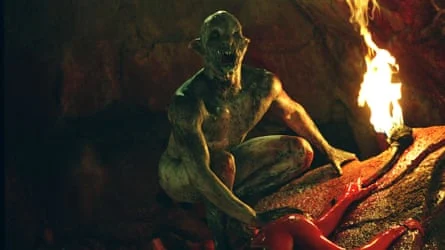
The primary antagonists of the film—subterranean humanoids colloquially known as "crawlers"—required a design that felt both evolutionary plausible and deeply unsettling. Marshall sought a creature aesthetic stripped of excessive ornamentation, opting for a minimalist biological framework.

The visual design was conceived as a hybrid between the iconic vampire from F.W. Murnau’s Nosferatu and the angular, pale physique of rock musician Iggy Pop. For their movement vocabulary, Marshall drew inspiration from arachnids. The crawlers were choreographed to exhibit jerky, unpredictable kinetic shifts—remaining terrifyingly motionless before executing sudden bursts of high-speed acceleration, only to freeze abruptly once more.
To maintain genuine reactions of terror, Marshall enforced a strict psychological barrier on set. The cast members portraying the explorers were prohibited from viewing the actors playing the crawlers or even seeing conceptual artwork prior to filming. Shauna Macdonald, who starred as the protagonist Sarah, was the first actor to encounter a crawler on set due to the chronological filming schedule inside the cave sets. This deliberate isolation ensured that the actors’ physical reactions of shock, intimidation, and vulnerability during combat sequences reflected authentic disorientation rather than practiced performance.
Deconstructing Gender Tropes and On-Screen Dynamics
When MacDonald initially received the script, her expectations were tempered by the prevailing cultural media landscape of the mid-2000s, characterized by lad magazines such as FHM and Loaded. She initially anticipated a conventional exploitation narrative featuring glamour models cast as victims in tight, blood-spattered attire.
Upon reading the material, however, MacDonald discovered a complex psychological study centered on a grieving mother navigating profound trauma alongside physical survival. The script demanded absolute physical resilience, emotional depth, and moral ambiguity.
While contemporary media marketing heavily promoted the film under the banner of "girl power," the cast members frequently highlighted the narrative’s subversion of simplistic female solidarity. The plot explicitly depicts the characters turning against one another under duress—culminating in violent confrontations, mercy killings, and ideological fractures driven by guilt and betrayal. Yet, off-screen, the ensemble forged a genuine, enduring camaraderie. The six lead actresses maintained a continuous support network spanning over two decades, meeting regularly and demonstrating a professional solidarity born from the shared intensity of their subterranean ordeal.
Chronology and Historical Context of the Release
The trajectory of The Descent from conception to cultural milestone unfolded across several key milestones:
- 2002: Following the release of Dog Soldiers, Neil Marshall pitches his initial oil-rig zombie concept to Celador Films, subsequently pivoting to the cave survival concept during transit to Newcastle.
- 2004: Principal photography commences on soundstages in the United Kingdom, utilizing custom sets designed by Simon Bowles and specialized lighting schemes directed by Sam McCurdy.
- July 2005: The film premieres theatrically in the United Kingdom via Pathé, drawing immediate critical praise for its technical craftsmanship, sound design, and subversion of horror tropes.
- August 2006: Following strong international reception, Lionsgate handles the North American distribution, expanding the film’s commercial reach and cementing its status as a modern horror classic.
- Post-2006 to Present: The film inspires a sequel (The Descent Part 2 in 2009) and is regularly cited by film critics and academics as a benchmark for independent genre filmmaking and female-driven action narratives.
Broader Impact and Industry Implications
The commercial and critical triumph of The Descent demonstrated that low-budget genre films could achieve high production value through disciplined planning, practical ingenuity, and strong character work. By refusing to rely on computer-generated imagery for its primary monsters—relying instead on physical actors, meticulous prosthetic design, and strategic lighting—the production achieved a tactile realism that aged far better than many contemporary digital effects-heavy releases.
Furthermore, the film challenged industry assumptions regarding bankability and gender in action-horror cinema. By centering an entire narrative on an ensemble of diverse female characters whose motivations ranged from heroic self-sacrifice to primal self-preservation, Marshall proved that audiences would embrace morally complex protagonists outside traditional male action archetypes.
Two decades after its initial release, The Descent remains a benchmark for atmospheric suspense. Its legacy persists not only through its influence on subsequent independent horror directors but also in the enduring professional relationships of its cast, who transformed an arduous subterranean shoot into a lifelong artistic alliance.