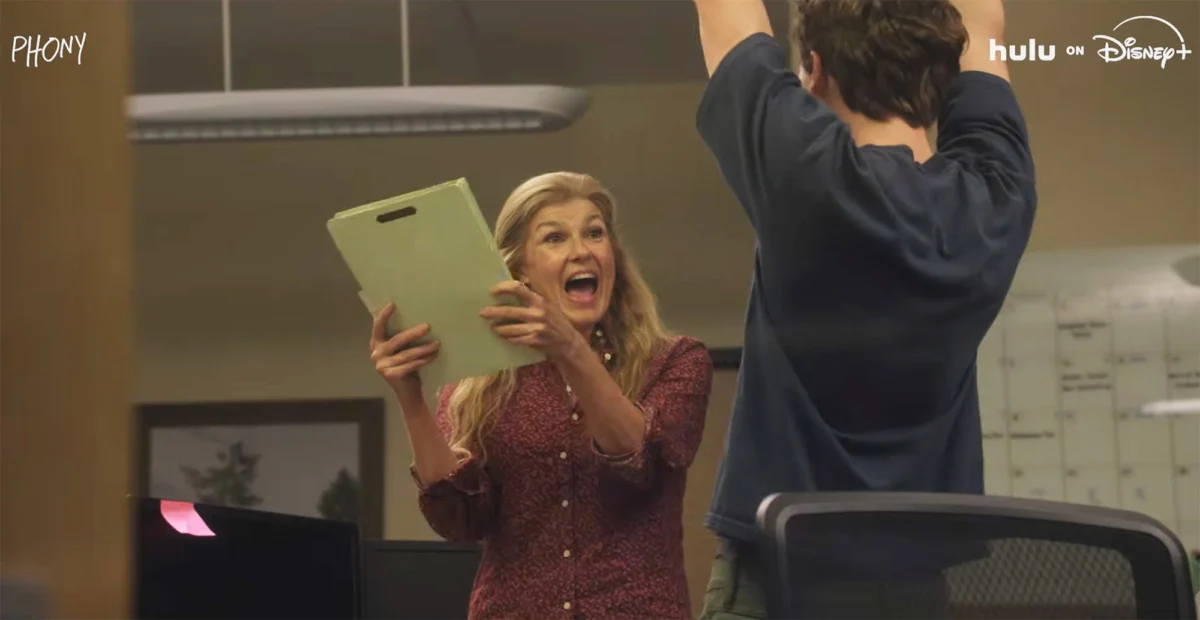
Hulu has officially released the high-anticipated trailer and promotional poster for Phony, an upcoming genre-bending mystery series created, written, and directed by filmmaker Nick Paley. Best known for his writing contributions to the critically acclaimed, Academy Award-nominated feature Marcel the Shell with Shoes On, Paley steps into the episodic television spotlight with a project that deftly blends cozy small-town tropes with psychological suspense and the hallmarks of a classic young adult coming-of-age comedy.
Scheduled to premiere on Hulu on October 20, 2026, Phony stars Emmy-nominated actress Connie Britton alongside rising talent Sam Nivola. The narrative centers on a high-stakes, deeply unsettling premise: a teenager survives a severe car accident, only to awaken in a hospital bed with the terrifying conviction that his mother—his sole surviving parent and closest confidant—has been systematically replaced by an exact impostor. As the boundary between adolescent paranoia and genuine conspiracy blurs, the series sets out to answer a chilling central question: Who is this woman, and what has she done with the real mother?
Main Facts of the Production and Release
Phony arrives as a major autumn tentpole for Hulu, developed under heavy anticipation within the television industry. The series consists of a serialized narrative arc that combines grounded family dynamics with high-concept mystery elements. Industry insiders and early press releases have characterized the tonal landscape of the show as an eclectic blend of atmospheric small-town mystery and teen-centric comedy, jokingly summarized as a collision between Widow’s Bay and Freaks and Geeks.
The primary catalyst for the plot occurs in a sterile hospital room, where Sonny, portrayed by Sam Nivola, regains consciousness following a harrowing automobile collision. Instead of experiencing the routine relief of survival, Sonny is immediately struck by an unshakeable psychological dissonance. His mother, Ellen—played by Connie Britton—welcomes him back with warmth and familiarity, yet every micro-expression, behavioral nuance, and subtle habit convinces Sonny that an unknown entity has usurped her identity.

The supporting ensemble features an eclectic mix of seasoned character actors and dynamic young performers, including Meera Syal, Grace Brennan, Mahaela Park, Maliq Johnson, and Colter Lee. Behind the camera, the production brings together heavy-hitting creative forces. Nick Paley shares showrunning duties with Anthony King, while the executive producer roster boasts Paley, King, Britton, Charlie Alderman, Drew Goddard, and Sarah Esberg. The series is a collaborative production involving Charlie’s Production Company, Goddard Textiles, and 20th Television.
Chronology and Development Background
The journey of Phony from concept to screen reflects the rising demand for elevated genre storytelling in the streaming television marketplace. Nick Paley first gained widespread industry recognition for his sharp, whimsical, and emotionally resonant writing on A24’s Marcel the Shell with Shoes On, which demonstrated his capacity to balance eccentric premises with profound human stakes. Following that success, Paley transitioned back into television—having previously directed episodes of the Comedy Central series Hack Into Broad City—with the explicit goal of constructing a narrative that toys with audience perception.
Development on Phony accelerated when 20th Television optioned Paley’s pitch, drawing early comparisons to classic speculative fiction anthologies and psychological thrillers where domestic spaces become sites of profound alienation. The involvement of heavyweight producers Drew Goddard and Sarah Esberg through Goddard Textiles further solidified the project’s institutional backing, signaling a commitment to cinematic production values within a serialized television format.
Casting announcements rolled out over the subsequent months, drawing significant media attention due to the pairing of Connie Britton—a television veteran renowned for her work in Friday Night Lights, Nashville, and The White Lotus—with Sam Nivola, whose burgeoning filmography includes prominent roles in Noah Baumbach’s White Noise and Bradley Cooper’s Maestro. Principal photography took place under tight security to preserve the twists of the narrative, culminating in Hulu’s official marketing push in late September 2026, punctuated by the release of the primary trailer and key art.
Supporting Data and Industry Context

The premiere of Phony occupies a strategic position within Hulu’s autumn streaming calendar, arriving on October 20, 2026. This timing places the series squarely in the lucrative Halloween viewing window, a period historically favored by platforms for releasing suspenseful, mysterious, and atmospheric content.
The psychological doppelgänger trope—a narrative device exploring themes of identity theft, gaslighting, and the uncanny valley of family dynamics—has experienced a commercial resurgence across prestige television. Shows that leverage domestic paranoia resonate strongly with modern audiences navigating an era of deepfakes, algorithmic replication, and shifting digital identities. By grounding this high-concept anxiety in the vulnerable, hyper-sensitive perspective of a teenage protagonist, Phony positions itself to capture both young adult demographics and traditional prestige-drama viewers.
Furthermore, the involvement of 20th Television and Disney’s broader streaming apparatus underscores the commercial confidence placed in Nick Paley’s directorial vision. The streaming landscape has increasingly favored auteur-driven television series where distinct authorial voices dictate the visual and tonal vocabulary of a project, moving away from assembly-line episodic structures toward cohesive, novelistic storytelling.
Official Responses and Creative Insights
While full promotional press circuits are slated to ramp up closer to the October release date, early statements from the creative team emphasize the delicate balancing act required to execute the series’ unique tone. Nick Paley has frequently noted in early development discussions that the core of Phony is not merely about a supernatural or sci-fi conspiracy, but rather the universal adolescent sensation of feeling alienated from one’s parents.
The transition from childhood to adulthood often involves seeing one’s parents as independent, complex individuals rather than infallible figures of absolute safety. Phony literalizes this psychological transition through the heightened lens of a thriller. For a teenager like Sonny, the emotional distance that naturally emerges during growing up is experienced not as a normal part of maturation, but as an existential invasion.

Connie Britton’s involvement similarly points to the dual nature of her character, Ellen. Whether Ellen is a loving mother coping with her son’s post-traumatic stress or an insidious impostor executing a calculated scheme remains the central engine of the narrative. Britton’s extensive experience portraying complex, emotionally layered maternal figures provides the series with an anchor of credibility, ensuring that the psychological ambiguity remains potent throughout the season’s arc.
Broader Impact and Critical Implications
As the entertainment industry continues to evaluate the viability of original, non-franchise intellectual property in the streaming era, series like Phony serve as critical test cases for audience appetite. Mid-budget, high-concept mystery dramas that rely on original screenplays rather than pre-existing literary adaptations face the challenge of cutting through a crowded content ecosystem. However, the combination of a recognizable cast, distinct auteur direction, and a universally compelling hook gives the series a competitive edge.
The implications for Nick Paley’s career are similarly substantial. Successfully executing a serialized mystery that balances tonal whiplash—moving seamlessly between the mundane awkwardness of high school life and the terrifying paranoia of a psychological thriller—will cement his status as a versatile hyphenate capable of commanding large-scale television productions.
For Hulu, Phony represents an opportunity to capture a demographic that spans generations, appealing to fans of YA coming-of-age comedies as well as aficionados of prestige psychological suspense. As viewers prepare to dive into the mystery when the series drops on October 20, 2026, the primary question dominating cultural discourse will not just be the fate of Sonny and Ellen, but whether television can successfully reclaim the sophisticated, character-driven mystery box format for a new generation of audiences.