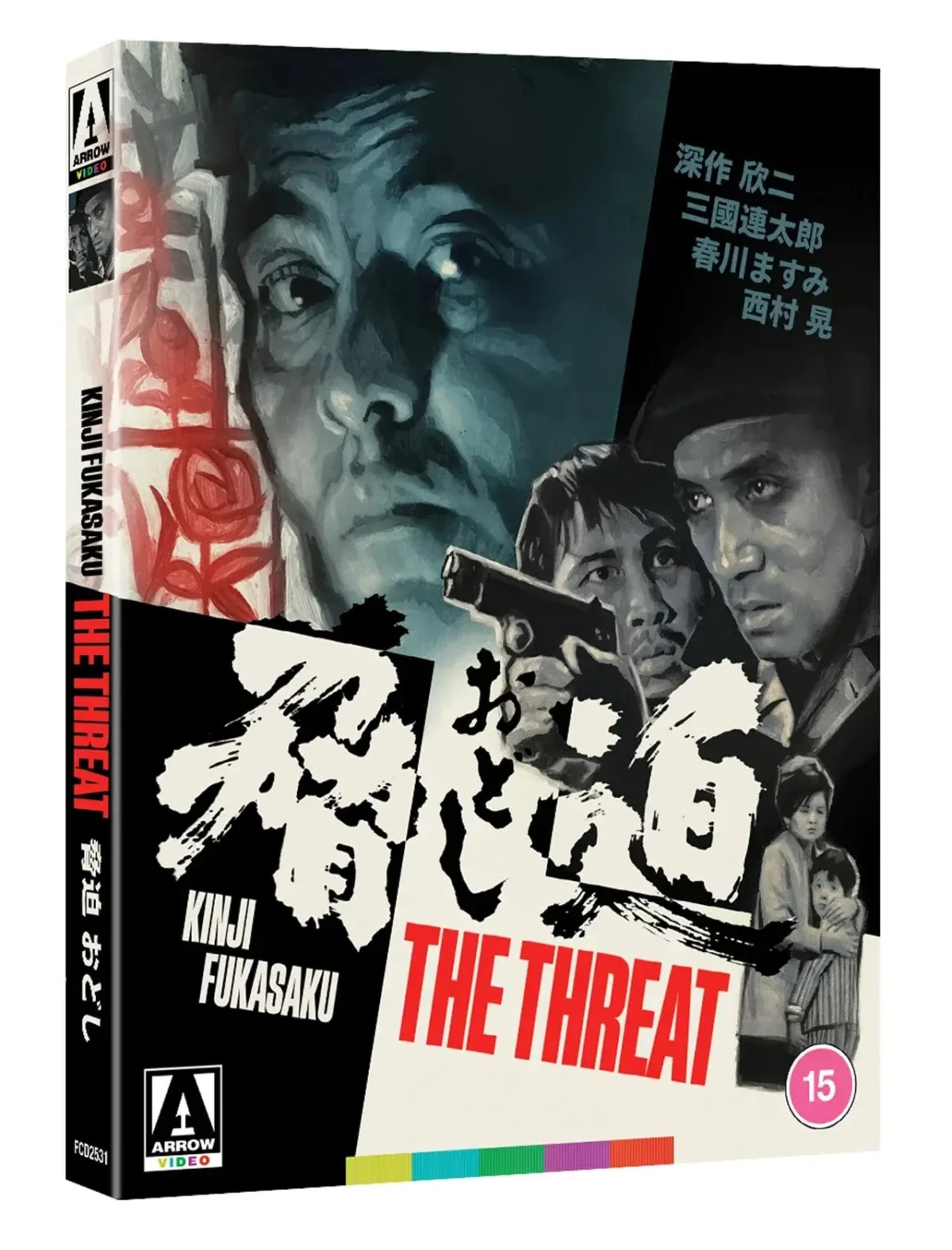
Kinji Fukasaku’s 1966 feature, "The Threat" (also known as "Kyohatsu" or "Blackmail Is My Life"), stands as a potent and uncompromising early statement from a director who would become synonymous with unflinching critiques of Japanese society. While his career in the 1960s saw him navigate the commercial demands of major studios like Toei and Nikkatsu, Fukasaku shrewdly utilized these projects to refine his distinct cinematic style and delve into the profound themes that would ultimately define his illustrious filmography. "The Threat" is a gripping home invasion thriller that masterfully transcends its genre confines, offering a chilling examination of obedience, power dynamics, the corrosive nature of violence, and the precarious fragility of civilization when confronted by an external, disruptive force.
Kinji Fukasaku’s Formative Years and Thematic Precursors
Born in 1930, Kinji Fukasaku began his filmmaking journey in the aftermath of World War II, a period that deeply influenced his worldview and artistic output. Graduating from Nihon University, he joined Toei Company in 1953, initially working as an assistant director. The 1960s marked his emergence as a director, a time of rapid economic growth and societal transformation in Japan. The nation was rebuilding, modernizing at an unprecedented pace, and grappling with its post-war identity. Fukasaku, however, often looked beneath the gleaming surface of prosperity, exposing the moral ambiguities and inherent violence he perceived in the social fabric.
Even in earlier works that largely adhered to studio commercial policies, Fukasaku’s burgeoning thematic concerns were evident. Films like "Jakoman and Tetsu" (1964) commented on the increasingly performance-driven nature of Japanese society, where appearances and roles often dictated reality. Similarly, "Wolves, Pigs and Men" (1964), while appearing to be a straightforward gangster film, delved into the socio-economic conditions that propelled individuals toward acts of violence and criminality. These early explorations laid crucial groundwork for "The Threat," allowing Fukasaku to hone his ability to blend social commentary with compelling narrative tension. "The Threat" distinguishes itself as arguably his most scathing and direct indictment up to that point, showcasing a director finding his authentic voice amidst the studio system’s constraints.
The Unfolding Hostage Crisis: A Microcosm of Societal Decay
The narrative of "The Threat" centers on Misawa (portrayed with remarkable restraint by Rentaro Mikuni), a successful and seemingly respectable executive at an advertising agency. He embodies the ideal of the post-war salaryman: diligent, upwardly mobile, enjoying a comfortable, if not exceptionally wealthy, life with his wife Hiroko (Masumi Harukawa) and their young son Masao (Pepe Hozumi). Their existence is meticulously ordered, a reflection of the hierarchical and conformity-driven corporate world Misawa navigates with practiced ease. The film’s opening sequence subtly establishes this order, depicting Misawa delivering a formal, almost detached, speech at a colleague’s wedding, praising the newlyweds for their professional attributes rather than their personal affection. It is later revealed that Misawa himself orchestrated this marriage, effectively "marrying off" the mistress of a senior executive – a maneuver that speaks volumes about his calculated approach to life, whether to avert scandal or advance his own standing within the corporate ladder.
This carefully constructed facade of order and respectability is shattered abruptly one evening. After returning home from a company event, the Misawa family’s dinner is violently interrupted by the intrusion of two escaped convicts: the ruthless and calculating Kawanishi (Ko Nishimura) and his more volatile accomplice, Sabu (Hideo Murota). Having recently broken out of prison and pursued by the authorities, the desperate pair have kidnapped the infant grandson of a wealthy businessman. Their immediate objective: to use the Misawa home as a temporary hideout and to extort a substantial ransom to finance their escape from justice.
The subsequent events transform the Misawa residence from a sanctuary of domesticity into a claustrophobic prison, a battleground where the lines between respectable citizen and hardened criminal rapidly blur. The convicts force Misawa to become an unwilling accomplice in their ransom scheme, threatening the lives of his wife and son should he refuse. With little choice, Misawa complies, driving the criminals through the city and making the ransom calls himself. This forced participation initiates a harrowing psychological ordeal, as Misawa gradually comes to the terrifying realization that, once the exchange is complete, neither he nor his family will be left alive. The imminent danger compels him to abandon his passive obedience and devise a desperate strategy to eliminate his captors, all while attempting to minimize the peril to his loved ones.
The Psychology of Power and Obedience
Throughout his career, Kinji Fukasaku remained deeply critical of the Japanese societal tendency toward conformity, often viewing it as a thin veneer that barely concealed underlying currents of violence and exploitation. "The Threat" provides an early, incisive demonstration of this critique, showcasing how effectively Fukasaku could combine sharp social satire with relentless suspense. A recurring and potent image in the film is that of the remote control, introduced chillingly when Kawanishi outlines his plan to transform Misawa into a mindless puppet, obediently following every command. Fukasaku reinforces this metaphor through Masao’s toy racing set, which Kawanishi eagerly repairs, ensuring the miniature cars run more smoothly and predictably under his control. These visual cues serve as powerful symbols of manipulation and the desire for absolute dominion over others.
Kawanishi, confident in his understanding of Misawa’s mentality, assumes his hostage has spent his entire life obeying orders and passively following the paths others have laid out for him. This belief grants Kawanishi a perceived psychological dominance, leading him to repeatedly dismiss Misawa as little more than an obedient drone. Yet, Fukasaku ultimately pushes this idea further, revealing a more complex truth. Misawa, initially paralyzed by fear and conditioned obedience, begins to realize that the very strategies which made him successful in the corporate world—his meticulous planning, his understanding of hierarchical power, his capacity for cold calculation—can also be employed to regain control of the dire situation.
At its core, "The Threat" is a drama-thriller about the acquisition, loss, and ultimate reclamation of power. Misawa is depicted as a man who has perfectly adapted to the rigid hierarchies governing every aspect of his life. He has ascended to a highly paid executive position with considerable responsibility, and he has transferred these same principles of authority and control into his family life. His home, much like his office, is a domain where he expects his orders to be followed, and his decisions to be unquestioned. The arrival of the convicts brutally exposes the fragility of both his authority and his sense of security, simultaneously revealing the precarious foundations upon which they have always rested.

Misawa is, in essence, a control freak, and Rentaro Mikuni’s portrayal captures this with remarkable nuance. His initial restraint and emotional detachment make his gradual psychological collapse, as his meticulously constructed world unravels, all the more convincing and disturbing. Fukasaku masterfully exposes how superficial and vulnerable Misawa’s power truly is, a brittle edifice susceptible to external pressures.
Violence as a Structural Force
As in many of Fukasaku’s films, violence plays a central and inescapable role in "The Threat." However, its function here differs subtly from its depiction in his later, more celebrated yakuza epics. In those films, violence often serves as a necessary, if brutal, tool for advancement within the criminal underworld, a means to an end in a corrupt system. In "The Threat," violence also exists as a fundamental structural force, intrinsically tied to the acquisition and preservation of power itself. The chilling fact that both Misawa and Kawanishi instinctively understand and operate by this principle creates one of the film’s most cynical and disturbing parallels between the supposedly civilized corporate world and the brutal criminal underworld.
Violence ultimately becomes the last refuge once control begins to slip away, with both men resorting to physical force whenever their authority is challenged or their plans are thwarted. One of the film’s most disturbing and unforgettable moments comes when Misawa brutally beats Hiroko after suspecting she has been assaulted by one of the criminals. This act is not born of protection, but rather a desperate and horrifying expression of his own profound disintegration, a primal assertion of a power he feels slipping away, and a projection of his own humiliation and impotence. Fukasaku reinforces the visceral impact of this scene through unsettling framing, abrupt and jarring editing, and Isao Tomita’s powerfully expressive and discordant score, amplifying the psychological horror of the moment.
Cinematic Craftsmanship: Fukasaku’s Distinctive Style
Beyond its thematic depth, "The Threat" is a visually captivating work, a testament to Fukasaku’s rapidly evolving cinematic prowess. The film’s depiction of the family’s gradual descent into chaos is rendered with a visceral intensity, where the previously clear line between respectable citizen and dangerous criminal becomes increasingly blurred, not just for the characters, but for the audience’s moral compass.
Fukasaku employs a tight, almost claustrophobic visual style within the confines of the Misawa home, effectively trapping the audience alongside the characters. His camera movements are deliberate, often unsettling, creating a sense of unease and impending doom. The editing is sharp and precise, utilizing abrupt cuts to punctuate moments of tension and violence, mirroring the suddenness with which the family’s life is overturned. Isao Tomita’s score is a crucial element, shifting from ominous suspense to jarring dissonance, underscoring the psychological torment and moral ambiguity at play. Tomita, a prolific composer known for his pioneering electronic music, delivers a score that feels modern and experimental for its time, perfectly complementing Fukasaku’s challenging narrative.
The use of close-ups on the characters’ faces, particularly Misawa’s, allows the audience to witness his internal struggle and transformation in stark detail. The contrast between the mundane domestic setting and the horrific events unfolding within it creates a powerful sense of cognitive dissonance, highlighting the arbitrary nature of safety and the ease with which it can be shattered.
Legacy and Enduring Relevance
"The Threat" stands as an early, yet fully realized, demonstration of Kinji Fukasaku’s uncompromising critique of Japanese society and its destructive obsession with hierarchy, power, and control – all of which, in his view, inevitably culminate in violence. The film condenses many of the ideas that would later define his career, serving as a significant precursor to his most acclaimed works.
The thematic threads of institutional corruption and power struggles found in "The Threat" are expanded upon in the monumental "Battles Without Honor and Humanity" (1973) series, which revolutionized the yakuza genre by stripping away romanticism and exposing the brutal, cyclical nature of gang warfare. Decades later, the dystopian vision of societal breakdown and human desperation under extreme pressure, so evident in "The Threat," would find its ultimate expression in the globally recognized "Battle Royale" (2000).
"The Threat" is not merely an outstanding thriller that maintains its suspense and psychological depth over half a century after its release. It is also one of the finest introductions to the singular vision of Kinji Fukasaku, offering a concentrated dose of his thematic concerns, stylistic daring, and relentless social commentary. Its continued availability, notably through boutique distributors like Terracotta and Arrow Video, attests to its enduring critical appreciation and its status as an essential piece in the puzzle of one of Japan’s most remarkable and influential filmmakers. The film remains a chilling reminder that the veneer of civilization is often thin, and the darkness within human nature can emerge under the most unexpected pressures, making its message as relevant today as it was in 1966.