Cinema has long utilized the dystopian genre as a mirror to reflect contemporary socioeconomic anxieties, ranging from climate degradation and widening wealth gaps to the erosion of public health and institutional trust. In Love Is the Monster, Costa Rican filmmaker Neto Villalobos Brenes constructs a chilling yet deeply intimate near-future society where these macro-level crises manifest directly within the fracturing dynamics of a single family. Co-written by Villalobos Brenes and Diego van der Laat Alfaro, the 95-minute feature film anchors its speculative terror not in grand sci-fi spectacles or extraterrestrial threats, but in the desperate, boundary-crossing love of a dying grandmother attempting to forge a connection with her granddaughter across an unbridgeable social divide.
Led by a devastating and emotionally resonant performance from acclaimed Chilean actress Paulina García, the film had its origins in deeply personal territory. Director Villalobos Brenes has publicly noted that the narrative evolved out of the profound grief of losing his own mother, channeling that personal loss into a universal inquiry: How far would an individual go to protect and hold onto the person they love most when time itself is running out?
Set against a visually striking backdrop of contrasting natural landscapes and oppressive urban architecture, Love Is the Monster balances the slow-burn atmospheric tension of an arthouse drama with the gripping, high-stakes progression of a psychological thriller. Yet, even as the narrative occasionally leaves certain structural and historical questions unanswered, its striking cinematography, meticulously crafted world-building, and stellar lead performances cement it as one of the most compelling regional cinematic releases of the year.
The Socioeconomic Architecture of a Fractured Costa Rica
The world of Love Is the Monster is defined by stark geographical and economic segregation. The narrative unfolds on the precarious outskirts of a dystopian Costa Rica, an environment rendered brittle and hostile by toxic air quality, environmental degradation, and profoundly lopsided wealth distribution. In this reality, the privileged class resides within "the Perimeter"—a heavily fortified, guarded enclave designed to insulate its inhabitants from the systemic decay rotting the rest of the country.
Within the Perimeter, children lead lives dictated by stringent biosecurity protocols. To ward off a persistent, highly contagious respiratory illness that mirrors pandemic-era societal anxieties, young residents breathe filtered indoor air, wear protective masks whenever they venture outside, and are perpetually shadowed by armed nannies. For outsiders like Abuela, a woman of approximately seventy years of age played by Paulina García, accessing this guarded enclave is an administrative and logistical hurdle. Crossing the threshold requires rigorous measures, including having her vehicle sterilized and securing special clearance—a process that underscores the insurmountable walls class disparity has erected between family members.
Outside the Perimeter, the atmosphere is loud, hostile, and constantly monitored. Overhead loudspeakers blare unceasing warnings regarding suspicious persons while simultaneously broadcasting state-mandated messaging declaring that "children are the future." This Orwellian backdrop is further complicated by the socioeconomic fallout experienced by Abuela’s daughter, Natalia (played by Natalia Regidor). Natalia manages a corporate industrial plant where workers have gone months without receiving their rightful wages. Consequently, she faces intense public hostility, including strangers confronting her in parking lots and activists spray-painting her vehicle in economically fueled fury.
The film’s meticulous world-building relies heavily on these background details rather than heavy-handed exposition. Missing-child posters line the weathered walls of buildings outside the Perimeter; local children are routinely taught firearm self-defense, with intercom systems casually announcing that personal defense is an individual’s "best friend"; and desperation drives unemployed laborers clutching machetes to stop motorists on rural roads simply to beg for basic sustenance. Through these vignettes, Villalobos Brenes reframes the perceived dangers of the outside world: the societal breakdown is not an inherent natural disaster, but the direct consequence of unchecked corporate greed leaving a populace deeply desperate.
A Tangled Web of Generational Trauma and Friction
At the heart of Love Is the Monster is a complex, unspoken generational friction between Abuela and her adult daughter, Natalia. While the film never explicitly details the historical catalysts that fractured their relationship, the emotional fallout is palpable in every interaction. It is heavily implied that Abuela was an absentee or emotionally distant parent during Natalia’s formative years—a failure the older woman now desperately attempts to rectify by exerting an intense, albeit misguided, presence in the life of her granddaughter (played by Gloriana Vargas).
Abuela’s maternal urgency frequently crosses the line into reckless desperation, creating a volatile dynamic that triggers genuine alarm in Natalia. In one sequence, Abuela locks the family’s armed nanny inside a bathroom to steal an unsupervised afternoon with her granddaughter, taking the young girl on a brief excursion to see a rabbit. In another harrowing lapse in judgment, she accidentally seals the child inside a vehicle with the keys locked firmly inside. These moments effectively showcase the duality of Abuela’s character: she is driven by a profound, agonizing ache to make amends, yet her methods lack the foresight required to navigate a society as hostile as the one they inhabit.
This friction is established early on through subtle, highly effective visual storytelling. Barred from driving her granddaughter home due to the stringent security protocols of the Perimeter, Abuela trails the child’s transport vehicle in her own car. In a tender moment of rebellion and connection, the two dance to their favorite song from their separate, moving vehicles. However, when these brief interludes conclude and Abuela is left alone, the psychological weight of her reality sets in.
Scenes of solitary respite reveal Abuela drinking and smoking through the night, surrounded by discarded medical documentation resting beside her ashtray—documents that strongly indicate she is terminally ill. In an act of quiet defiance and denial, she burns the medical papers, choosing to incinerate the evidence of her mortality. The film’s musical score, which weaves subtle thriller motifs into its early movements, darkens noticeably during these solitary sequences, amplifying the harrowing realization that time is rapidly running out.
Cinematic Mastery and Aesthetic Choices
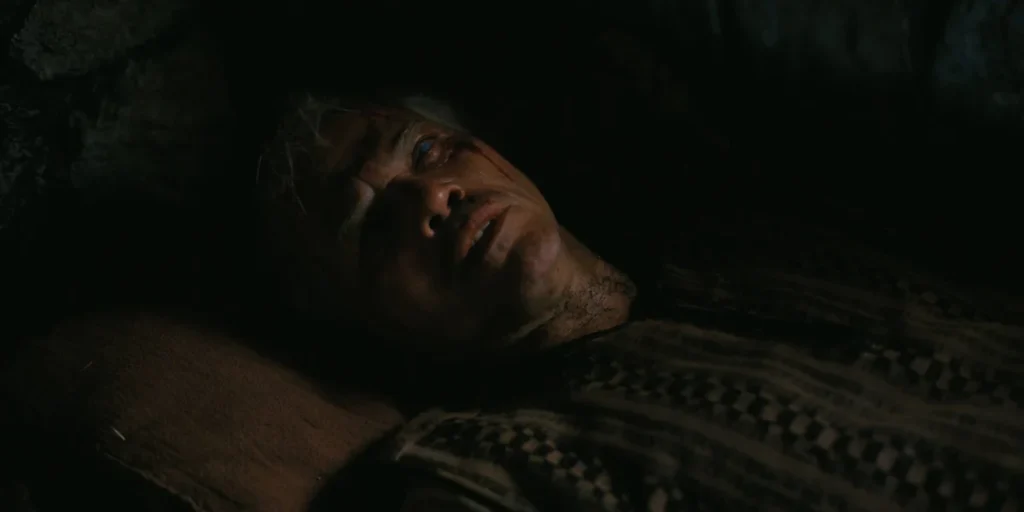
Beyond its thematic exploration of family and societal decay, Love Is the Monster distinguishes itself through exceptional cinematography and visual composition. The film opens with a striking cross-fade from an expansive blue sky directly to Abuela lying on a blue bed, establishing a visual motif of spatial and emotional confinement that persists throughout the runtime.
Director of photography and the creative team utilize the varied Costa Rican landscape to reinforce the narrative’s tonal shifts. The audience is treated to breathtaking aerial perspectives of dense, untouched tropical forests contrasting sharply with sterile, militarized urban corridors and endless, symmetrical rows of commercial palm plantations. These visual choices elevate the production, making it widely regarded as one of the most aesthetically polished and visually arresting regional releases of recent years. The deliberate pacing allows these cinematic vistas to breathe, ensuring that the environment functions almost as a silent character within the unfolding drama.
Narrative Ambiguity: A Double-Edged Sword
While the film excels in its atmospheric tension, technical execution, and lead performances, critics have noted certain narrative vulnerabilities—specifically regarding its heavy reliance on omission. Love Is the Monster consistently gestures toward significant historical events within the family lineage, such as the specific trauma that occurred years prior which left Natalia terrified enough to employ armed guards for child protection. However, the screenplay persistently withholds these explanations, leaving the exact nature of the family’s past opaque.
Furthermore, the script leaves broader socio-political questions unanswered. The film never explicitly addresses the demographic absence of adult men in the region, the systemic drivers behind widespread child kidnappings, or the precise nature of the external threats the Perimeter is ostensibly engineered to keep out. While a degree of ambiguity is often acceptable or even desirable in dystopian storytelling, the missing family history carries a heavier narrative toll, occasionally undercutting the emotional stakes by making the characters’ motivations appear reactive rather than fully contextualized.
Despite these structural omissions, the film remains anchored and elevated entirely by Paulina García’s magnetic central performance. García portrays Abuela not as a villainous or purely sympathetic figure, but as a deeply flawed, frantic, and physically weakening matriarch whose internal desperation is rendered completely tangible. When the narrative finally shifts fully into its thriller mechanics in the final act, García’s ability to project a grandmother’s sheer panic and protective instinct makes for riveting cinema.
Broader Implications and Critical Reception
Love Is the Monster arrives at a time when global cinema is increasingly exploring themes of isolation, intergenerational healing, and ecological precarity. By localizing these global anxieties within the specific socio-political texture of Costa Rica, Neto Villalobos Brenes and his creative team have crafted a work that resonates far beyond its regional origins.
The film’s exploration of corporate negligence, wealth disparity, and the commodification of basic human safety offers a stark commentary on contemporary socio-economic trajectories. Yet, its true triumph lies in its refusal to reduce its characters to mere mouthpieces for political critique. Instead, it examines how systemic pressures distort domestic intimacy, transforming natural protective instincts into potential hazards.
Ultimately, while the film has drawn minor critiques for its narrative restraint and unresolved background arcs, its strengths far outweigh its shortcomings. Supported by striking, evocative cinematography, a haunting score, and a masterclass in lead acting by Paulina García, Love Is the Monster succeeds in posing a timeless and deeply uncomfortable question: How far would an individual go to shield their loved ones from a world engineered to tear them apart? It is a film that lingers in the consciousness long after the credits roll, cementing Villalobos Brenes as a visionary voice in modern Latin American cinema.