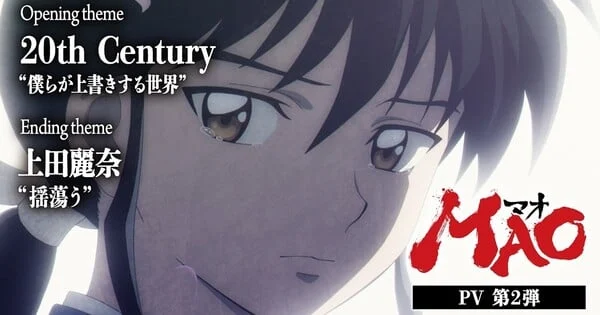
The official website for Sunrise’s television anime adaptation of Rumiko Takahashi’s highly anticipated manga, MAO, has officially released a captivating new promotional video and announced the artist behind the ending theme song for its second cour. This significant update comes as the supernatural adventure series gears up for its next phase, promising further exploration of its intricate plot and compelling characters. The revelations were made public on Sunday, generating considerable excitement among the series’ growing fanbase.
Leading the musical charge for the second cour is the talented Reina Ueda, who will perform the evocative new ending theme titled "Tayutau," translating to "Swaying" in English. The newly released promotional video offers fans a tantalizing preview of "Tayutau," allowing viewers to experience its mood and melody. Complementing this, the video also showcases the electrifying new opening theme, "Bokura ga Uwagaki suru Sekai" (The World We Overwrite), a powerful track delivered by the popular idol group 20th Century. This dual musical reveal underscores the anime’s commitment to high-quality production values and its dedication to enlisting prominent artists to enhance the viewing experience.
The second cour of the MAO anime is scheduled to commence with its 14th episode on July 4. This marks a pivotal moment in the series’ narrative, as it transitions into its latter half, which will continue to be broadcast over a total of two continuous cours, or quarters of a year, without any breaks. This broadcasting strategy, common for ambitious anime productions, ensures a consistent and uninterrupted flow of the story for viewers. The anime debuted on April 4 on the NHK-General channel at 11:45 p.m. JST (10:45 a.m. EST), immediately drawing attention for its faithful adaptation of Takahashi’s acclaimed work and its unique blend of supernatural elements and historical setting.
A Deeper Dive into the MAO Narrative
Viz Media, a prominent publisher of manga in English, offers a comprehensive description of MAO’s compelling narrative. The story is characterized as an "era-spanning supernatural adventure" that intricately weaves together elements of time travel, exorcism, and the lingering presence of the supernatural. The plot centers on Nanoka, a young woman who finds herself unexpectedly transported back in time to the early 20th century, a period rife with supernatural occurrences. It is during this disorienting journey that she encounters MAO, an aloof and skilled exorcist who becomes her reluctant guide and partner.
The synopsis further elaborates on the mysterious connection that binds Nanoka and MAO, hinting at a deeper, perhaps fated, relationship that drives their shared quest for answers. Their adventures are not merely observational; they actively engage in confronting and defeating demons, adding an action-packed dimension to the supernatural exploration.
A more detailed account provided by Viz Media reveals the initial circumstances of Nanoka’s temporal displacement. She traverses a portal, landing in the Taisho era, where she narrowly escapes a perilous encounter with a grotesque yokai, only to be rescued by MAO. Upon her return to the present, Nanoka discovers that she has acquired extraordinary new abilities, a consequence of her journey. Driven by a desire to understand these newfound powers and the mysteries surrounding her time travel, she returns to the past. There, she becomes entangled in MAO’s investigation into a series of gruesome murders, which are intrinsically linked to the supernatural undercurrents of the era.
As Nanoka grapples with her evolving abilities and the escalating mysteries, she uncovers a crucial piece of information about MAO: he is afflicted by a curse involving a cat demon named Byoki, a curse that also extends to his formidable sword. The narrative highlights the dire consequences of anyone other than MAO attempting to wield this cursed weapon, emphasizing the inherent danger. However, in a pivotal moment where MAO’s life hangs in the balance, Nanoka bravely defies these warnings and takes up his blade, demonstrating her growing resolve and her deepening involvement in the supernatural conflict.
Production and Distribution Details
Sunrise, a renowned animation studio with a rich history of producing iconic anime series, is at the helm of the MAO adaptation. The studio’s expertise in bringing complex manga worlds to life is evident in the visual style and animation quality of the series. The anime’s debut on NHK-General underscores its broad appeal and its status as a significant release within the Japanese television landscape.

For international audiences, the MAO anime is readily accessible through various streaming platforms. Hulu is providing the series to viewers in the United States, while Disney+ is offering it in Canada, Latin America, Australia, and New Zealand. This widespread distribution ensures that fans across the globe can follow Nanoka and MAO’s supernatural escapades.
Musical Contributions: A Harmonious Blend
The musical landscape of the MAO anime has been a significant talking point since its premiere. The first cour featured the energetic opening theme song "HEARTLOUD" performed by the popular boy band Kis-My-Ft2, and the poignant ending theme "Juai" (Cursed Love) by the esteemed vocalist TRUE. These artists contributed significantly to the anime’s initial atmosphere and emotional resonance.
The introduction of Reina Ueda and 20th Century for the second cour signifies a continuation of this commitment to high-caliber musical collaborations. Reina Ueda, known for her versatile vocal performances in numerous anime, is expected to imbue "Tayutau" with a depth and emotional nuance that complements the evolving narrative. Similarly, 20th Century’s "Bokura ga Uwagaki suru Sekai" promises to inject a dynamic and memorable energy into the opening sequences, setting the tone for each new episode. The synergy between these artists and the anime’s themes is a key factor in its overall appeal.
The Legacy of Rumiko Takahashi
The MAO anime is an adaptation of a manga created by the legendary Rumiko Takahashi, a figure whose name is synonymous with the golden age of manga and anime. Takahashi’s career, spanning over three decades, has produced a string of universally beloved and critically acclaimed works that have left an indelible mark on popular culture. Her distinctive art style, memorable characters, and knack for blending humor, romance, and action have garnered her a massive international following.
Her extensive bibliography includes iconic titles such as Urusei Yatsura, Maison Ikkoku, Mermaid Saga, Rumic Theater, Ranma 1/2, One-Pound Gospel, and the globally recognized Inuyasha. Many of these manga series have not only achieved immense popularity but have also been successfully adapted into anime series, films, and even live-action productions, further cementing Takahashi’s legacy as a master storyteller. The MAO manga, launched in Shogakukan’s Weekly Shonen Sunday magazine in May 2019, represents her continued creative output and her enduring ability to captivate audiences with new worlds and characters. Viz Media began publishing the manga in English in 2021, making it accessible to a wider Western audience. The 29th compiled book volume was released on June 18, indicating the manga’s ongoing success and the depth of its narrative.
Analysis and Implications
The release of a new promotional video and theme song for the second cour of the MAO anime signifies a critical juncture for the series. It demonstrates the production’s confidence in the ongoing narrative and its commitment to maintaining audience engagement. The continued broadcast for two full cours without breaks suggests a well-planned story arc that will allow for substantial character development and plot progression, a crucial element for adapting a manga series.
The involvement of established artists like Reina Ueda and 20th Century not only enhances the anime’s appeal but also speaks to the broader impact of Takahashi’s work. Her name alone draws significant attention, and the high-quality production values, including music, further solidify the anime’s position as a must-watch for fans of supernatural thrillers and classic anime storytelling.
The success of the MAO anime can also be viewed as a testament to the enduring appeal of Rumiko Takahashi’s storytelling. Her ability to craft compelling narratives that resonate across generations and cultures continues to be a driving force in the manga and anime industries. The international streaming availability through platforms like Hulu and Disney+ ensures that MAO can reach a global audience, potentially introducing new fans to Takahashi’s expansive body of work and contributing to the ongoing growth of anime’s international market. The series’ exploration of Japanese folklore, historical settings, and complex character relationships offers a rich tapestry that appeals to both seasoned anime viewers and newcomers alike, reinforcing the medium’s capacity for diverse and engaging storytelling.