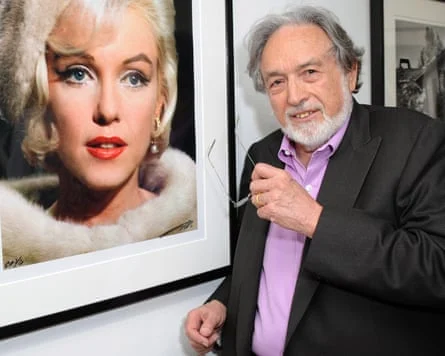
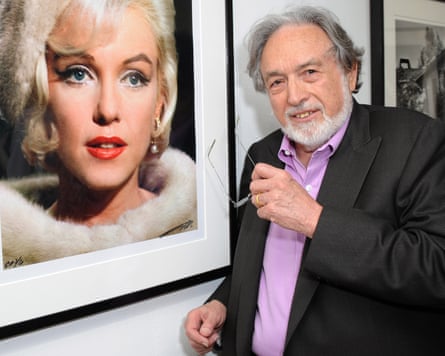
A few days after a pivotal nude swimming pool shoot for the unfinished 1962 comedy Something’s Got to Give, Marilyn Monroe, the icon whose image transcended celluloid, demonstrated a profound and often overlooked control over her own legacy. In a scene now etched in photographic history, she drove her photographer, Lawrence Schiller, to the iconic Schwab’s Pharmacy on Sunset Boulevard. Schiller had brought the negatives from their recent session, eager to see them developed into prints. Monroe, however, had brought her own tools – a pair of scissors. Under the warm glow of the legendary Hollywood hangout’s streetlights, she began to meticulously cut the color film into pieces.
"Ziiiiiip – the ones she didn’t like," Schiller recounted, mimicking the sound with a palpable sense of awe. "Ziiiiiip." When pressed if she was destroying them, the now 89-year-old, the last living photographer to have extensively documented Monroe, laughed. "Oh yeah, but that came with the territory." He vividly recalls his 25-year-old self bending to collect the discarded fragments, thinking, "Well, I would’ve killed that one, too." Schiller’s admiration for Monroe’s discerning eye was unequivocal. "There wasn’t a picture she destroyed that I would’ve published," he stated. This act of deliberate curation, of actively shaping her visual narrative, stands in stark contrast to the pervasive myth of Monroe as a passive figure, endlessly molded by the studios and the public gaze.
Tragically, just two months after this powerful display of agency, Marilyn Monroe died from a drug overdose at the age of 36. In the six decades since her untimely passing, her image has often been filtered through the lens of the "messy" blonde bombshell, a persona that struggled for self-control and was frequently depicted as being at the mercy of external forces. However, a growing re-evaluation of her life and career, championed by exhibitions like the one at the National Portrait Gallery in London, aims to reposition Monroe not as a victim of her fame, but as a sophisticated architect of her own enduring image.
Reclaiming the Narrative: Monroe’s Creative Agency
Rosie Broadley, the curator of the National Portrait Gallery exhibition, emphasized this shift in perspective in the accompanying catalogue: "Monroe not only performed, but also directed and claimed the right to veto any images she did not like." While photographers like Richard Avedon, Milton Greene, and Bert Stern held the cameras, the exhibition argues that Monroe was instrumental in guiding their vision, dictating the terms of her representation. This was not merely about vanity; it was a strategic engagement with the powerful machinery of celebrity photography.

The exhibition, timed to coincide with what would have been Monroe’s 100th birthday, centers on this concept of Monroe’s "creative agency." It portrays her as an active participant, not a passive bystander, in the construction of her public persona. Accounts from those who knew her suggest that while Monroe could be emotionally vulnerable, she was also remarkably tenacious and firm in her convictions, particularly when it came to her image. Broadley notes that Monroe "so brilliantly conveyed" a vitality that was often "frequently at odds" with the private struggles she faced once the cameras stopped rolling.
The Pool Shoot: A Moment of Defiance and Self-Expression
The swimming pool shoot for Something’s Got to Give in May 1962 provides a compelling illustration of Monroe’s assertiveness. Schiller recalls Monroe disregarding director George Cukor’s instructions, intentionally swimming to where the light was more favorable. In one iconic shot, she gracefully hooks her leg over the edge of the pool, evoking the timeless allure of a mythological nymph. In another, a subtly dropped towel hints at the curve of her back, a pose described by Schiller as "cello-like, as if waiting to be played."
Before the shoot commenced, Monroe famously posed a provocative question to Schiller: "What would happen if I jumped into the swimming pool with my bathing suit, like they say, but I come out with nothing on?" Schiller, then a young photographer, responded with a calculated blend of professional respect and youthful ambition: "You’re already a famous woman. But if I take those photos, you’re going to make me famous." Monroe’s quick retort, "Don’t be so cocky, Larry. I could fire you in two seconds," underscored the dynamic of their relationship. Schiller describes it as one where "I could crack a joke – and she could crack a joke back that was more poignant and piercing, with a lot of subtext. And you had to understand Marilyn’s subtext."
The Subtext of Joy and Struggle
This notion of "subtext" resonates deeply with the observations of Eve Arnold, another prominent photographer who documented Monroe. Arnold likened Monroe to a woman in search of her lost self, with photographers seemingly offering her what was missing. This interpretation gains poignancy when examining Schiller’s luminous images of Monroe skinny-dipping in the moonlight, her face alight with a joy that starkly contrasted with the tumultuous reality of her life.
The summer of 1962 was a period of intense personal upheaval for Monroe. It followed her divorce from playwright Arthur Miller, and was marred by gynecological and gallbladder surgeries, a harrowing stay in a psychiatric clinic, and an escalating dependency on alcohol and prescription drugs. Against this backdrop, the seemingly carefree images captured by Schiller offered a powerful counter-narrative, a testament to her enduring spirit and her ability to project an image of effervescence even in the face of profound personal challenges.
A Strategic Gambit in the Hollywood Arena
Monroe’s actions on set were not merely artistic expressions; they were often strategic. Schiller suggests that Monroe’s willingness to engage in daring photo shoots, like the nude pool scene, was partly motivated by a desire to command public attention and rival the media dominance of other stars. At the time, Elizabeth Taylor was a constant fixture in the tabloids due to her affair with Richard Burton and the colossal production of Cleopatra, a film that was hemorrhaging studio funds and would nearly bankrupt Twentieth Century Fox. "What was in her mind," Schiller posited, "was: if I do this shoot in a certain way, I’m going to be on the cover of every magazine around the world – and Liz Taylor won’t be."
This perspective suggests that Monroe’s artistic choices were interwoven with a keen understanding of the competitive landscape of Hollywood and the power of visual media. Her naked pool frolics, therefore, can be seen as more than just a performance; they were a complex attempt at self-reclamation, a bid to control her narrative and reassert her presence in a world that often sought to define her. At 36, this reclamation was as much about reclaiming her past and her agency as it was about asserting her present.
The Still Camera as a Canvas for Self-Creation
Monroe herself articulated this sense of control in her final interview before her death, a mere few months after the pool shoot: "I don’t look at myself as a commodity, but I’m sure a lot of people have." This sentiment echoes the experiences of photographer Douglas Kirkland, who, in a 2015 conversation, recalled a 1961 session photographing Monroe naked in bed. Kirkland observed that Monroe seemed to relish creating still images as much as making movies, explaining, "Because she could write the script as it went along. She could make things happen. I did not tell her, ‘Turn this way, turn that way, do this, do that.’ She did it herself. That was Marilyn."
This perspective aligns with the National Portrait Gallery’s framing of Monroe’s "creative agency" operating outside the rigid confines of the studio system. The studio dictated her roles, her appearance, and her positioning, but with the still camera, Monroe found a medium where she could shape her own destiny. Schiller concurs, stating, "I don’t think any photographer captured Marilyn because what they captured is what Marilyn wanted them to capture. She wanted to be the splish splash in the water with me. She wanted to be the dream in the middle of the night with Cecil Beaton. The short and long of it was: she controlled the still camera."
The Shadow of Tragedy and the Enduring Presence
Away from the controlled environment of the still camera, however, the pressures of her career and personal life continued to take their toll. In June 1962, just days after Schiller photographed her joyfully celebrating her 36th birthday on the set of Something’s Got to Give, Monroe was found in a state of severe depression, having ingested a significant quantity of prescription pills. Five days later, Twentieth Century Fox terminated her contract for repeated absences and initiated a lawsuit for $750,000, citing "breach of contract." The film, a story about a woman who returns after being lost at sea, was never completed, leaving a significant void in cinematic history.
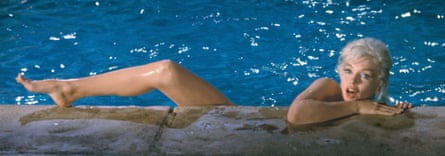
Schiller, reflecting on his time with Monroe, expresses a subtle reluctance to overemphasize his proximity to her final days. "In front of the lens," he states, "she was somebody for me to capture." Yet, he also acknowledges a persistent quality of distance, fragility, and elusiveness in her demeanor. He likens her to "a deer out in the woods. You wanted to capture it before somebody shot it. You wanted to get it alive before it no longer existed." This sense of urgency, of capturing a luminous spirit before it was extinguished, was palpable even on their last shoots together. "You wanted to photograph her before some tragedy entered her life again."
The day before Monroe’s death, August 4, 1962, Schiller visited her home in the Brentwood neighborhood of Los Angeles. He recalls finding her "just out there with the flowers," discussing a potential Playboy cover. The call informing him of her death at 5 AM the following morning was a shock he initially dismissed as a cruel prank. It was not. By 7 AM, Schiller was driving back to her residence, only to find the property swarmed by media. He witnessed the broken glass of her bedroom window and the somber procession of officials removing her body, covered on a gurney.
Schiller describes her death as a "tragic end," one that compelled him to bear witness. "Photography is part of the texture of my life," he muses. And so, it seems, was Marilyn Monroe. He concludes in his 2021 memoir, Marilyn & Me, "Marilyn Monroe came into my life in 1960, and she is still a living, breathing, extraordinary presence." Her magic, meticulously curated and powerfully expressed, continues to captivate, proving that the images she chose to embrace, and those she so decisively rejected, form the true and enduring testament to her complex and compelling legacy.