Amazon MGM Studios has officially moved forward with its high-stakes reimagining of the iconic 1980s franchise, Masters of the Universe, a project that has navigated one of the most complex development histories in modern Hollywood. Directed by Travis Knight, the live-action feature represents a significant attempt by Mattel Films to capitalize on its intellectual property following the global success of Barbie. With a running time of 132 minutes and a screenplay credited to Chris Butler, Aaron Nee, Adam Nee, and David Callaham, the film aims to bridge the gap between nostalgic appeal and contemporary cinematic sensibilities.
The production features a high-profile ensemble cast led by Nicholas Galitzine as Prince Adam, alongside Camila Mendes as Teela and Academy Award winner Jared Leto as the antagonist Skeletor. The supporting cast includes industry veterans such as Idris Elba, Kristen Wiig, Morena Baccarin, and Alison Brie. Despite the star power involved, the film faces the daunting task of revitalizing a property whose previous live-action attempt in 1987 was a critical and financial failure that contributed to the bankruptcy of Cannon Films.
Narrative Overview and Structural Framework
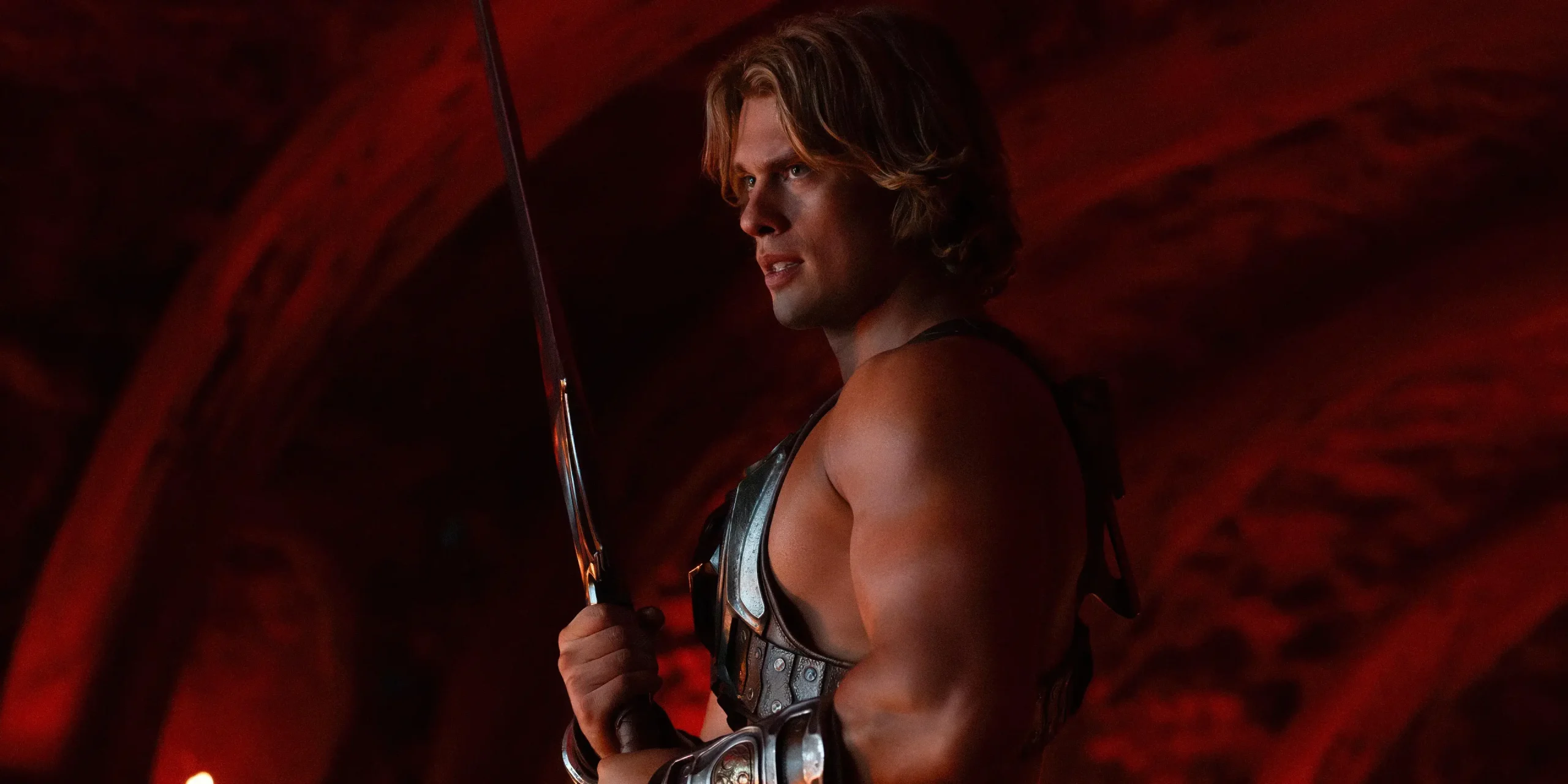
The plot of Masters of the Universe centers on Prince Adam Glenn, portrayed by Nicholas Galitzine, a young man living a suburban life in Oklahoma who remains unaware of his extraterrestrial royal lineage. The narrative establishes that Adam was sent to Earth as a child to escape the fall of his home planet, Eternia, which was conquered by the dark sorcerer Skeletor.
The story follows a classic "hero’s journey" template. After fifteen years of living a mundane existence, Adam discovers his true identity and the existence of the Sword of Power, a mystical artifact capable of granting its wielder immense strength. The inciting incident occurs when figures from Adam’s past, including the grizzled General Duncan (Idris Elba) and his daughter, the warrior Teela (Camila Mendes), arrive on Earth to retrieve him.
The second act transitions the setting from the rural United States to the high-fantasy landscapes of Eternia. The mission is twofold: Adam must master the mechanics of the Sword of Power to become He-Man and lead a resistance against Skeletor’s forces to reclaim the throne. The film attempts to weave a coming-of-age story into a grand space-opera setting, focusing on Adam’s internal struggle to reconcile his humble Earth upbringing with the expectations of a warrior-prince.
A Legacy of Development Challenges
The path to the current iteration of Masters of the Universe has been marked by nearly two decades of "development hell." The rights to the franchise have transitioned through multiple major studios, including Warner Bros., Sony Pictures, and Netflix, before finally landing at Amazon MGM Studios.
In 2019, Sony was heavily invested in a version of the film starring Noah Centineo, but the project stalled during pre-production. Subsequently, Netflix acquired the rights and spent an estimated $30 million in development costs, with the Nee brothers attached to direct. However, in a surprising move in 2023, Netflix canceled the project citing budget concerns, which were reportedly ballooning toward $200 million. Amazon MGM eventually stepped in, providing the financial backing necessary to bring Travis Knight’s vision to fruition.
This turbulent history underscores the industry’s hesitance regarding the property. While the original 1980s Mattel toy line and the subsequent Filmation animated series were cultural phenomena, translating the "barbarian-meets-sci-fi" aesthetic to live-action has historically proven difficult. The 1987 film, starring Dolph Lundgren, is often cited as a cautionary tale of how budget constraints and tonal inconsistencies can alienate a fanbase.
Production Analysis and Technical Execution
Director Travis Knight, known for his work on the stop-motion masterpiece Kubo and the Two Strings and the Transformers spin-off Bumblebee, brings a distinct visual style to the project. However, industry analysts and early screenings suggest that the film struggles with the technical demands of its vast scope.
While Knight’s previous work was lauded for its tactile nature and emotional resonance, Masters of the Universe relies heavily on digital environments and computer-generated imagery (CGI). Reports indicate that while certain sequences—such as a creative assault in a mountain fortress—showcase Knight’s flair for choreography, other action set pieces suffer from a perceived lack of "weight." Critics have noted that the reliance on green-screen technology is occasionally palpable, creating a disconnect between the actors and the fantastical world of Eternia.
The combat sequences have also drawn scrutiny for their traditional "stunt-team" staging, where secondary antagonists often appear to wait their turn to engage the protagonist. This style of action filmmaking, while common in the 1990s and early 2000s, has faced criticism in a post-John Wick era where audiences expect more fluid and integrated choreography.
Performance and Character Dynamics
The casting of Nicholas Galitzine reflects a strategic move to attract a younger demographic, following his success in romantic dramas and comedies. Galitzine’s performance is noted for its physicality, though some observers have pointed out a lack of chemistry between him and Camila Mendes’ Teela. Mendes, a veteran of Riverdale, portrays Teela as a fierce and capable warrior, yet her character is often relegated to a supporting role that lacks significant development.
The film’s most praised elements reside in its veteran supporting cast. Idris Elba’s portrayal of Duncan (Man-At-Arms) provides a grounded, gravitas-filled performance as a broken soldier seeking redemption. Similarly, Jared Leto’s Skeletor has been described as a hyperbolic, campy villain, utilizing a refined British accent to emphasize his aristocratic malevolence. Leto’s performance leans into the theatricality of the source material, though the script occasionally undercuts his menace with humor.
Alison Brie also receives high marks for her portrayal of Evil-Lyn. Critics have noted that Brie manages to command the screen with minimal dialogue, using physical presence and expression to convey the character’s cunning and power.
Thematic Ambitions and Tonal Conflicts
One of the most discussed aspects of the new Masters of the Universe is its attempt to modernize the themes of the 1980s source material. The screenplay attempts to deconstruct traditional concepts of masculinity. Adam’s journey is framed not just as a quest for physical power, but as a lesson in empathy and emotional maturity.
However, this thematic exploration has faced criticism for being inconsistent. The film’s "meta" tone—frequently acknowledging the absurdity of its own premise—has been compared to Dungeons & Dragons: Honor Among Thieves, but with less success. Where Honor Among Thieves leaned into its sincerity despite its humor, Masters of the Universe often feels embarrassed by its origins. Frequent jokes regarding Skeletor’s laugh or the "suggestive" nature of the Sword of Power have been described as distracting, potentially alienating both long-time fans who want a serious epic and new viewers who may find the self-referential humor jarring.
The pacing of the 132-minute runtime has also been flagged as a concern. The transition from the grounded Oklahoma scenes to the high-fantasy world of Eternia creates a narrative shift that some find difficult to navigate, leading to a loss of momentum in the second act.
Market Context and Industry Implications
The release of Masters of the Universe is a pivotal moment for Mattel Films. Under the leadership of Ynon Kreiz, Mattel has pivoted from being a toy manufacturer to an IP-driven media company. The success of Barbie (2023) proved that toy-based properties could achieve both critical acclaim and box-office dominance.
However, Masters of the Universe represents a different challenge. Unlike Barbie, which utilized a satirical and feminist lens to reinvent its brand, He-Man is rooted in the "Sword and Sorcery" genre, which has a narrower margin for error. The film’s performance will likely determine the viability of other planned Mattel projects, including live-action adaptations of Hot Wheels, Polly Pocket, and Barney.
For Amazon MGM Studios, the film is a major "tentpole" release intended to bolster its streaming and theatrical library. By securing a high-profile cast and a director with a cult following, the studio is betting that the "He-Man" brand still possesses enough cultural equity to launch a multi-film franchise.
Conclusion and Future Outlook
Masters of the Universe arrives at a crossroads in popular culture. It is a film caught between the desire to be a serious fantasy epic and the urge to be a self-aware parody. While the performances of Idris Elba, Jared Leto, and Alison Brie provide highlights, the film’s technical inconsistencies and muddled thematic goals present significant hurdles.
Whether the film can overcome the "curse" of the 1987 original remains to be seen. If it finds an audience, it could solidify the "Mattel Cinematic Universe" as a dominant force in Hollywood. If it fails to resonate, it may serve as a reminder that some 1980s properties are better left in the nostalgia of the past. As the film prepares for its global rollout, the industry will be watching closely to see if Prince Adam can truly find the power to lead a new generation of cinema-goers.