Christopher Nolan has solidified his standing as a defining filmmaker of the 21st century, a status further cemented by the release of his thirteenth feature film, The Odyssey. Over a career spanning nearly three decades, Nolan has transitioned from an independent director working with a three-thousand-pound budget to a global brand capable of commanding hundred-million-dollar budgets for original, non-franchise concepts. His career trajectory is unique in the modern era; while many directors are absorbed by the machinery of superhero franchises, Nolan utilized his tenure with the Dark Knight Trilogy as a springboard to establish himself as a standalone genre. Following his Academy Award success with Oppenheimer in 2024, the arrival of his adaptation of Homer’s The Odyssey represents a new chapter in his exploration of large-scale, practical-effects-driven cinema.

The Auteur of the Modern Blockbuster
The filmography of Christopher Nolan is characterized by recurring thematic preoccupations: the elasticity of time, the weight of guilt, and the obsession with control. These themes are packaged within a distinct visual and auditory style, featuring non-linear narratives, an insistence on shooting on film—specifically 70mm and IMAX formats—and a preference for practical stunts over digital effects. With a cumulative global box office exceeding $6 billion, Nolan is one of the few directors whose name alone serves as a primary marketing tool, drawing audiences to complex, intellectual narratives that traditionally struggle in the blockbuster landscape.
A Comprehensive Ranking and Analysis of the Nolan Filmography
The following analysis evaluates Nolan’s thirteen feature films based on their narrative complexity, technical execution, and cultural impact, incorporating the 2026 release of The Odyssey.

13. Insomnia (2002)
Nolan’s third feature and his first major studio production for Warner Bros. served as a crucial transition point. A remake of the 1997 Norwegian film of the same name, Insomnia stars Al Pacino and Robin Williams in a psychological cat-and-mouse game set in Alaska. While the film is a masterclass in atmosphere and performance, it remains the most conventional entry in Nolan’s body of work. It lacks the experimental structural play found in his later films, though it introduced the "haunted protagonist" archetype that would define his future heroes. Critically, the film holds a 92% on Rotten Tomatoes, proving that even Nolan’s most standard procedural operates at a high level of craftsmanship.
12. Following (1998)
Shot on weekends over the course of a year, Following is a 70-minute neo-noir that established Nolan’s fascination with non-linear storytelling. With a budget of approximately £3,000, the film displays a level of ingenuity that compensated for its lack of resources. It features a protagonist obsessed with shadowing strangers, a premise that allowed Nolan to experiment with fragmented editing and circular narrative structures. Despite its micro-budget origins, Following contains the DNA of his entire career, from the brooding tone to the final-act twist.

11. The Prestige (2006)
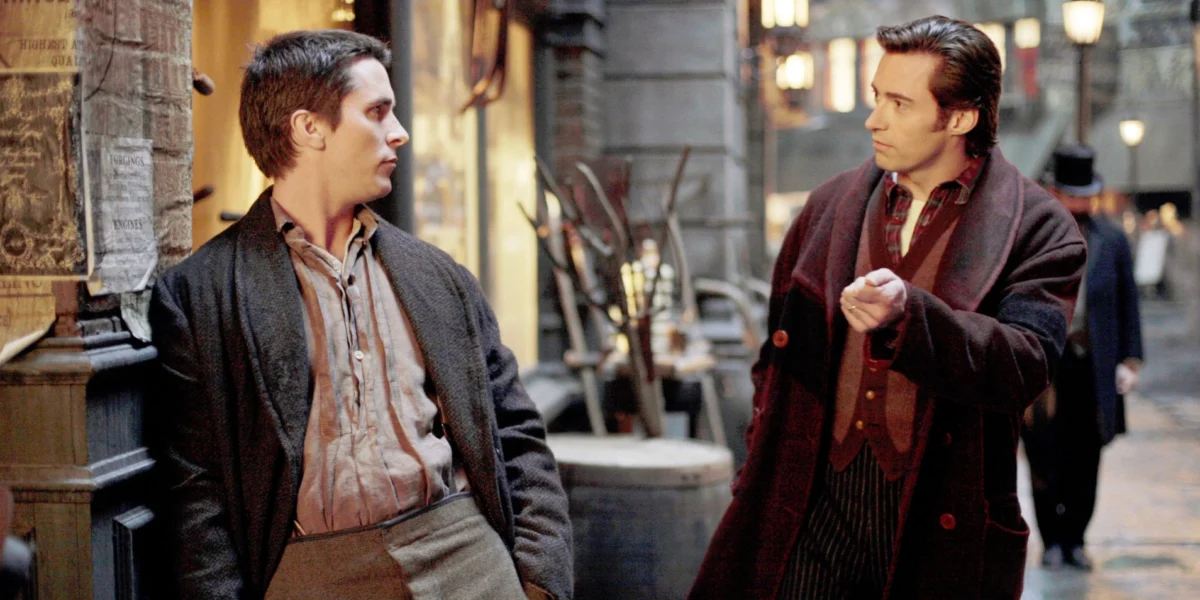
Positioned between his first two Batman films, The Prestige explores the obsessive rivalry between two Victorian-era magicians, played by Hugh Jackman and Christian Bale. The film’s structure mimics a magic trick, divided into the pledge, the turn, and the prestige. While highly regarded for its intricate plotting, some critics have noted that the film’s reliance on a late-stage science fiction element can strain the internal logic of its historical setting. Nevertheless, it remains a quintessential Nolan film regarding its exploration of the cost of artistic and professional dedication.
10. Batman Begins (2005)
Batman Begins was instrumental in the mid-2000s shift toward "gritty" reboots. Nolan moved away from the camp aesthetics of previous iterations, grounding the character in a world of corruption and psychological fear. The film’s first act, focusing on Bruce Wayne’s training in the Himalayas, is often cited as a benchmark for superhero origin stories. By the time the film reached its $373 million global box office conclusion, it had successfully restored the commercial and critical viability of the DC property.

9. Memento (2000)
The film that launched Nolan into the cultural zeitgeist, Memento utilized a unique reverse-chronological structure to put the audience in the headspace of a man with short-term memory loss. Based on a story by his brother, Jonathan Nolan, the film was a critical sensation, earning Academy Award nominations for Best Original Screenplay and Best Film Editing. It remains a foundational text in 21st-century independent cinema, demonstrating that mainstream audiences were willing to engage with demanding, non-traditional narratives.
8. The Dark Knight Rises (2012)
The conclusion to the Dark Knight Trilogy was a massive financial success, grossing $1.08 billion worldwide. While it faced the difficult task of following its predecessor, the film is an ambitious, large-scale epic that draws inspiration from Charles Dickens’ A Tale of Two Cities. Despite some narrative leaps, its depiction of a city under siege and the introduction of Tom Hardy’s Bane provided a definitive, if polarizing, end to the series.

7. The Odyssey (2026)
Nolan’s most recent effort, The Odyssey, marks a significant departure into the realm of high fantasy and ancient mythology. Starring Matt Damon as Odysseus, the film is a technical marvel, utilizing massive practical sets to recreate the Mediterranean of legend. Reports from the production indicated that Nolan refused to use blue screens for the sea-bound sequences, opting instead for complex gimbal systems and location shooting. The film’s centerpiece—a terrifying encounter with the Cyclops—showcases Nolan’s ability to translate horror into a PG-13 blockbuster context. While the episodic nature of the source material presents challenges, the film’s third-act homecoming provides a powerful emotional resolution.
6. Tenet (2020)
Released during the height of the COVID-19 pandemic, Tenet was a polarizing but undeniably bold attempt to save the theatrical experience. A high-concept spy thriller involving "time inversion," the film is Nolan’s most complex puzzle box. While some audiences struggled with the sound mixing and the density of the physics-based exposition, Tenet features some of the most innovative action choreography in modern cinema, with sequences literally filmed both forward and backward simultaneously.

5. Interstellar (2014)
Interstellar represents Nolan’s foray into hard science fiction, grounded by a story of paternal love. Working with theoretical physicist Kip Thorne, Nolan aimed for a high degree of scientific accuracy regarding black holes and time dilation. The film’s score by Hans Zimmer, dominated by a massive pipe organ, helped elevate the movie into a space-age myth. Since its release, the film has undergone a significant critical reappraisal, with many now viewing it as his most emotionally resonant work.
4. The Dark Knight (2008)
The Dark Knight is frequently cited as the greatest superhero film ever made. Beyond its genre trappings, it functions as a sprawling urban crime drama. Heath Ledger’s posthumous Academy Award-winning performance as the Joker became an instant cultural icon. The film was the first major feature to utilize IMAX cameras, a technical choice that would define Nolan’s later career. Its omission from the Best Picture category at the 81st Academy Awards is widely credited with the Academy’s decision to expand the nominee field to ten films.

3. Oppenheimer (2023)
A three-hour biographical thriller about the "father of the atomic bomb," Oppenheimer was an unlikely blockbuster success, grossing $975 million. The film is a technical triumph, utilizing black-and-white IMAX film for the first time in history. It swept the 96th Academy Awards, winning seven Oscars, including Best Picture and Best Director. The film’s ability to make board-room hearings and scientific debates feel as tense as an action movie is a testament to Nolan’s mastery of pacing and sound design.
2. Inception (2010)
Inception is the definitive "original" blockbuster of the 21st century. A heist movie set within the layers of the human subconscious, it balanced high-concept world-building with visceral action. The film’s ending, featuring a spinning top, remains one of the most discussed cliffhangers in cinema history. Grossing $839 million, it proved that Nolan could sell complex, original intellectual property to a global audience without the need for an existing brand.

1. Dunkirk (2017)
Dunkirk is the purest expression of Nolan’s cinematic philosophy. By stripping away dialogue and traditional character backstories, Nolan relied on pure visual storytelling and a relentless "Shepard tone" score to depict the 1940 evacuation of Allied soldiers. The film’s three-tiered timeline—land (one week), sea (one day), and air (one hour)—creates a sense of mounting tension that is unparalleled in the war genre. It is a lean, 106-minute exercise in suspense that functions as both a historical document and an avant-garde experiment in time.
Chronology and Industry Impact
The career of Christopher Nolan can be divided into three distinct phases: the Independent Phase (1998–2002), the Franchise Phase (2005–2012), and the Auteur/Epic Phase (2014–Present). Each phase has seen him push the boundaries of what is possible within the studio system.

Nolan’s commitment to the theatrical experience has made him a de facto spokesperson for the industry. During the pandemic, his insistence on the theatrical release of Tenet sparked a global conversation about the future of cinema. Furthermore, his transition from Warner Bros. to Universal Pictures for the production of Oppenheimer signaled a shift in the power dynamics between directors and major studios, as he secured a 100-day theatrical window and a significant percentage of the first-dollar gross.
Broader Implications and Future Outlook
The success of The Odyssey suggests that Nolan’s "blank check" status remains intact following his Oscar sweep. By tackling a foundational text of Western literature, Nolan is moving into a phase of his career where he is no longer just a filmmaker, but a custodian of large-scale cultural myths.

The data indicates that Nolan’s audience is growing rather than shrinking; Oppenheimer’s box office performance nearly tripled that of Tenet and outperformed several of his earlier Batman films in many international territories. As the industry continues to grapple with the rise of streaming and the decline of traditional mid-budget films, Nolan’s career provides a blueprint for the survival of the "event" film—movies that demand to be seen on the largest screen possible, not because of a brand name, but because of the visionary filmmaker behind the camera. With thirteen films completed, Christopher Nolan’s legacy is no longer just about the "bat-shaped shadow," but about the enduring power of the cinematic image.