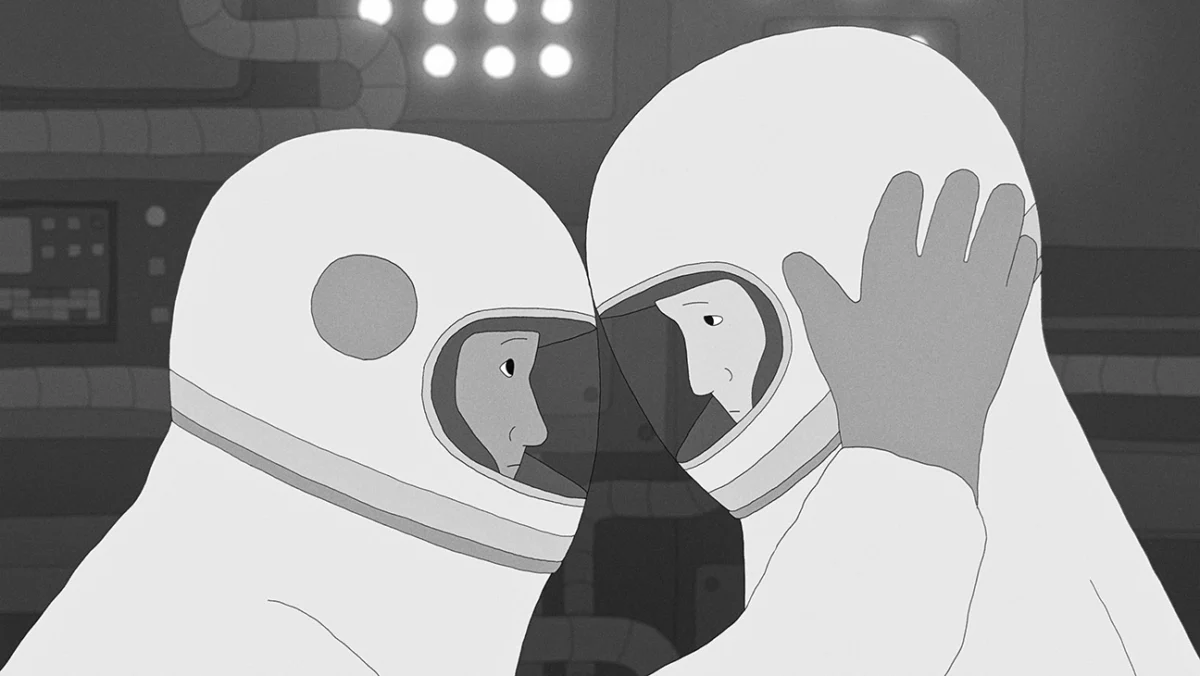
The feature debut from Brooklyn-based artist Daniel Zvereff, which premiered at the Venice Film Festival as part of the prestigious Biennale College Cinema program, presents a stark vision of humanity five centuries removed from the present. The film, a meditative and grayscale animated work, documents the plight of indentured astronauts tasked with the perilous, lonely labor of asteroid mining. Through a minimalist lens, Zvereff interrogates themes of corporate exploitation, the fragility of the human psyche under extreme duress, and the fundamental need for connection in a universe that offers none.
The Premise: Labor in the Void
The narrative centers on Cassius, voiced by Morgan Spector, and Vesper, voiced by Lucy Liu. The pair are introduced as a functional unit, co-existing in a cramped, claustrophobic space station environment. Their relationship is characterized by a pragmatic, almost professional intimacy rather than overt romance, reflecting the dehumanizing nature of their contract. The duo is tasked with a 355-day mission—a duration aligned with the orbital period of the asteroid they are assigned to mine.
The stakes are established early and with brutal clarity: the pair are not merely employees but indentured servants. Their employers have issued a stark ultimatum: meet the established extraction quotas, or face total abandonment. This dynamic evokes the darker traditions of science fiction, echoing the corporate callousness found in the Alien franchise, where human life is treated as a disposable commodity in the pursuit of resource extraction.
Chronology and the Catalyst of Grief
The mission’s trajectory is abruptly altered by a catastrophic landing on their assigned asteroid. The impact renders their landing craft inoperable, effectively stranding the duo and isolating them from any hope of immediate rescue. The structural failure of the vessel serves as the film’s first major pivot point.
In the ensuing struggle, Vesper is killed. The film handles this loss with a stark, unflinching realism; Cassius buries his partner beneath the surface of the asteroid. What follows is a psychological descent. Left to fulfill the mining quota alone, Cassius begins to experience auditory hallucinations. He begins to perceive the voice of his deceased partner through their sole remaining companion: a goldfish.
The presence of the fish is a deliberate, historical touchpoint. Much like the canaries once utilized in coal mines to detect methane or carbon monoxide, the goldfish in Moonfish serves as a biological indicator of the environment’s integrity—in this case, monitoring the functionality of the station’s water filtration systems. However, as Cassius’s isolation deepens, the fish transforms from a diagnostic tool into a vessel for his own fractured consciousness.
Comparative Analysis and Thematic Depth
The film draws inevitable comparisons to the seminal works of Stanisław Lem, particularly Solaris. Much like the protagonist in Lem’s novel—and its subsequent film adaptations by Andrei Tarkovsky and Steven Soderbergh—Cassius is forced to confront the manifestation of his grief within an alien landscape. While Moonfish does not lean into the grandiosity of Solaris, it shares the core preoccupation with the unknowability of extraterrestrial environments and the way they act as a mirror for the human mind.
Zvereff’s background as an immigrant, seen in his earlier shorts Drago and Life Is a Particle Time Is a Wave, provides a thematic anchor for the film. The story is less a polemic against capitalism and more an inquiry into the concept of "home." Whether through the physical return to Earth or the psychological creation of a new, internal home, the film posits that survival is not merely a matter of oxygen and sustenance, but of narrative and memory.
Production and Aesthetic Choices
The film’s visual language is deliberately restricted. Zvereff utilizes a 4:3 aspect ratio, which serves to heighten the sense of claustrophobia and the limited perspective of the protagonists. The animation is sparse, utilizing fine, hand-drawn lines to render the characters as nearly indistinguishable, bald figures. This minimalism is an intentional stylistic choice, stripping away the visual noise of modern blockbuster animation to force the viewer to engage with the core emotional beats of the narrative.
Despite the bleakness of the visual style, the film incorporates a deliberate shift in tone toward its conclusion. A transition from grayscale to a more vibrant color palette signals an upbeat resolution—a "glow up" that offers a brief, necessary reprieve from the film’s otherwise monochromatic austerity. This decision has been noted by critics as a vital counterweight to the potential for "overwhelming depression" inherent in the premise.
Industry Context and Reception
The debut of Moonfish at the Venice Film Festival via the Biennale College Cinema highlights the project’s specific niche in the current film landscape. The Biennale College is designed to support micro-budget feature films, providing a platform for emerging talent to produce works that might not find backing within the traditional studio system.
For Zvereff, the project serves as a clear indicator of his creative trajectory. While the film’s aesthetic and pacing may limit its reach to arthouse circuits, film festivals, and niche streaming platforms, the reception among industry insiders suggests that the "talent on display" is significant. The film has been lauded for its ability to extract profound human resonance from a very limited cast and setting, a testament to both the direction and the voice performances of Spector and Liu.
Broader Implications of the Narrative
The film functions as a commentary on the "gig economy" of the future. By projecting current labor practices into the vacuum of space, Zvereff invites viewers to consider the implications of total corporate control over the individual. When the employer is millions of miles away and the employee is bound by a life-or-death quota, the power dynamic shifts from contractual to existential.
The "Bottom Line" of the film—"In space, no one can hear you cry"—is a nod to the classic tagline of the Alien series, yet it serves a different purpose here. In Alien, it denotes the futility of screaming before a predator. In Moonfish, it denotes the futility of grieving in a vacuum. The film’s ultimate resolution, however, suggests that while the universe may not listen, the act of vocalizing one’s grief—even to a goldfish—is a necessary component of the human experience.
Technical Specifications
- Director/Screenwriter/Editor: Daniel Zvereff
- Cast: Morgan Spector (Cassius), Lucy Liu (Vesper)
- Runtime: 89 minutes
- Production Venue: Venice Film Festival (Biennale College Cinema)
- Visual Style: Grayscale, 4:3 aspect ratio, minimalist line art
Conclusion
Moonfish stands as a unique entry in the contemporary science fiction genre. By eschewing the spectacle of space travel for the intimate horror of solitude, Daniel Zvereff has crafted a work that prioritizes psychological depth over technical pyrotechnics. While the film’s minimalist aesthetic may pose a challenge for mainstream commercial distribution, its intellectual rigor and the strength of its performances establish it as a noteworthy addition to the festival circuit and a compelling debut for its creator. As humanity continues to contemplate the future of space exploration and the ethics of extreme labor, Moonfish provides a haunting, if ultimately redemptive, mirror to our own collective anxieties about survival in an increasingly disconnected world.