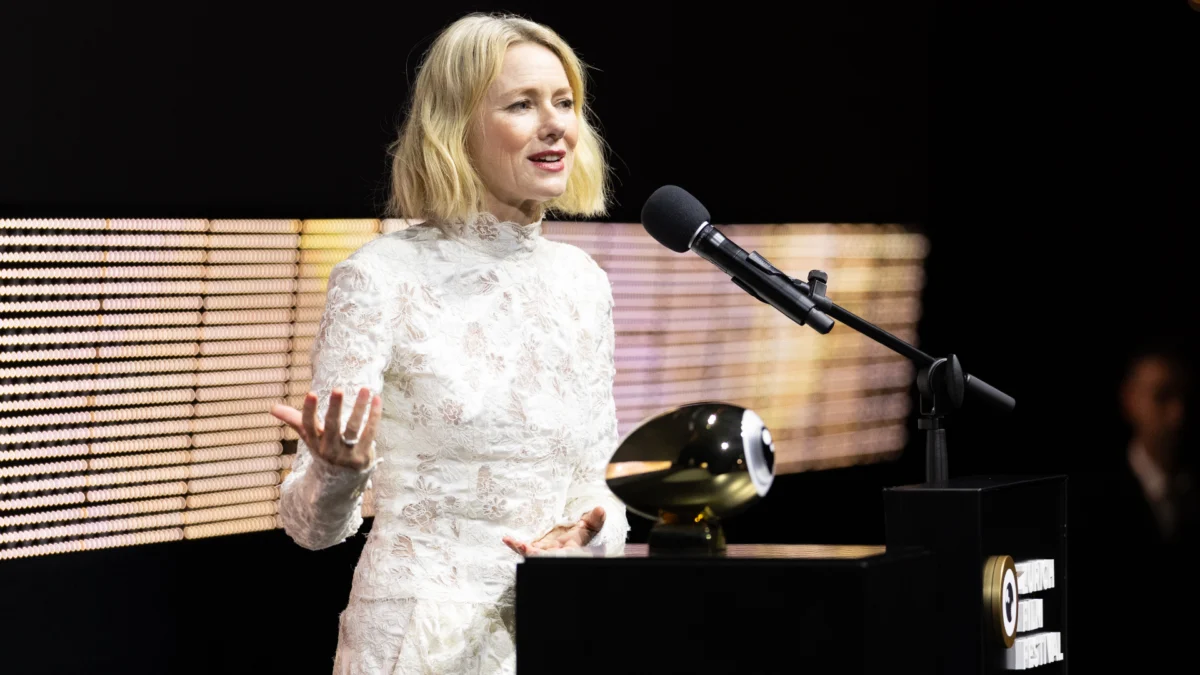
The Zurich Film Festival served as a grand stage for reflection and industry discourse this past Sunday as Academy Award-nominated actress Naomi Watts delivered an expansive masterclass. Speaking to an audience of cinephiles and industry professionals, the British star traversed the complexities of her three-decade career, touching upon the psychological toll of early Hollywood rejection, the transformative impact of working with director David Lynch, and her current mission to destigmatize the menopause through her business ventures. This appearance followed her receipt of the festival’s prestigious Golden Eye award, an honor bestowed in recognition of her latest cinematic contribution, The Housewife.
A Decade of Struggle: The Pre-Mulholland Drive Era
Before achieving international recognition with the 2001 surrealist masterpiece Mulholland Drive, Watts navigated a grueling ten-year period of auditions and professional stagnation. For many in the industry, Watts is synonymous with the craft of nuanced character work, but her path to such acclaim was fraught with the volatility of the casting process.
Watts candidly addressed the psychological erosion that occurs when an actor is subjected to the arbitrary whims of casting directors. During her conversation with host Max Loong, she described the experience of auditioning in Los Angeles during the 1990s as a "grind" that left her feeling alienated from her own identity. She recalled being told by an agent that her intensity was "freaking people out," a critique that forced her into a cycle of performance where she attempted to calibrate herself to fit perceived industry demands—alternating between being overly "funny" or artificially "sexy" to secure employment.
This lack of authentic self-expression created a sense of worthlessness. Watts noted that she was often caught in a dichotomy of either presenting an extreme version of herself or a diluted one. It was only through her collaboration with David Lynch that she was able to strip away these layers of defensive artifice. Lynch, she noted, possessed the singular ability to look past the "weirdness" she had cultivated as a survival mechanism, allowing her to access the vulnerability necessary for the breakout performance that would redefine her trajectory.
The Mulholland Drive Catalyst
Released in 2001, Mulholland Drive remains a touchstone of 21st-century cinema, frequently cited by critics and academics as one of the greatest films ever produced. The film’s success was not immediate in purely financial terms; it grossed approximately $20 million against a $15 million production budget. However, its cultural impact was seismic, elevating Watts from an aspiring actor to a globally recognized talent.
The emotional weight of that period remains vivid for the actress. During the masterclass, Watts shared a poignant anecdote regarding the film’s premiere at the Cannes Film Festival. While sitting in a car with co-star Justin Theroux, the radio played "Morning Has Broken" by Cat Stevens—a song that had been performed at the funeral of her father, Peter Watts, who died when she was seven years old. The juxtaposition of professional triumph and personal grief underscored the fragility of her ascent. Watts’ admission of the moment—and the subsequent support provided by Theroux—served as a reminder of the human element often obscured by the glitz of red-carpet culture.
Menopause Advocacy and the Evolution of Stripes Beauty
In the latter half of her career, Watts has transitioned into the role of an activist, specifically regarding the discourse surrounding menopause. Having experienced early menopause, Watts noted that she found herself in a vacuum of information and support. Her response was the founding of Stripes Beauty, a wellness company focused on providing education, community, and product solutions for women transitioning through this stage of life.
Watts emphasized the importance of male participation in this dialogue, highlighting the support of her husband, actor Billy Crudup. She shared a candid story about being self-conscious while managing symptoms—specifically regarding the use of estrogen patches—and how Crudup’s reaction served to dismantle the shame she felt. By treating the transition as a matter of science and personal health rather than a source of embarrassment, Crudup’s openness allowed Watts to feel secure. This interaction serves as a cornerstone of her advocacy: the belief that men should be integrated into the conversation to foster a more supportive environment for their partners.
Professional Trajectory and Current Projects
Watts’ presence in Zurich is linked to her latest project, The Housewife, directed by Ben Shirinian. Set in 1964 New York, the film features a narrative centered on the discovery of a suspected Nazi officer living under the guise of an ordinary citizen in Queens. Co-starring Tye Sheridan, Michael Imperioli, and Luke Evans, the film reflects Watts’ continued interest in complex, historically grounded, and tension-filled storytelling.
The Zurich Film Festival, now in its 22nd year, continues to serve as a vital platform for both established auteurs and emerging talent. By honoring Watts with the Golden Eye—an award shared this year with industry peers such as John Turturro and Tom Hiddleston—the festival highlights the ongoing significance of actors who maintain long-term relevance by evolving their professional interests. The festival, which runs through October 4, has consistently focused on bridging the gap between artistic integrity and commercial reach.
Implications for Industry Standards
The discourse initiated by Watts during her masterclass reflects broader shifts in the entertainment industry. The focus on actor wellbeing, the destigmatization of aging, and the re-evaluation of how performers are treated during the audition process are becoming central themes in Hollywood’s current cultural evolution.
Watts’ transition from an actor who felt she had to "reshape" herself to survive, to an entrepreneur and advocate who dictates her own narrative, provides a blueprint for contemporary performers. Her success suggests that the industry is moving—albeit slowly—toward a model that values longevity and authenticity over the fleeting, performative requirements of the past. As menopause becomes a less "taboo" topic in both public and private spheres, Watts’ efforts with Stripes Beauty and her public candor act as a catalyst for systemic change, proving that an actor’s influence can extend well beyond the screen.
In retrospect, the trajectory of Naomi Watts from the uncertainty of 1990s Los Angeles to her current position as a respected veteran and advocate illustrates the transformative power of resilience. By grounding her public persona in the realities of both her professional history and her personal evolution, Watts ensures that her legacy is defined not just by her roles, but by her commitment to transparency in an industry that has historically demanded the opposite.