The landscape of contemporary streaming television has experienced a notable resurgence in traditional whodunit narratives, propelled largely by the commercial success of cinematic features such as Rian Johnson’s Knives Out franchise and its sequel, Glass Onion. Capitalizing on this global appetite for isolated-island mysteries, bourgeois suspects, and eccentric detectives, Spanish creators have introduced a four-part prestige miniseries titled The Final Problem to the Netflix catalog. Directed and adapted from bestselling source material by writers Alberto Macías, Carlos Molinero, and Marisol Farré, the series attempts to merge classical Conan Doyle tropes with modern Iberian thriller sensibilities. However, despite a distinguished cast featuring veteran actors José Coronado, Maribel Verdú, and María Valverde, the production ultimately falters under the weight of a glacial narrative pace and an overly straightforward execution that fails to fully leverage its unique meta-fictional premise.
Main Facts and Production Overview
At its core, The Final Problem functions as a closed-circle murder mystery set against the rugged backdrop of Santa Agueda, a remote island situated off the coast of Mallorca. The narrative centers on Benjamin Basil, portrayed by José Coronado (noted for his work in Innocent and The Snow Girl), an aging, struggling Spanish actor whose career highlights include a past life portraying Sherlock Holmes in a series of cinematic adaptations. Plagued by fading Hollywood prospects and ongoing struggles with sobriety, Basil is lured onto a boat by his producer friend Fonseca, played by Gonzalo De Castro, under the guise of discussing a prospective acting role.
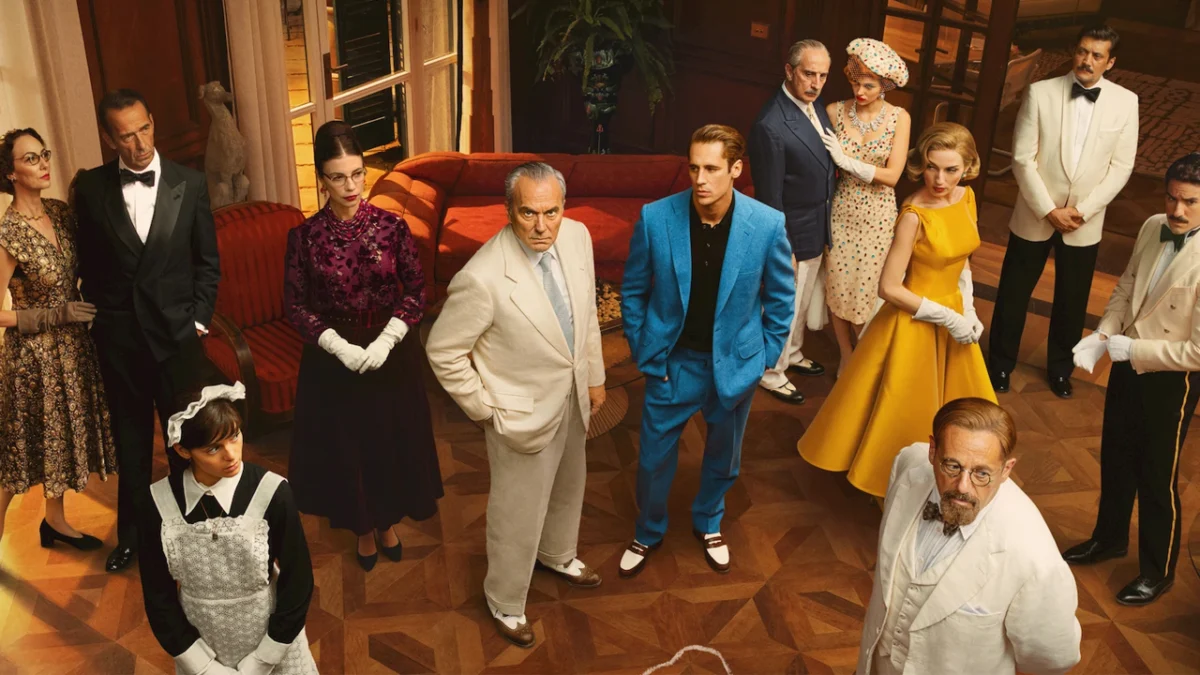
Instead of a routine professional meeting, Basil finds himself deposited at a secluded, austere establishment on Santa Agueda managed by the strictly mannered Mrs. Ausländer, brought to life by Maribel Verdú. The island’s insular ecosystem is populated by a quintessential assembly of genre archetypes: the abrasive producer Fonseca, his ambitious young starlet girlfriend Vicky (Cristina Kovani), aspiring crime novelist Francisco Foxá (Martiño Rivas), and the coldly elegant wealthy widow Adela Figueroa (María Valverde), who serves as the close friend of a subsequently murdered victim, Elisa Mander.
When a violent storm sweeps across the island, an initial apparent suicide—discovered as a body hanging from a rope—is quickly unmasked as a deliberate homicide through Basil’s acute observations. Because local police deployment to the isolated location is severely delayed by weather conditions, the hotel’s occupants must rely on the amateur sleuth to navigate the escalating paranoia.
Chronology of the Narrative and Structural Progression

The four-episode chronology of The Final Problem unfolds across a compressed timeline dictated by the isolation of the island and the inclement weather system. The progression of events follows a standardized procedural formula typical of classic closed-room mysteries:
- Arrival and Setup: Benjamin Basil arrives on Santa Agueda island via Fonseca’s boat, where he is introduced to the remote hotel, the resident manager, and the collection of guests harboring various hidden agendas.
- The Inciting Incident: Following a severe nocturnal storm, a body is discovered hanging within the establishment. Initial assumptions point toward suicide.
- The Deduction Phase: Utilizing the observational habits developed from portraying Sherlock Holmes over a dozen films, Basil meticulously examines the crime scene, debunking the suicide theory and proving the death was a homicide.
- Escalation and Investigation: As the arrival of law enforcement remains stalled, additional suspicious occurrences transpire. Basil attempts to interrogate the suspects, while novelist Francisco Foxá begins to harbor doubts regarding the actor’s authority and methods.
- The Climax and Resolution: The miniseries culminates in a finale that reveals the identity of the mastermind behind the crimes, though the concluding sequence leaves several character arcs unresolved and audience expectations partially unfulfilled.
Character Dynamics and Performance Analysis
A critical pillar of any successful whodunit is the dynamic interplay between the central investigator and the supporting ensemble of suspects. In The Final Problem, the performances present a mixed evaluation of the material. José Coronado delivers a grounded portrayal of Benjamin Basil, avoiding excessive camp despite the inherent theatricality of a washed-up actor adopting the persona of Sherlock Holmes. However, the conceptual twist of the series—that Basil is merely an actor who has played Holmes rather than a legitimate consulting detective—is largely downplayed by the screenwriters. Rather than utilizing this premise to generate meta-humor, commentary on celebrity ego, or skepticism from fellow characters, the narrative plays the premise entirely straight. Basil is accepted as an authority figure without significant pushback from the hotel’s inhabitants.
Supporting performances exhibit varying degrees of impact. Martiño Rivas’s character, Francisco Foxá, functions narratively as a modern equivalent to Dr. Watson or an inquisitive skeptic, yet the writing fails to provide the character with sufficient duplicity or sympathetic depth to anchor the tension. Conversely, María Valverde delivers a standout performance as Adela Figueroa, capturing the icy composure and intellectual sharpness required of a classic bourgeois suspect. Maribel Verdú maintains a steady, no-nonsense presence as Mrs. Ausländer, anchoring the logistical operations of the fictional hotel amidst the rising chaos.
Supporting Data and Contextual Analysis
The release of The Final Problem reflects broader industry trends regarding regional content production within major streaming ecosystems. Netflix has increasingly invested in localized European miniseries designed to appeal to international audiences through universally recognized genres. The traditional whodunit framework offers a commercially viable template, lowering cultural barriers to entry while providing prestige production values, picturesque coastal cinematography of Mallorca, and high-profile domestic talent.
Despite these production assets, empirical engagement metrics for short-run murder mysteries frequently highlight viewer fatigue when pacing fails to align with compressed formats. At only four episodes, The Final Problem compresses its exposition while simultaneously suffering from a slow narrative tempo. Analysts of television structure note that limited series requiring deep psychological profiling of multiple suspects often struggle to balance character development with plot progression when runtime is restricted. In this instance, the production leaves the audience with minimal insight into the interior lives of the suspects until the final episode, undermining the cumulative suspense essential to the genre.

Industry Implications and Critical Reception
The critical reception of The Final Problem highlights ongoing challenges in adapting classic detective tropes for modern streaming platforms accustomed to self-referential subversions. While works like Rian Johnson’s Glass Onion or Netflix’s own ensemble murder mysteries actively deconstruct the mechanics of the whodunit, The Final Problem adheres strictly to conventions reminiscent of traditional board games like Clue.
By playing the material with complete sincerity without offering innovative narrative twists or sharply satirical commentary, the series risks alienating viewers seeking contemporary genre elevation. Furthermore, the handling of Basil’s sobriety and his psychological recovery remains peripheral, functioning more as a background character detail than an active driver of the plot. Consequently, the overarching tension remains tepid, failing to cultivate the palpable paranoia characteristic of successful isolated-setting thrillers.
Comparative Recommendations and Final Verdict
For audiences with an affinity for closed-circle mysteries and island-set investigations, alternative titles within the streaming landscape offer varied interpretations of the genre:
- Glass Onion: A Knives Out Mystery provides a satirical, fast-paced deconstruction of the billionaire-in-isolation trope, balancing meta-commentary with intricate puzzle-box mechanics.
- The Residence delivers an institutional, behind-closed-doors procedural approach to classical mystery-solving with a distinct American political backdrop.
Verdict
The Final Problem occupies an awkward space between traditional homage and modern prestige drama. While boasting strong production values, picturesque Spanish coastal locations, and capable lead performances from José Coronado and Maribel Verdú, the miniseries ultimately fails to cohere as a compelling whodunit or a resonant variation on Sherlock Holmes lore. For viewers navigating an oversaturated market of murder mysteries, the ultimate solution to The Final Problem is that it can safely be bypassed.