Narrative Overview and Character Dynamics
At the heart of Horsegirls is Margarita, portrayed by Lillian Carrier, whose performance has already garnered significant attention for its authenticity and depth. The narrative begins at a crossroads for the protagonist; her mother, Sandy (Gretchen Mol), is facing a health crisis that threatens the stability of their domestic life. This medical uncertainty acts as a catalyst for Margarita’s forced transition into a more independent existence.
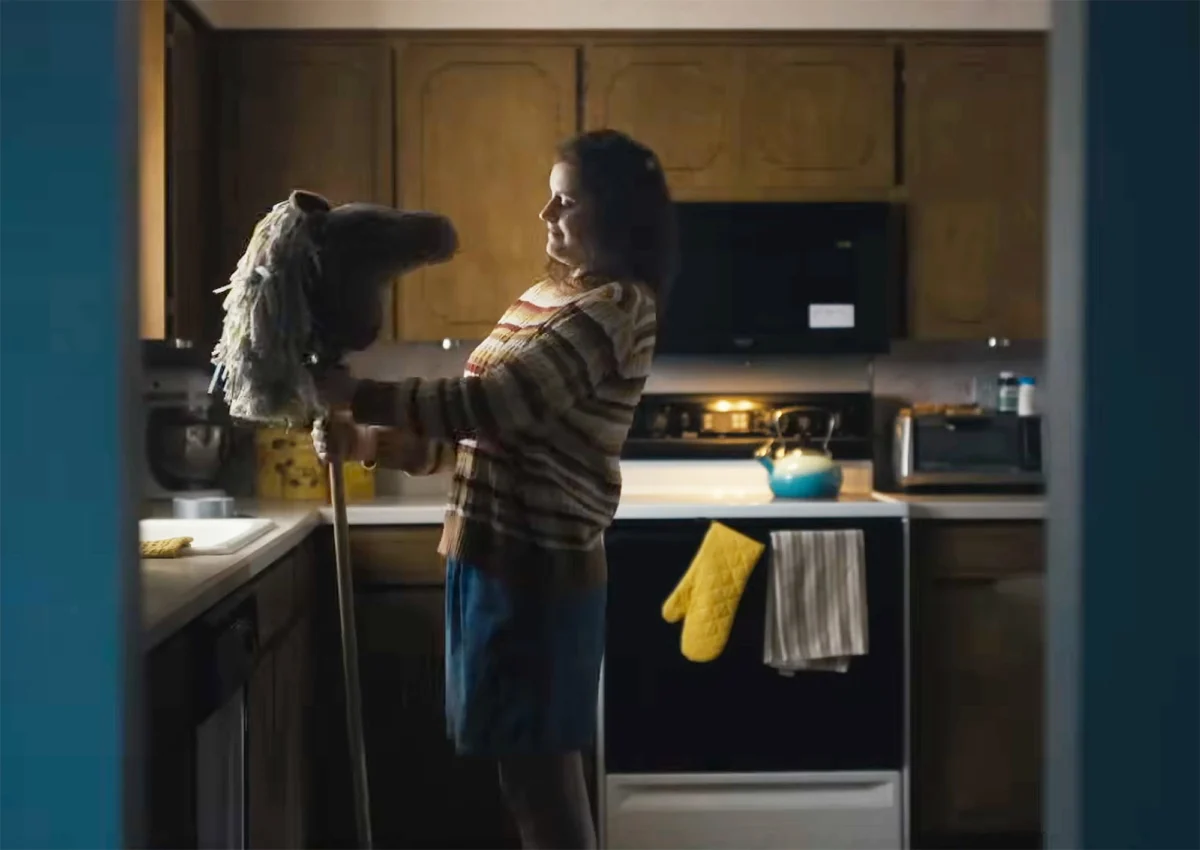
While struggling with the mundane and often overwhelming requirements of her new position at a local Halloween retail store, Margarita encounters a competitive hobbyhorsing dance team. This discovery provides more than just a physical outlet; it offers a structured environment where her neurodivergent traits—such as focus and repetitive motion—are channeled into a disciplined athletic pursuit. The film details her immersion into this world, where she learns the intricacies of dressage and show jumping, all performed without a live animal.
The supporting cast provides a framework for Margarita’s growth. Gretchen Mol delivers a performance as a mother grappling with both her own mortality and the fear of leaving her daughter unprepared for the world. Jerrod Haynes plays the team’s coach, a figure who recognizes Margarita’s potential and pushes her toward competitive excellence. The inclusion of seasoned actors like Tony Hale and Iqbal Theba suggests a film that balances its dramatic weight with moments of levity and character-driven humor.
The Cultural Phenomenon of Hobbyhorsing
A central element of the film’s identity is its focus on hobbyhorsing, a sport that originated in Finland and has since grown into an international movement. To provide context for the film’s premise, it is necessary to understand the origins and mechanics of the sport. Hobbyhorsing involves athletes "riding" a handcrafted stick horse while executing movements modeled after traditional equestrianism, including galloping, jumping hurdles, and intricate footwork.

The sport gained global visibility through Selma Vilhunen’s 2017 documentary Hobbyhorse Revolution (Keppihevosten vallankumous), which highlighted how the activity serves as a safe space for young women to build confidence, community, and physical fitness. For many participants, the sport is an act of subverting traditional expectations of "girly" play, transforming it into a rigorous athletic discipline. By centering Horsegirls on this subculture, Lauren Meyering taps into a real-world community that prizes self-expression over conventional social approval.
In the context of the film, hobbyhorsing serves as a metaphor for Margarita’s life. Just as the sport requires the imagination to see a wooden stick as a powerful stallion, Margarita must imagine a future for herself that exists outside the limitations others have placed upon her. The trailer emphasizes this through the poignant quote: "The world is very good at making people feel small. You’re not afraid to be yourself."
Production History and Creative Team
Horsegirls marks the transition of Lauren Meyering from short-form storytelling to feature-length cinema. Meyering, known in the independent circuit for her work on "Max and Mandy" and various short films, developed the project based on a story by Mackenzie Breeden. The production was overseen by Alix Madigan, Michael Sherman, and Mackenzie Breeden, a team with a history of fostering character-centric indie projects.
The film’s journey to the screen began in earnest when it was selected for the 2025 Tribeca Film Festival. During its premiere last summer, the film was praised for its refusal to treat autism as a "condition to be cured," instead presenting it as a fundamental part of the protagonist’s identity. This approach aligns with a broader shift in the film industry toward authentic representation, where neurodivergent characters are portrayed by neurodivergent actors. Lillian Carrier, who is herself on the autism spectrum, brings a lived experience to the role that has been cited as a key factor in the film’s emotional resonance.
Chronology of Development and Release
The timeline for Horsegirls reflects the typical trajectory of a successful independent film:

- Development and Filming (2023–2024): The project moved through pre-production with a focus on casting for authenticity and researching the hobbyhorsing community in the United States and Northern Europe.
- World Premiere (June 2025): The film debuted at the Tribeca Film Festival, where it secured positive reviews and caught the attention of distributors.
- Distribution Acquisition: Sumerian acquired the theatrical and digital rights, recognizing the film’s potential to reach both the indie-drama audience and the specific communities represented in the story.
- Official Trailer Launch (June 2, 2026): The marketing campaign began in earnest with the release of the trailer on YouTube and social media platforms, sparking renewed interest in the film’s unique subject matter.
- Theatrical Release (July 17, 2026): The film is set for a limited theatrical run in major metropolitan areas, with plans for a subsequent digital rollout.
Industry Analysis and Implications for Representation
The release of Horsegirls is significant for several reasons within the current cinematic landscape. First, it continues the trend of "niche sport" cinema—films that use specific, often misunderstood subcultures to explore universal human themes. By legitimizing hobbyhorsing through a dramatic lens, the film challenges audiences to look past the surface-level "quirkiness" of the activity to see the genuine passion and skill of its participants.
Second, the film represents a step forward for neurodivergent representation in Hollywood. For decades, autistic characters were often portrayed by neurotypical actors, frequently relying on tropes and stereotypes. By casting Lillian Carrier and allowing the character’s autism to be a background fact rather than the sole plot point, Meyering joins a growing group of filmmakers—such as those behind As We See It or The Reason I Jump—who prioritize authentic voices.
Market analysts suggest that Sumerian is positioning Horsegirls as a "sleeper hit" for the summer of 2026. While it faces competition from larger studio blockbusters, its specific demographic appeal—ranging from the autism advocacy community to fans of indie coming-of-age stories—provides a dedicated audience base. The success of similar low-budget, high-concept dramas in recent years suggests that there is a significant appetite for "wholesome" yet grounded storytelling that avoids the cynicism often found in modern cinema.
Critical and Community Reception
Initial reactions to the trailer have been largely positive, with viewers praising the film’s visual style and the chemistry between Carrier and Mol. Within the hobbyhorsing community, the film is being viewed with a mixture of excitement and caution; while many are thrilled to see their sport given a spotlight, there is always a concern about how a niche activity will be perceived by the general public. However, the trailer’s respectful and athletic portrayal of the sport has gone a long way in assuaging those fears.
Advocacy groups for neurodiversity have also noted the film’s importance. The depiction of Margarita’s employment struggles and her relationship with her mother reflects real-world challenges faced by many young adults on the spectrum. By showing Margarita finding success and independence through an unconventional path, the film provides a narrative of empowerment that is often missing from more traditional medical-model depictions of autism.

Conclusion and Future Outlook
As Horsegirls prepares for its July 17, 2026, release, it stands as a unique entry in the year’s film schedule. It is a movie that seeks to bridge the gap between different worlds: the world of competitive athletics and creative play, the world of neurotypical expectations and neurodivergent reality, and the world of a mother’s protection and a daughter’s need for autonomy.
With a strong creative pedigree, a breakout lead performance, and a subject matter that is as visually engaging as it is emotionally complex, Horsegirls is poised to be more than just a "trailer of the week." It is a film that asks its audience to reconsider what it means to be "normal" and to find the beauty in the things that make us feel large in a world that often tries to make us feel small. Whether it sparks a broader interest in the sport of hobbyhorsing or simply serves as a landmark for authentic representation, its impact is likely to be felt well beyond its theatrical run.