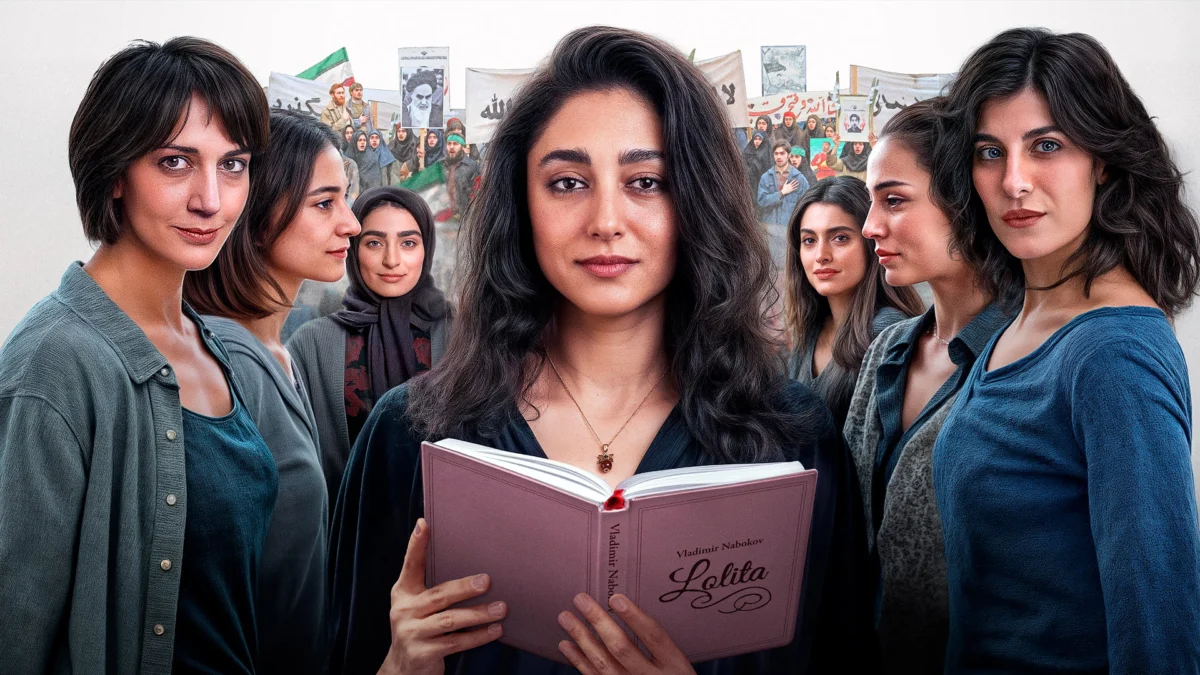
The film’s narrative is set against the backdrop of post-revolutionary Iran, specifically during the decade following the 1979 Islamic Revolution. It follows the experiences of Azar Nafisi, portrayed by Golshifteh Farahani, a professor of English literature who, after being forced out of her university position for refusing to wear the mandatory veil, organizes a secret reading group. For two years, she meets weekly with seven of her most committed female students to discuss Western literary classics that had been banned or heavily censored by the new regime. The curriculum includes works by Vladimir Nabokov, F. Scott Fitzgerald, Henry James, and Jane Austen—authors whose themes of individuality, romantic agency, and moral ambiguity stood in direct opposition to the rigid ideologies of the fundamentalist state.
Cinematic Narrative and Thematic Framework
The trailer highlights the central tension of the film: the contrast between the suffocating atmosphere of the public sphere in Tehran and the liberated, intellectual sanctuary of Nafisi’s living room. As the "Islamic morality squads" conduct raids and fundamentalist factions seize control of educational institutions, the students—unaccustomed to expressing their private thoughts—gradually find their voices through the medium of fiction.
The screenplay, written by Marjorie David with a screen story contribution by Riklis, emphasizes the parallels between the fictional heroines of the novels and the real-world struggles of the Iranian women. The act of reading becomes a form of "cultural tool against oppression," allowing the characters to dream, love, and question the societal structures imposed upon them. The film portrays the complexity of lives under political, moral, and personal siege, illustrating how the internal world of the mind remains a territory that the state cannot fully occupy.

The Literary Foundation: Azar Nafisi’s Memoir
The film is an adaptation of Azar Nafisi’s 2003 memoir, Reading Lolita in Tehran: A Memoir in Books. Upon its initial publication, the book became an international sensation, remaining on the New York Times bestseller list for over 100 weeks and being translated into 32 languages. Nafisi’s work was praised for its nuanced depiction of the Iranian Revolution, moving beyond political headlines to provide a deeply personal account of how the transition to a theocracy affected the daily lives and intellectual aspirations of women.
Nafisi, who eventually emigrated to the United States in 1997, wrote the memoir as a tribute to the students she left behind. The book’s title refers to Vladimir Nabokov’s Lolita, a choice that Nafisi defended by explaining that the protagonist’s experience of being a prisoner of another person’s "ghastly" imagination mirrored the experience of Iranian citizens living under a regime that sought to redefine their identities and histories.
Production Profile and Creative Team
Director Eran Riklis, an Israeli filmmaker known for his ability to navigate complex Middle Eastern sociopolitical landscapes, brings a veteran perspective to the project. Riklis’s previous filmography includes critically acclaimed titles such as The Syrian Bride (2004) and Lemon Tree (2008), both of which dealt with themes of borders, identity, and female agency in conflict zones. His involvement in Reading Lolita in Tehran represents a cross-cultural collaboration, produced by a consortium including Marica Stocchi, Gianluca Curti, Moshe Edery, Santo Versace, and Michael Sharfshtein.
The casting of Golshifteh Farahani in the lead role of Azar Nafisi is particularly significant. Farahani, one of Iran’s most famous international stars, has lived in exile in France since 2008 after facing repercussions from the Iranian government for her participation in Hollywood films. Her personal history of artistic defiance adds a layer of authenticity to her portrayal of Nafisi. Joining her is Zar Amir Ebrahimi, who gained international prominence after winning the Best Actress award at the Cannes Film Festival for Holy Spider. The ensemble cast is rounded out by Mina Kavani, Reza Diako, Arash Marandi, Catayoune Ahmadi, and Sina Parvaneh, many of whom have their own histories with the Iranian diaspora and the struggle for creative freedom.

Festival History and Critical Reception
Before its scheduled 2026 US release, Reading Lolita in Tehran made its world premiere at the 2024 Rome Film Fest. The film was a standout entry at the festival, securing both the Audience Award and the Special Jury Prize. These accolades underscored the film’s broad appeal and its ability to resonate with viewers across different cultural backgrounds.
Early reviews from the festival circuit have been largely positive, with critics highlighting the film’s sensitive handling of its source material and the powerhouse performances of its lead actresses. Analysts have noted that while the film is set in the 1980s, its themes are strikingly relevant to contemporary global discourse regarding censorship, women’s rights, and the role of the humanities in a democratic society. The film has been described by festival programmers as an "inspiring story" that provides a necessary perspective on the resilience of the human spirit.
Historical Chronology of the Setting
To understand the stakes of the film, one must look at the historical timeline of the era it depicts:
- 1979: The Iranian Revolution results in the overthrow of the Pahlavi dynasty and the establishment of an Islamic Republic under Grand Ayatollah Ruhollah Khomeini.
- 1980–1983: The Iranian Cultural Revolution leads to the closure of universities for three years to "purify" them of Western and non-Islamic influences. Many professors are dismissed, and curricula are overhauled.
- 1980–1988: The Iran-Iraq War creates a state of perpetual emergency, which the government uses to further consolidate power and suppress domestic dissent.
- The 1990s: A period of relative "thaw" begins under reformist movements, though many of the fundamental restrictions on speech and dress remain in place.
- 1997: Azar Nafisi leaves Iran for the United States, where she begins writing her memoir.
The film captures the height of this volatility, focusing on the period when the promise of the revolution had curdled into a restrictive reality for the secular and intellectual classes of Tehran.

Broader Implications and Sociopolitical Context
The US release of Reading Lolita in Tehran in 2026 comes at a time of renewed international focus on Iran. Following the "Woman, Life, Freedom" protests that began in late 2022, the struggle for women’s autonomy in the region has remained a primary concern for human rights organizations and the global community. The film acts as a historical mirror, showing that the current movements for reform are rooted in decades of quiet, domestic resistance.
Furthermore, the film’s emphasis on the "forbidden" nature of Western literature addresses ongoing global debates about censorship and the "canon." By showing how books like Pride and Prejudice can be viewed as revolutionary acts of defiance, the film reinforces the idea that literature is never merely aesthetic; it is inherently political because it fosters empathy and independent thought.
Greenwich Entertainment’s decision to release the film in mid-summer suggests a strategy aimed at capturing the attention of "prestige" film audiences and academic communities. Following its theatrical run, the film will be available on Kanopy, a streaming service often utilized by libraries and universities, ensuring that the film’s educational and cultural message reaches a wide audience of students and educators—fitting for a story centered on the transformative power of the classroom.
As the trailer concludes with the evocative quote, "Great books are supposed to make you feel uneasy, and make you question what you take for granted," it sets the stage for a cinematic experience that is both a tribute to the history of Iranian women and a universal call for intellectual liberty. Reading Lolita in Tehran is positioned not just as a historical drama, but as a contemporary testament to the idea that culture remains one of the most potent tools against oppression.