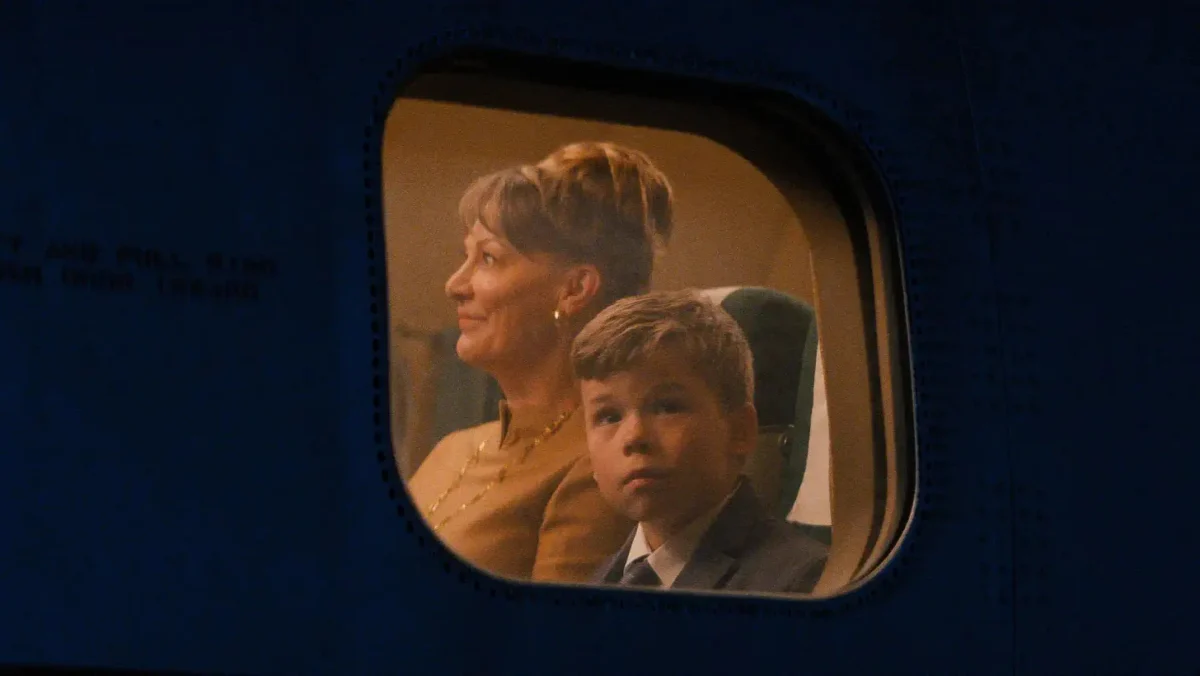
John Travolta, a cinematic icon renowned for his indelible performances across five decades, has made a triumphant foray into feature film directing with Propeller One-Way Night Coach (2026), a deeply personal and critically acclaimed picture that premiered at the Cannes Film Festival and subsequently achieved global streaming success. The film, a tender, semi-autobiographical portrayal of a young boy’s inaugural airplane flight in 1962, captivated audiences and critics alike, earning Travolta an honorary Palme d’Or and swiftly becoming the most-streamed film on Apple TV in its debut week.
A Resounding Premiere at the Cannes Film Festival
The anticipation surrounding Propeller One-Way Night Coach was palpable as it debuted on the frantic first Friday night of the Cannes Film Festival. Prior to the screening, a poignant highlights reel showcased Travolta’s illustrious career, featuring iconic moments from films like Saturday Night Fever (1977) and Pulp Fiction (1994), reminding attendees of the actor’s profound impact on cinema. The evening reached an emotional zenith when Thierry Frémaux, the esteemed General Delegate of the Cannes Film Festival, bestowed upon Travolta an honorary Palme d’Or, acknowledging his extraordinary contributions to the art form. Travolta’s heartfelt gratitude resonated with the packed theater, setting a reverent tone for what was to follow. The central question lingering in the minds of many was how the legendary actor would translate his artistic sensibilities into his directorial vision, particularly with a narrative so rooted in personal memory.
The answer, as the film unfolded, was a revelation. Critics lauded Propeller One-Way Night Coach as an "absolutely charming portrait of experience," praised for its meticulous attention to detail and a profound sense of memory that seemed to leap from the screen in vibrant color, as if directly from Travolta’s own childhood recollections. The 60-minute feature stood out amidst the festival’s often intense and dramatic offerings, described by some as a "welcome, frankly uncynical oasis" that transported viewers to a bygone era through the innocent yet keenly observant eyes of a child. This reception underscored the film’s unique artistic merit and its ability to connect with audiences on a deeply emotional level, a testament to Travolta’s directorial prowess.
From Novella to Silver Screen: A Personal Journey
The genesis of Propeller One-Way Night Coach lies in Travolta’s 1997 novella of the same name. Originally penned in 1993 for his family, with only 70 copies circulated, the book’s intimate charm and vivid storytelling garnered such enthusiastic feedback that Travolta was encouraged to pursue wider publication. Warner Brothers ultimately published the novella in 1997, recognizing its inherent appeal without requiring significant alterations. Despite consistent interest from producers over the years to adapt it into a film, Travolta deliberately withheld the rights. He felt the story was too personal, too intimate, to risk having its essence misinterpreted or compromised by external influences.
The decision to finally bring his vision to the screen came about a year and a half prior to the film’s premiere, as Travolta approached his 70th birthday. Reflecting on his life and career, he recognized that if he didn’t direct it himself now, the opportunity might never arise. This realization spurred him to self-finance and produce the film, ensuring that his artistic vision remained unadulterated. He approached the project as a painter approaches a canvas, meticulously crafting every detail to match the vivid imagery in his mind, unburdened by commercial pressures. The outcome was a pure, unfiltered expression of his memories and artistic intentions.
Crafting 1962: A Masterclass in Sensory Detail
Travolta’s film is a vivid tapestry woven from the threads of 1960s Americana, a period he remembers with astonishing clarity and affection. He meticulously recreated the sensory landscape of 1962, focusing on elements that resonated deeply with his childhood self. This included the unique aesthetics of mid-century design, which he saw reflected everywhere from architecture to fashion and industrial design. "The big architects and the artists of the world had vision," Travolta explained, citing figures like Marrot, Calder, and Picasso, whose "fresh new vision of life" permeated the era and shaped how everything was absorbed.
His commitment to authenticity extended to every facet of the airplane experience. He recalled collecting airline tickets and schedules as a boy, absorbing every advertisement. This meticulousness translated into the film’s visual fabric:
- Interior Colors: The distinct, often vibrant, color palettes of airplane cabins in the early 60s, a stark contrast to contemporary designs.
- In-flight Dining: The exotic (for the time) and colorful meals, such as Chateaubriand and chicken cordon bleu, served on "divine" plateware and glassware, reflecting a more luxurious era of air travel.
- Flight Attendant Uniforms: The elegant attire of "stewardesses," designed by renowned figures like Don Loper, and earlier, even Dior, underscoring the glamour associated with air travel.
- Cabin Atmosphere: The pervasive presence of cigarette smoke, mingled with the scent of food, a detail that sharply defines the period.
- Passenger Density: The observation that planes rarely felt "sold out," often being only "a fourth full," suggesting air travel was a more exclusive, less common experience.
The film’s soundtrack is equally deliberate, a symphonic journey through Travolta’s personal auditory memories of the era. He infused the narrative with a rich array of music, from the burgeoning popularity of Brazilian samba artists like Jobim and Sérgio Mendes to the timeless tunes of Frank Sinatra, Tony Bennett, and Barbra Streisand. Each musical choice is carefully choreographed to evoke specific moments and emotions, such as Henry Mancini’s "Moon River" from Breakfast at Tiffany’s (1961) accompanying a walk down the red corridor of the TWA terminal, or Dave Brubeck’s iconic "Take Five" complementing the modernist airport architecture. The use of "A Girl from Ipanema" in slow-motion for Ella Bleu’s character and Barbra Streisand’s "Lazy Afternoon" perfectly timed with his mother’s dialogue further exemplify this kismet between sound and visual. This deep immersion in the sensory details of the past creates a truly transporting experience for the audience.
The Child’s Eye: Narrative and Performance
A pivotal element of Propeller One-Way Night Coach is its voiceover narration, which provides a unique internal monologue and commentary from the perspective of the young protagonist, Jeff. This narrative device allows adult Travolta to articulate the "fleeting thoughts of a child" with a distinct, childlike cadence, recalling vivid memories such as a first encounter with chicken cordon bleu on a late-night flight. The sincerity and richness of a child’s experience, as Travolta puts it, are central to the film’s emotional core. "That really was what I was like as a child," he confessed, "precocious, and absorbing every minute of my life."
Clark Shotwell, cast as Jeff, delivers a performance that resonated deeply with the director and his family. Travolta’s daughter, Ella Bleu, who also appears in the film as a captivating flight attendant, noted Shotwell’s uncanny ability to evoke her father, remarking, "He’s a little him." Kelly Eviston-Quinnett portrays Jeff’s mother, Helen, with a "keen interest in the world" that clearly proves contagious for her son. This joie de vivre mirrors Travolta’s own generous and observant nature, a quality that also permeated his interview responses and his introduction of the film at Cannes, where he described himself as a "voyeur, an observer of life."
The boy Jeff’s non-judgmental awareness is a defining characteristic. He observes his mother’s flirtatiousness and habits without condemnation, prioritizing the overarching experience. His innocent yet profound observations extend to the broader world, including understanding the pain of a neighbor who survived a concentration camp or the fear of a passenger rattled by news of an airplane crash. These real-life historical details, like the 1960 Idlewild crash, are woven into the narrative through the child’s processing, highlighting his resilience and ability to recover from distressing information. This intricate portrayal of a child’s stream of consciousness, navigating both personal and global events, provides a deeply empathetic and authentic perspective.
Influences and Artistic Homages
Travolta views Propeller One-Way Night Coach as "more than an homage to aviation; this is an homage to movies and actors and cinema and soundtracks and music." Thierry Frémaux echoed this sentiment, calling it "an homage to many things." The film’s eclectic stylistic approach is a deliberate reflection of the diverse artistic influences that shaped Travolta’s youth and career. He cites a wide range of cinematic inspirations, from the European artistry of Bertolucci (Last Tango in Paris, 1972) and Fellini (the "ten-foot tall man" sequence, which was a real event for Travolta, but executed as a "Fellini move") to classic Hollywood features like The V.I.P.s (1963) with Liz Taylor, and Breakfast at Tiffany’s (1961) with Audrey Hepburn. Films like A Man and a Woman (1966) and Two for the Road (1967) also left strong impressions, influencing specific scenes and moods within his film. Even foreign language cinema, such as the stunning Brazilian film Black Orpheus (1959), contributed to his artistic palette.
Travolta emphasizes that these diverse influences, though spanning different years, shared a "similar era" aesthetic, allowing them to coexist harmoniously within his film. He compares it to designing a house with elements from Saarinen, Lapidus, and Frank Lloyd Wright – disparate yet cohesive. This "mixing and matching" reflects his own life experience of "viewing these different visuals" that converged to define the mid-century spirit. The film became a "cathartic" outlet for stylistic expression, yet remained "organic" and "steady" in its execution. The slow-motion sequence of Ella Bleu as the flight attendant, accompanied by "A Girl from Ipanema," or the pairing of Barbra Streisand’s "Lazy Afternoon" with his mother’s wistful recollections, are prime examples of these "kismetic" artistic convergences.
Beyond the artistic and cinematic, the film also subtly reflects the "spirit of the day" in the early 1960s. Despite global tensions like the Bay of Pigs, the Cuban Missile Crisis, and the threat of atomic bombs, there was a prevalent "resilience of character" and a "post-World War II hopefulness." The economy was generally good, and dreams felt possible, as symbolized by the futuristic optimism of the 1964 World’s Fair and the "Jetsons"-like vision of airport terminals. Travolta subtly integrates the era’s challenges, such as the neighbor’s concentration camp story, but frames them through the child’s inherent capacity for empathy and recovery, demonstrating a collective societal optimism that allowed individuals to "move on" with a sense of possibility.
Directorial Lessons from a Veteran Actor
Having spent decades working with some of cinema’s most acclaimed directors, including Quentin Tarantino, Brian De Palma, and Mike Nichols, Travolta arrived at his directorial debut armed with invaluable insights. He meticulously "sifted down the things that were valuable and mattered" from his vast experience on sets ranging from "great movies, mediocre movies, not-so-good movies, and just okay movies."
Key lessons he applied to Propeller One-Way Night Coach include:
- Efficiency in Storytelling (from Tarantino): Travolta learned from Tarantino’s approach in Pulp Fiction that it’s possible to tell a story efficiently without needing to visually depict every single detail described in a script. Audiences are intelligent enough to infer events, allowing for tighter editing and a more impactful narrative flow.
- Minimizing Takes and Maximizing Rehearsal: Travolta observed that excessive takes often lead to actors "rehearsing on screen." Instead, thorough rehearsal ensures actors know their characters inside out, leading to stronger performances captured in fewer takes. This not only enhances performance quality but also boosts morale on set, creating a sense of "productivity" for both cast and crew.
- The Primacy of Casting (from Nichols and De Palma): Both Mike Nichols and Brian De Palma emphasized that "90% of your issues are: is everyone right for those characters?" Travolta’s mother, an acting teacher, instilled in him the belief that acting talent is "inborn," not taught. He believes that correct casting means actors already "own that character," requiring only subtle guidance from the director to "give color and dimension" to the performance. Miscasting, conversely, leads to burdensome micromanagement.
These principles allowed Travolta to execute his 15-day shoot (five days each in New York, Kansas, and Los Angeles, preceded by six weeks of prep) with remarkable speed and precision, translating his detailed vision into a cohesive and captivating film.
Defying Conventional Narrative: The Power of Observation
One of the most striking aspects of Propeller One-Way Night Coach is its deliberate departure from conventional dramatic structures. Many might expect a "big conflict or drama," such as the boy getting lost in the airport. However, Travolta consciously rejected such pressures. "I felt the opposite," he stated. He trusted that the "cool journey" and the inherent interest in the "very interesting and bizarre" people encountered along the way would be compelling enough.
His film relies on the power of "observation," transporting viewers to another era where "nothing dramatic had to happen other than the observation of these fascinating people." The stated "drama" is more implied than explicit, seen in the "nervous passenger," the "crazy behavior," and the "acceptance of a person’s past." The film aims to "awaken the senses," like a Michelin-star restaurant offering an unprecedented culinary experience. The "drama," in Travolta’s view, lies in the effect the film has on the viewer, rather than overt conflict within the narrative. Even minor incidents, like the boy’s toy plane breaking, take on significant emotional weight within this immersive context.
The film’s runtime of 60 minutes was also a carefully considered choice. Both Thierry Frémaux and Eddie Cue of Apple agreed that the length was "exactly what it had to be," underscoring its perfect pacing and narrative economy. This unconventional approach, prioritizing sensory immersion and observational storytelling over traditional dramatic arcs, proved to be a critical strength, distinguishing the film and contributing to its widespread appeal.
The Journey to Distribution: Apple TV and Global Reach
Following its completion, Travolta sought to share his deeply personal film with a wider audience. The first person he approached was Eddie Cue, Apple’s Senior Vice President of Internet Software and Services. Cue’s reaction was immediate and enthusiastic: "This is spectacular. John, you have to sell me this movie because you want the world to see it, don’t you? I will make sure the world sees this. This is an important movie." This powerful endorsement led to Apple acquiring the distribution rights, a significant coup for the tech giant’s streaming platform.
The journey then led to Cannes, where Thierry Frémaux viewed the film, unaware of Apple’s acquisition. His response mirrored Cue’s effusive praise: "I can’t see anything wrong with this movie. I love it." Frémaux was so captivated that he engaged Travolta in a 45-minute Q&A session, a rare occurrence. In an unprecedented move, he declared Propeller One-Way Night Coach the "first selection of the Cannes Film Festival five months before," promising Travolta a "very special night." When Travolta revealed Apple’s involvement, Frémaux expressed slight disappointment at not being the sole introducer but quickly pivoted, stating, "Let me lead the way, and let Apple lead the way, and together we’ll make this beautiful for you."
This dual support from Cannes and Apple provided Travolta with "two pillars of strength" for the film’s launch. Frémaux further highlighted the film’s significance, particularly its modest budget, declaring, "Now you’re the most important film in the festival, because I want your piece of art to show everybody that film can be made at a low cost and still be impactful." This recognition not only celebrated Travolta’s artistic achievement but also championed the potential of independent, cost-effective filmmaking. The subsequent success on Apple TV, where it became the most-streamed film globally for seven consecutive days, validated the faith placed in Travolta’s unique vision, demonstrating that a deeply human and uncynical film could resonate profoundly in the contemporary media landscape.
Implications and Legacy
John Travolta’s directorial debut, Propeller One-Way Night Coach, marks a significant moment in his illustrious career and offers broader implications for the film industry. For Travolta, it represents a new chapter, showcasing his capabilities not just as a performer but as a nuanced and evocative storyteller behind the camera. The film’s critical acclaim and popular success suggest a potential shift in his artistic trajectory, opening doors for future directorial endeavors that might further explore his unique perspective and personal experiences.
The film also serves as a powerful testament to the enduring appeal of personal, art-house cinema in an era often dominated by large-scale franchises. Its low budget, coupled with its high artistic impact and global streaming dominance, provides a compelling case study for independent filmmakers worldwide. It demonstrates that authentic storytelling, meticulously crafted and deeply felt, can achieve widespread recognition and commercial success without requiring immense financial investment. Thierry Frémaux’s emphasis on its low cost and high impact resonates as a message of hope and possibility for emerging and established artists alike.
Furthermore, Apple TV’s strategic acquisition and enthusiastic promotion of Propeller One-Way Night Coach highlight the platform’s commitment to acquiring diverse, high-quality content that transcends conventional blockbusters. This success reinforces the streaming model’s potential to bring unique cinematic voices and culturally enriching narratives to a global audience that might otherwise be overlooked by traditional distribution channels. In an industry often driven by cynicism, Travolta’s film stands as a vibrant, optimistic reminder of cinema’s power to evoke nostalgia, celebrate human observation, and inspire through deeply personal artistry.