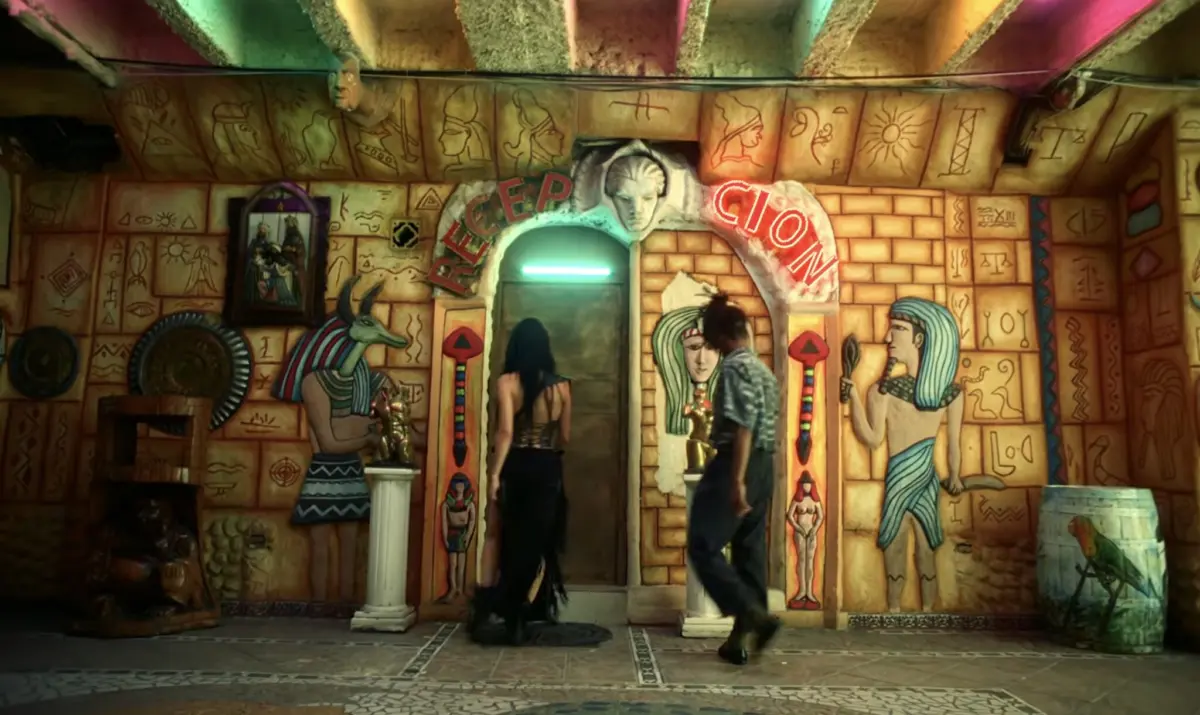
Rains Over Babel, Colombia’s official submission for Best International Feature at the 99th Academy Awards, has emerged as one of the most unexpected and creatively audacious cinematic releases of the decade. Blending the thematic architecture of Dante’s Inferno with a vibrant, distinctly queer Latin American sensibility, the film navigates a labyrinth of intersecting narratives. The plot follows Felipe Aguilar Rodriguez as a deputy grim reaper attempting to settle financial obligations with his superior, portrayed by Saray Rebolledo. Simultaneously, William Hurtado stars as a drag queen—potentially mirroring the figure of Jesus—who is grappling with a strained relationship with his preacher father, played by Jhon Narváez. These storylines converge around a high-stakes mission to rescue a singer, interpreted by Jacobo Vélez, from a subterranean sex club operating within a surreal metropolitan landscape.
Guiding the audience through this chaotic yet deeply heartfelt journey are the fourth-wall-breaking narrators El Boticario, the devil played by Santiago Pineda, and Erato, a guardian angel brought to life by Sofia Buenaventura. Characterized by its creators as campy, visually arresting, and emotionally resonant, the feature has defied conventional industry expectations regarding international distribution and the market viability of non-English, LGBTQ+-centric fantasy cinema.
The Journey from Sundance to Global Theatrical Runs
The trajectory of Rains Over Babel from a high-profile festival premiere to an Academy Awards contender has been marked by both critical acclaim and commercial hurdles. The film first captured international attention during its premiere at the Sundance Film Festival in January 2025. Entering the global cinematic landscape during a turbulent political climate for marginalized communities in the United States, the project was initially met with hesitation from domestic distribution executives.
According to writer and director Gala del Sol, major distribution networks in the United States expressed reluctance to acquire a Spanish-language queer fantasy feature, viewing the combination of linguistic and thematic elements as a double-niche financial risk. Consequently, the film faced rejections from multiple domestic distributors during the first quarter of 2025.

Despite these setbacks, the production bypassed traditional U.S. hurdles by establishing a robust international footprint. Throughout 2025, Rains Over Babel traveled through an extensive festival circuit, screening at more than 80 international film festivals and securing theatrical distribution deals across 23 countries. Digital distribution rights were acquired by HBO Max for European territories and FILMIN in Spain.
The film’s commercial momentum culminated on April 16, when it opened in commercial theaters across Colombia. Defying industry forecasts that predicted a brief, one-to-two-week theatrical window, the indie feature maintained a continuous theatrical run for 14 weeks. The prolonged exhibition period surprised local industry analysts and prompted inquiries from skeptical distribution executives seeking to understand the mechanisms behind the film’s grassroots success.
The Mechanics of a Grassroots Phenomenon
The sustained box-office performance of Rains Over Babel in Colombia and select international markets has been widely attributed to direct audience engagement and organic word-of-mouth promotion. Operating on an independent budget spearheaded by a young creative team, the production relied heavily on social media outreach, with del Sol directly communicating with viewers and digital communities.
This grassroots strategy fostered a dedicated fan base, with repeat viewings becoming a notable trend among theatergoers. Cultural adoption of the film extended beyond standard viewership, resulting in high school fan clubs, character cosplay, and commercial merchandising of the movie’s distinct costume design in Mexico and Colombia.
Following its domestic commercial success, the film received official selection status not only as Colombia’s submission for the 99th Academy Awards in the Best International Feature category but also garnered recognition at the Goya Awards. Industry observers note that these accolades represent a significant milestone for Colombian genre cinema, historically dominated by social realism and narratives centered on political violence.

Aesthetic Framework: Retro-Futuristic Tropical Punk
Visually, Rains Over Babel establishes a distinct stylistic identity that del Sol defines as retro-futuristic tropical punk or tropical steampunk. Set in an alternate-dimension version of Cali, Colombia—a city noted in the director’s commentary for holding a high concentration of both religious institutions and short-stay motels—the film reimagines familiar urban landscapes as a domain where demigods, humans, and talking animals coexist under anachronistic rules.
The production design draws direct inspiration from surrealist art, notably referencing the painting Harmonia by Spanish-Mexican artist Remedios Varo. This surrealist foundation grants the production poetic freedom, manifesting in unconventional characterizations such as Death depicted as a card-playing woman in seedy establishments, a bartender functioning as the devil, and an angel operating as a guardian interlocutor.
Production logistics also defied standard expectations regarding animal handling in cinema. While assistant directors initially scheduled extensive time allotments for animal actors—including a salamander, a snake, a cat, and a dwarfism-affected horse—the animal performers executed their sequences with unexpected efficiency, contributing to the surreal atmosphere of the production.
Building a South American Cinematic Universe
Rains Over Babel is positioned by its creator as the foundational anchor for a broader, interconnected South American cinematic universe. Del Sol’s ongoing writing projects and future directorial ventures are designed to expand within this shared continuity, utilizing recurring locations and overlapping character arcs across different historical periods.

The upcoming slate includes a tropical adaptation of Sheridan Le Fanu’s 1872 gothic vampire novella Carmilla. Scheduled to begin principal photography next year, the project is set within a sugarcane hacienda in the city of Maya, approximately two centuries prior to the events of Rains Over Babel. The narrative explores the fictional towns of Sweet Waters and Salty Waters.
Additionally, a co-production with Carlos López Estrada’s Antigravity Academy is currently in development. This subsequent project will explore an underground sex motel named The Temple, incorporating surrealist labyrinth mechanics, a recurring bellboy, and a talking crow named Eleazar.
Industry Implications and Studio Screenings
The unexpected international traction of Rains Over Babel has facilitated institutional screenings within major American entertainment entities. Following its festival run, the film was invited for private screenings and question-and-answer sessions at Pixar Animation Studios and Lionsgate.
Industry analysts suggest that the film’s reception by mainstream studio personnel highlights a growing appetite for genre-blending international content that addresses heavy thematic subjects—such as religious repression and queer identity—through satirical or fantastical frameworks rather than traditional melodrama. By employing the structural device of the medieval bouffon, the film utilizes comedy and fantasy as vehicles to make complex social critiques digestible to global audiences.
As Rains Over Babel advances through the Academy Awards race, its performance serves as a case study in independent global distribution, proving that commercial viability exists for regional fantasy narratives that successfully bypass traditional gatekeepers through direct digital engagement and cross-border cultural resonance.