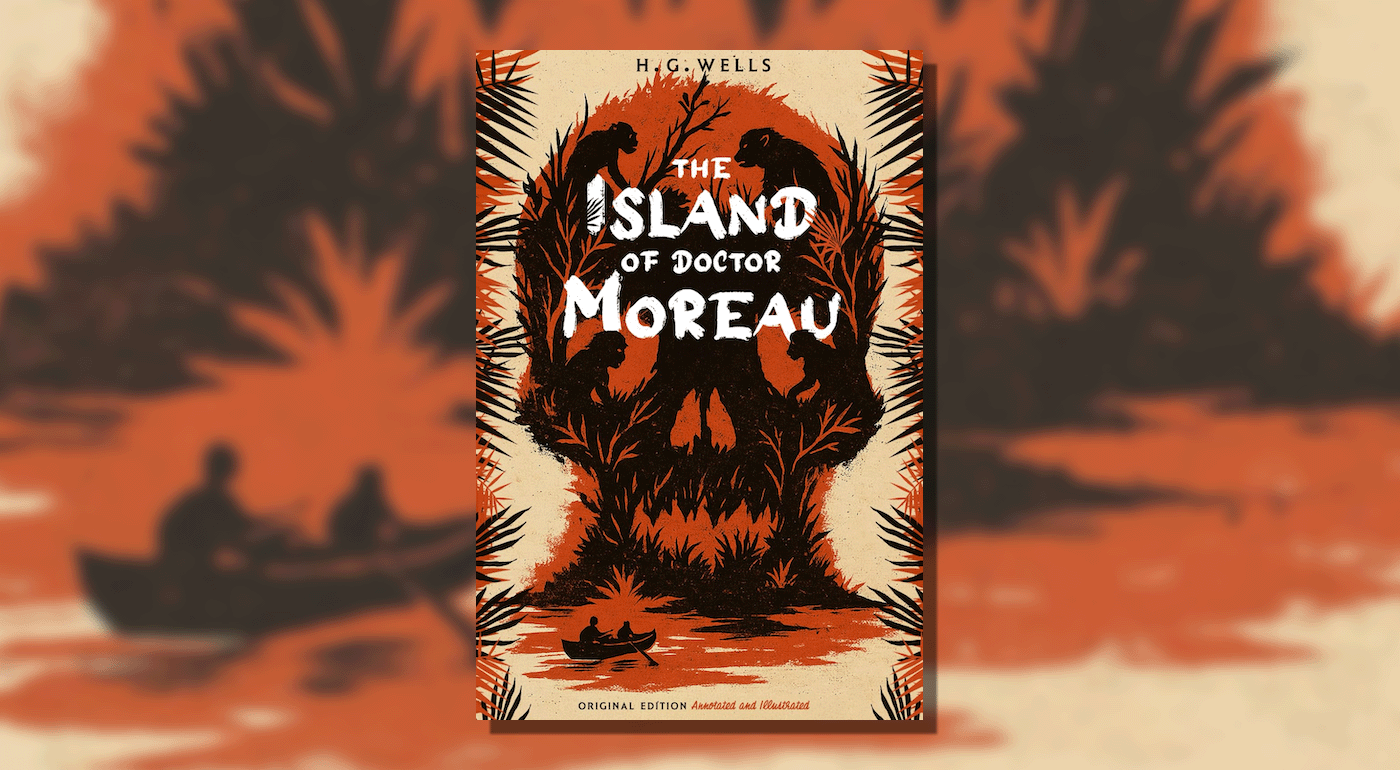
The ongoing literary retrospective series "Reading the Weird" has advanced its deep-dive analysis into H.G. Wells’s seminal 1896 science fiction masterwork, The Island of Doctor Moreau, focusing specifically on Chapters 10 through 12. This latest installment of the critical column continues an examination of the historical roots of cosmic horror and weird fiction, dissecting the psychological unraveling of protagonist Edward Prendick as he uncovers the horrific biological experiments taking place on a secluded tropical atoll.
The Chronology of Terror: Chapters 10-12
The sequence of events detailed in Chapters 10 through 12 marks a rapid escalation in tension, moving from psychological disorientation to absolute terror and a confrontation with institutionalized dogmatism.
In Chapter 10, titled "The Crying of the Man," a near-exhausted Prendick stumbles back to Doctor Moreau’s compound after fleeing a terrifying pursuit in the dark interior of the island. Montgomery, Moreau’s reluctant assistant, administers brandy and sedatives, attempting to dismiss Prendick’s harrowing accounts of the creatures he encountered as the product of fatigue and a superstitious imagination. However, the illusion of safety is shattered the following morning. Awakened by groans and sobs that are unmistakably human rather than bestial, Prendick breaches the interior courtyard. There, he witnesses a blood-stained scene of surgical horror: a human-like form strapped to a framework, undergoing what is visually and olfactory confirmed to be vivisection. A frantic and bloodied Moreau intercepts Prendick, locks him in his quarters, and laments the potential ruin of a lifetime of scientific labor before cutting off all communication.
Chapter 11, "The Hunting of the Man," chronicles Prendick’s desperate escape. Convinced that Moreau intends to subject him to the same grotesque surgical transformations that warp the island’s inhabitants, Prendick forces his way out of the compound. Armed with a crude weapon improvised from a nail-studded chair rail, he flees into the dense tropical forest. Despite being hunted by Montgomery, an island servant, and a staghound, Prendick manages to mask his scent by wading through a stream. Seeking potential allies or at least a temporary sanctuary, he encounters a simian-featured humanoid—one of Moreau’s creations—who retains the power of speech and accepts Prendick based on the shared anatomical trait of having five-fingered hands.
This alliance leads directly into Chapter 12, "The Sayers of the Law." Prendick is led into a cramped, foul-smelling ravine settlement populated by a society of modified beings, collectively known as the Beast People. Here, Prendick is introduced to the "Sayer of the Law," a heavily veiled, man-sized entity that presides over an indoctrinated congregation. The inhabitants are subjected to a rigorous, sing-song liturgical code designed to suppress their animalistic instincts. The commandments—prohibitions against walking on all-fours, consuming fish or flesh, clawing trees, and hunting fellow beings—are interwoven with theological declarations praising Moreau as the creator, healer, and inflictor of the "House of Pain." The ritual is abruptly terminated by the arrival of Moreau, Montgomery, and their hunting party. Prendick fights off his pursuers, scales a natural rock chimney, and reaches the coast, securing a temporary reprieve by the edge of the open sea, though deeply unsettled by the servile psychology of the Beast People.
Historical and Literary Context of Wells’s Masterpiece
Published during the fin-de-siècle period—a time of deep cultural anxiety characterized by rapid industrialization, moral uncertainty, and the cultural shockwaves of Charles Darwin’s theory of evolution—The Island of Doctor Moreau reflects contemporary scientific overreach. H.G. Wells utilized the conventions of adventure fiction to interrogate the fragile boundary between civilization and bestiality, as well as the ethical vacuum of unregulated scientific experimentation.
Vivisection was a subject of intense public debate in late 19th-century Britain, marked by the formation of the Victoria Street Society and the passage of the Cruelty to Animals Act 1876. Wells tapped into this societal unease, projecting the moral questions of animal testing into a gothic, isolated setting where human ethics no longer apply.
Analytical Perspectives on The Law and Societal Control
Literary analysts examining these chapters frequently draw parallels between Moreau’s constructed theology and institutionalized religion. The "Law" recited by the Beast People functions as an absolute mechanism of behavioral modification. By framing biological impulses as moral sins punishable by a return to the surgical horrors of the "House of Pain," Moreau maintains total autocracy over his creations.
Scholarly commentary on the text highlights the psychological paradox embodied by the Beast People. Having been artificially endowed with human faculties, they are rendered vulnerable to shame, guilt, and the internalization of an oppressive dogma. They willingly participate in their own subjugation, chanting litanies that validate their creator’s tyranny. This dynamic serves as a satirical critique of human social structures, suggesting that civilization often relies on manufactured fear, arbitrary prohibitions, and the suppression of natural instincts rather than genuine ethical enlightenment.
Furthermore, the narrative challenges the comforting dichotomy between human and animal. Prendick’s own descent into panic, his physiological reactions to hunger and danger, and his involuntary participation in the rhythmic fervor of the Beast People’s litanies underscore Wells’s underlying thesis: that humanity is inextricably linked to its evolutionary ancestry, and civilization is a thin veneer easily stripped away under duress.
Broader Implications and Legacy
The endurance of The Island of Doctor Moreau in modern discourse lies in its prophetic engagement with bioethics. Long before the advent of genetic engineering, cloning, and modern xenotransplantation, Wells anticipated the moral dilemmas of attempting to redesign life forms.
The themes explored in Chapters 10 through 12—the weaponization of religious dogma, the psychological toll of isolation, and the ethical limits of scientific inquiry—continue to resonate within contemporary science fiction and speculative horror. As subsequent iterations of "Reading the Weird" demonstrate, Wells’s grim fable remains a foundational text for understanding humanity’s perpetual anxiety regarding its own nature and the potential consequences of playing creator.