The fourth season of Star Trek: Strange New Worlds, broadcast during the landmark diamond anniversary year of the overarching Star Trek franchise, has encapsulated the historic duality of Gene Roddenberry’s universe. As Paramount+ continues to navigate the modern streaming era, this particular chapter of the USS Enterprise’s voyages under Captain Christopher Pike has served as a concentrated microcosm of the franchise’s greatest historical achievements alongside its most persistent structural pitfalls.
The television landscape’s broader structural shift toward shorter seasonal episode counts has significantly transformed production methodologies across major science fiction franchises. For Star Trek, a property historically bound by the grueling network television model of twenty-two to twenty-six episodes per year, transitioning to ten-episode or even eight-episode runs has fundamentally altered writer room dynamics. Under the traditional twenty-plus-episode paradigm, writing staffs frequently suffered from severe burnout, resulting in conceptual fatigue and compromised scripts—such as the widely acknowledged missteps in Star Trek: Deep Space Nine’s third-season episode Prodigal Daughter. Furthermore, shorter production windows have measurably enhanced actor availability and contract retention, allowing networks to secure top-tier talent without demanding a six-month blockade of an actor’s annual calendar. Serialization has similarly flourished under this compressed format; complex multi-episode arcs, such as the Xindi narrative spanning the entirety of Star Trek: Enterprise Season Three, would have arguably achieved tighter pacing and heightened narrative impact if condensed to a lean eight-episode run.
However, the reduction in episode volume introduces a distinct creative vulnerability, particularly for episodic storytelling. When a season is restricted to a handful of chapters, the imperative to avoid redundancy and narrative repetition becomes paramount. While the first two seasons of Strange New Worlds successfully balanced standalone exploratory storytelling with serialized character arcs, Season Three labored under the logistical constraints of industry-wide writers’ and actors’ strikes that severely disrupted production timelines. Although Season Three produced competent television, it notably lacked the transcendent breakout episodes that defined the show’s early run, such as the series premiere Strange New Worlds, Memento Mori, Ad Astra per Aspera, and Under the Cloak of War.
Season Four successfully remedied this absence of standout installments through critically acclaimed entries including Off-Hour, Tomorrow’s Enterprise, and the universally praised Orders of Magnitude. Yet, this latest outing simultaneously resurrected a historical structural flaw reminiscent of Star Trek: Voyager during the late-era showrunner tenure of Brannon Braga. Voyager notoriously suffered from an overreliance on high-concept premises that lacked rigorous execution or thematic internal consistency. Industry accounts from freelance writers active during Voyager’s broadcast window frequently noted a directive from production executives prioritizing isolated "ideas" over cohesive "stories."
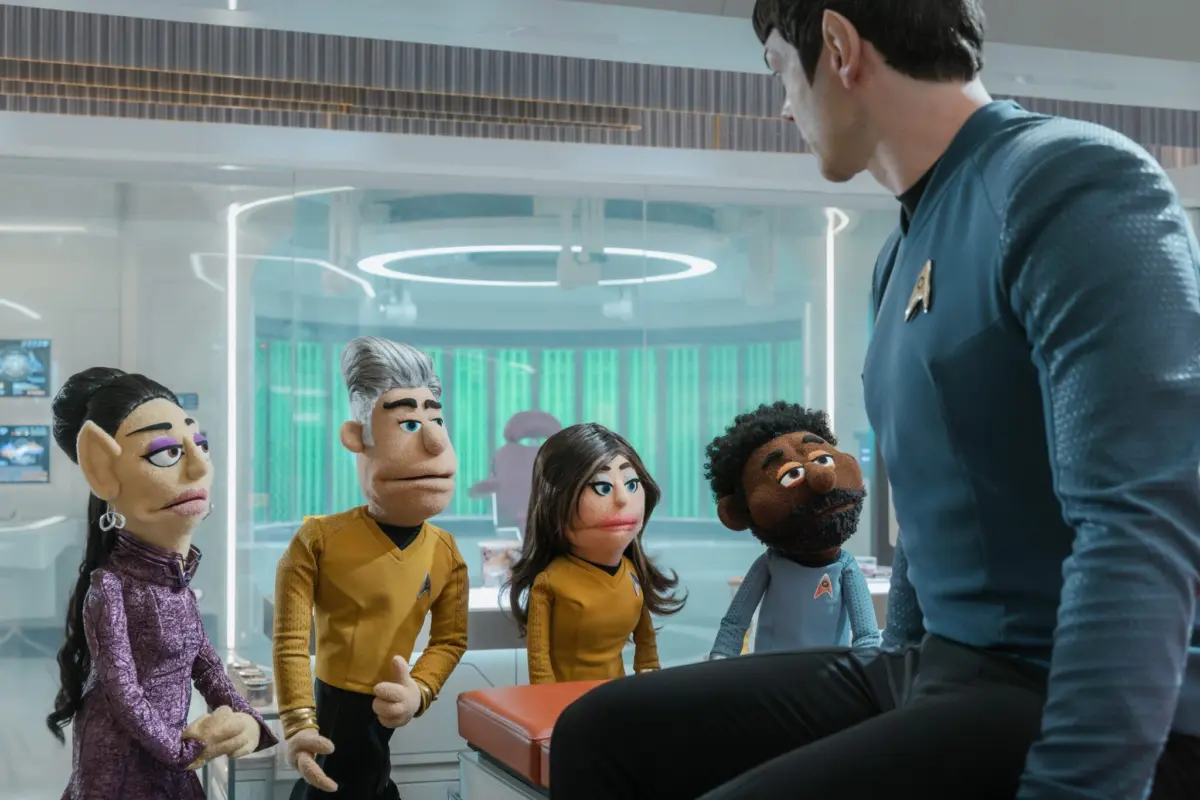
Strange New Worlds Season Four manifested this exact creative tension. The season leaned heavily on high-concept genre pastiches and radical tonal departures: the Enterprise inadvertently altering prehistoric Earth to create the asteroid belt, a haunted starship mystery, a black-and-white noir aesthetic, an entire crew transformed into puppets save for Spock, a comedic Star Trek take on The Hangover, and deep-dive soap opera melodrama. While certain high-concept swings successfully integrated into meaningful narratives—such as the time-travel moral dilemmas bookending the season in Valles Marineris and Tomorrow’s Enterprise—others struggled under the weight of their own gimmicks.

Chronology and Episode Analysis
The chronological rollout of Season Four offered a disparate array of narrative triumphs and misfires. The season premiere, Valles Marineris, established a sombre tone regarding temporal ethics, bolstered by the commanding presence of guest star Saffron Burrows as Commander Cassell of Mars. This thematic exploration of temporal consequence found its structural mirror in the season finale, Tomorrow’s Enterprise, though both episodes drew mild scrutiny from hard science fiction analysts regarding their loose interpretations of astrophysics.
Mid-season horror entry The Griffin Incident delivered palpable tension despite lacking deep scientific exposition for its central phenomenon. Meanwhile, A Case of Chiaroscuro deployed a dense layering of stylistic devices—including monochromatic cinematography, lookalike casting, and legacy character integration—that ultimately succeeded by serving as a potent vehicle for Rebecca Romijn’s Una Chin-Riley. The episode functioned as a timely, classic Star Trek parable against fascism. Following closely, Off-Hour emerged as a tightly paced thriller that advanced character development for Scotty, Dr. M’Benga, and Nurse Chapel, anchored by a stellar guest performance from Brian Markinson as a successor to original series physician Dr. Boyce.
Conversely, more experimental outings yielded mixed audience reception. The Level-Five Transporter Accident, which featured the crew transformed into Jim Henson Company puppets while navigating a psychological anxiety dream experienced by Spock, polarized the fan base. Similarly, Human Best Friend failed to generate substantial comedic momentum, while Like Chronitons Through the Hourglass relied on an initially excruciating narrative framework before delivering an emotionally resonant meditation on grief, anchored by a career-best performance from Anson Mount as Captain Pike alongside Deidre Hall as Counselor Chivers.
Character Evolution and Franchise Continuity
The overarching triumph of Strange New Worlds remains its meticulous bridging of character trajectories between the mid-23rd century era of Pike’s Enterprise and the 1966 broadcast continuity of Star Trek: The Original Series. Season Four delivered vital developmental milestones for Nyota Uhura, Spock, and the Kirk brothers.
Throughout the first three seasons, Spock’s recurring experiments with his human heritage consistently resulted in internal conflict and emotional distress. By Season Four, narrative progression explicitly established Spock’s deliberate rejection of his human DNA in favor of strict Vulcan logic and emotional suppression, neatly aligning his psychological baseline with the stoic science officer introduced by Leonard Nimoy in the original pilot and series run.
Simultaneously, Celia Rose Gooding’s interpretation of Uhura evolved away from initial insecurity and professional drift. Episodes such as A Case of Chiaroscuro and Orders of Magnitude actively accelerated Gooding’s character arc toward the confident, authoritative communications officer exemplified by Nichelle Nichols.

The integration of James T. Kirk, portrayed by Paul Wesley, along with Sam Kirk, played by Dean Jeannotte, further expanded the canonical tapestry of the Kirk family dynamic. While James Kirk’s recurring presence aboard the ship he is destined to command stretched narrative plausibility in episodes like Human Best Friend, the broader writing staff successfully established foundational family lore that television in the 1960s never explored. The exploration of the Kirk patriarch in Orders of Magnitude provided substantial psychological depth, avoiding the reductive trauma tropes utilized in contemporary feature film reboots.
Production Implications and Future Outlook
As Paramount+ prepares for the fifth and final season of Strange New Worlds—shortened strictly to a six-episode order—the production team faces an unprecedented structural challenge. Condensing the series’ remaining narrative ambitions into a six-episode arc will require maximum efficiency from the writers’ room, ensuring that character arcs reach satisfying conclusions without sacrificing the exploratory ethos foundational to the franchise.
Industry observers note that the systematic reduction in seasonal lengths across major streaming platforms reflects broader economic adjustments within the media sector. For legacy intellectual properties like Star Trek, maintaining narrative momentum across compressed windows requires striking a delicate equilibrium between high-concept experimentation and character-driven continuity.
Meanwhile, related franchise developments continue to face external scrutiny. Production updates regarding adjacent series, such as Starfleet Academy, have underscored the complex nature of managing contemporary online fan discourse, prompting network chroniclers to adopt consolidated multi-season review strategies moving forward.
Ultimately, Star Trek: Strange New Worlds Season Four stands as a testament to the creative ambitions and inherent risks of modern franchise television. By daring to experiment with form, tone, and genre while honoring sixty years of established lore, the series continues to mirror the enduring spirit of exploration that defined the inception of Star Trek in 1966. As the series approaches its definitive conclusion, the lessons learned from its triumphs and overreaches will undoubtedly shape the future trajectory of the broader franchise.