The cinematic musical genre has long struggled with a structural ailment commonly known in theatrical circles as the second-act collapse. Historically, film adaptations of stage musicals face a distinct hurdle: once the primary narrative mechanism is established and the initial parade of expositional showstoppers concludes, screenwriters often find themselves abruptly abandoning the melodic momentum to hastily resolve complex plot points. Classic examples, such as the second half of William Wyler’s 1968 film Funny Girl—which shifts its focus from Barbra Streisand’s dazzling vocal ascension to the heavy domestic burdens of a husband’s gambling addiction—illustrate how tonal whiplash can undermine an otherwise cohesive production.
However, select cinematic entries manage to evade this structural trap through tight screenwriting, disciplined runtimes, and a mastery of mise-en-scène. Frank Oz’s 1986 adaptation of Little Shop of Horrors stands as a prime exemplar of this equilibrium. Operating at a brisk 94 minutes, the film translates a cult Off-Broadway musical into a visually arresting cinematic experience. It marries the dark sensibilities of 1950s B-movie horror with a sophisticated, Motown-infused score, creating a satirical critique of capitalist desperation that continues to resonate decades after its initial theatrical release.
Origins and Evolution: From Corman’s B-Movie to Off-Broadway Triumph
The trajectory of Little Shop of Horrors is a study in unlikely cultural synthesis. Its origins trace back to a low-budget, black-and-white 1960 horror-comedy directed by independent cinema pioneer Roger Corman. Shot in just two days on leftover sets from The Bucket of Blood, Corman’s original film was a minor novelty that achieved lasting notoriety primarily for featuring an early, uncredited cinematic appearance by Jack Nicholson. Notably, Corman famously neglected to properly copyright the motion picture, allowing the property to enter the public domain and opening the door for future creative reinterpretations.
Two decades later, librettist Howard Ashman and composer Alan Menken seized upon the core premise of a Florist’s assistant cultivating a man-eating botanical specimen. Transforming the premise into an Off-Broadway stage musical that premiered in 1982, Ashman and Menken crafted a score that leaned heavily into doo-wop, early rock-and-roll, and rhythm and blues. The production became a massive theatrical hit, running for 2,209 performances at the Orpheum Theatre in the East Village and establishing Ashman and Menken as major musical forces—a partnership that would soon transition to Walt Disney Feature Animation, where they catalyzed the late-1980s and 1990s Disney Renaissance with films like The Little Shop-esque musical sensibilities of The Little Mermaid, Beauty and the Beast, and Aladdin.
The Production Design and Director’s Vision
When the property transitioned to the screen in the mid-1980s under the stewardship of Geffen Company and Warner Bros., director Frank Oz was selected to helm the project. Oz, celebrated for his extensive background as a master puppeteer and co-creator of iconic characters within the Jim Henson ecosystem including Yoda and Miss Piggy, brought a distinct visual philosophy to the production.
Rejecting the emerging 1990s industry shift toward digital realism and location shooting, Oz insisted on constructing a richly detailed, expressionistic soundstage rendition of Skid Row. Designed by Roy Forge Westerman, the set was an intentional stylistic throwback to classical Hollywood soundstages, featuring deliberately exaggerated textures, perpetual gloom, and atmospheric grayness. This artificiality enhanced the fable-like quality of the narrative, framing the urban decay not as gritty realism, but as a stylized theatrical proscenium.
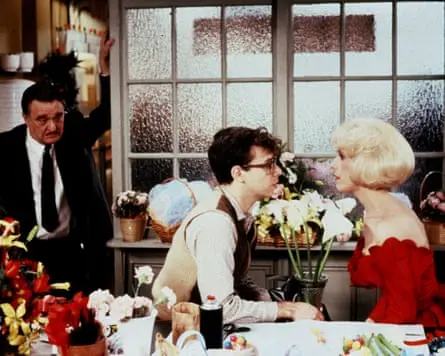
The central cast anchored this heightened reality. Rick Moranis portrayed Seymour Krelborn, the orphaned, meek floral assistant whose timid demeanor masks a latent ambition. Ellen Greene reprised her acclaimed stage role as Audrey, delivering a performance that combined vulnerability with operatic vocal power. The supporting ensemble featured a roster of prominent 1980s comedic talent, including Steve Martin as the sadistic dentist Orin Scrivello, Vincent Gardenia as the mercenary shop owner Mr. Mushnik, and Bill Murray in a memorable cameo as a masochistic dental patient. Furthermore, the titular carnivorous plant, Audrey II, was brought to life through elaborate physical puppetry operated by multiple technicians simultaneously, with its booming, soulful vocals provided by Levi Stubbs, the legendary lead singer of The Four Tops.
Thematic Subtext: Anti-Capitalist Satire Through Musical Form

Beneath its slapstick horror and catchy melodies, Little Shop of Horrors functions as an incisive critique of consumer capitalism and the pursuit of the American Dream at any moral cost. Film historians and cultural critics have frequently noted parallels between Oz’s film and other high-concept genre satires of the era, such as Jonathan Lynn’s 1985 board-game adaptation Clue. Both films use heightened comedic premises to skewer institutional corruption and the transactional nature of human relationships.
In Little Shop, this critique is articulated most clearly through the musical numbers. The opening title sequence, Skid Row (Downtown), establishes the socio-economic despair of the community, framing individual aspirations against systemic poverty. The choreography and framing utilize compositional techniques reminiscent of mid-century social realist art and agitprop theater, visually connecting the characters’ claustrophobia to the broader apparatus of urban neglect.
Seymour’s moral descent mirrors the trajectory of corporate ascension: as Audrey II grows larger, more articulate, and more demanding, Seymour is rewarded with fame, wealth, and societal validation, all while supplying the plant with human bodies. The narrative explicitly links material success with ethical compromise, offering a dark fable about the hidden human costs required to sustain economic expansion.
Original Ending Controversy and Critical Reception
The film’s initial theatrical release was accompanied by a notable creative conflict regarding its conclusion. Ashman’s original stage production featured a nihilistic, tragic finale in which Audrey II devours both Seymour and Audrey before conquering New York City, culminating in a striking tableau of giant plants looming over the Statue of Liberty.
However, following disastrous preview screenings where test audiences—accustomed to traditional Hollywood narrative resolutions—reacted negatively to the death of the protagonists, studio executives demanded a complete reshoot. The ending was subsequently altered to the upbeat, celebratory conclusion in which Seymour defeats the plant, rescues Audrey, and lives happily in a suburban home, albeit with a small mutant bud sprouting in their garden to hint at lingering menace.
Despite the studio interference, the film received generally favorable reviews upon its release in December 1986. Critics praised the technical achievements of the animatronics, the strength of the musical score, and the chemistry between Moranis and Greene. Over the subsequent decades, the film has achieved enduring cult status, celebrated for its unique blend of practical effects, sharp social commentary, and theatrical showmanship.
Long-Term Impact and Cultural Legacy
The legacy of the 1986 Little Shop of Horrors extends beyond its box-office performance, influencing subsequent generations of filmmakers and theater practitioners. It remains a benchmark for practical visual effects in an era that preceded widespread computer-generated imagery. The integration of complex animatronics with live-action performance demonstrated the viability of creature features outside the traditional sci-fi and horror genres.
Furthermore, the film solidified the artistic reputation of its creative principals. For Frank Oz, the project proved his capacity to direct large-scale feature films with human casts while maintaining the precise timing honed during his years in puppetry. For Ashman and Menken, the critical success of the musical numbers reinforced their industry standing, directly paving the way for their dominant tenure at Walt Disney Animation Studios.
Decades after its premiere, Little Shop of Horrors endures as a distinct artifact of 1980s cinema—a rare convergence of high-concept satire, technical craftsmanship, and melodic accessibility that continues to attract new audiences and analytical re-evaluation.