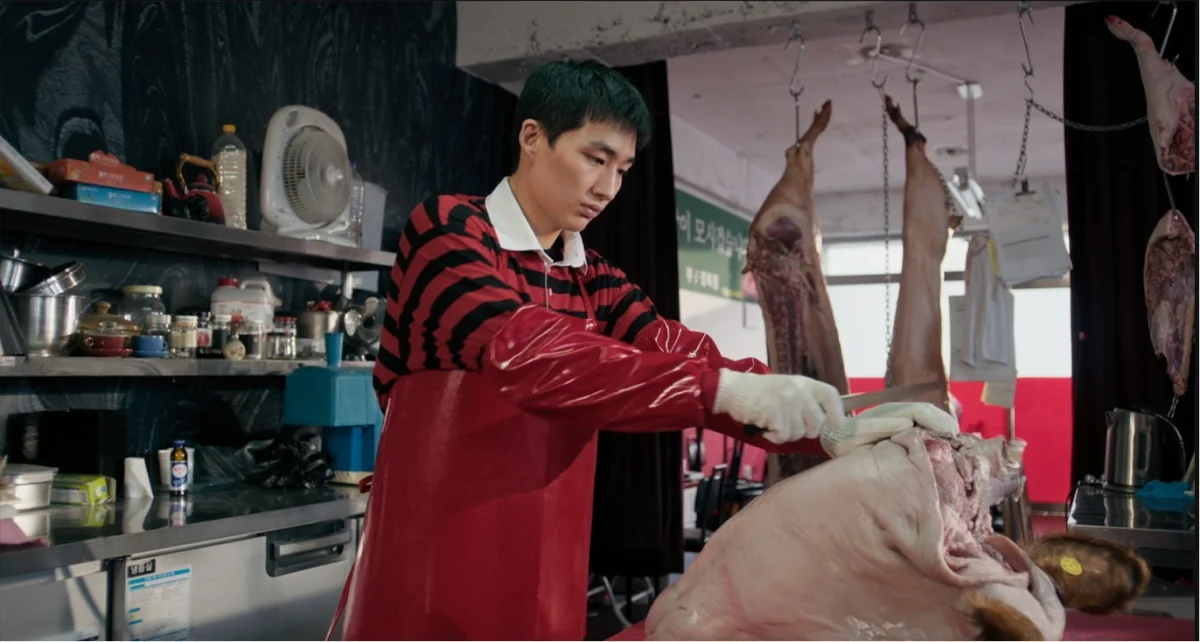
Yoo Hyoung-joon’s feature debut, "The Only Child in the Butchery," produced through the esteemed Korea National University of Arts (K-Arts), has been critically acclaimed, earning the Best Director Choice award at the 30th Bucheon International Fantastic Film Festival (BIFAN). The 81-minute production, presented in the highly competitive Bucheon Choice Korean: Features section, also saw Jeong Hyeong-seok receive a Special Mention for his compelling performance, marking a significant entry for the emerging filmmaker into the vibrant landscape of Korean cinema.
A Director’s Diverse Artistic Journey
Yoo Hyoung-joon’s background is notably eclectic, providing a unique foundation for his directorial vision. Before embarking on his journey into live-action filmmaking at K-Arts, Yoo honed his skills in character animation at the prestigious California Institute of the Arts (CalArts). CalArts, renowned globally for its pioneering animation programs and as a crucible for some of the industry’s most influential animators and filmmakers, instilled in Yoo a profound understanding of visual storytelling, character development, and narrative pacing. This specialized training at a top-tier institution likely contributed to the meticulous construction and layered depth observed in "The Only Child in the Butchery."
His transition from animation to live-action directing at K-Arts—one of South Korea’s premier institutions for arts education, celebrated for nurturing talent across various creative disciplines including film, theater, and music—speaks to a broader artistic ambition. K-Arts has a strong reputation for producing innovative filmmakers who often challenge conventional narratives and forms. Yoo’s earlier work reflects this diverse trajectory, including animated shorts like "Kincet Side" and "Dream Merchant," alongside live-action shorts such as "As Seen" and "A Record to Be Remembered." These earlier projects likely served as crucial proving grounds, allowing him to experiment with different storytelling modes and cinematic techniques, ultimately culminating in the assured direction seen in his debut feature. The success of "The Only Child in the Butchery" at BIFAN underscores the effectiveness of K-Arts’ interdisciplinary approach and its commitment to fostering distinctive directorial voices.
BIFAN: A Platform for Fantastic Cinema and Emerging Talent
The Bucheon International Fantastic Film Festival, celebrating its 30th edition, stands as a pivotal event in the global film festival circuit, particularly for its focus on genre cinema. Established in 1997, BIFAN has cultivated a reputation as Asia’s leading fantastic film festival, championing horror, thriller, mystery, fantasy, and science fiction films from around the world. The festival’s "Bucheon Choice" section is particularly significant, designed to discover and promote new talents in genre filmmaking. Within this, the "Korean: Features" category specifically highlights outstanding domestic productions, offering a crucial platform for independent Korean filmmakers to gain critical recognition and industry attention.
Winning the Best Director Choice award at BIFAN is a substantial achievement for a debut filmmaker. It signals not only the director’s technical prowess but also a unique artistic vision that resonates with both critics and genre enthusiasts. For Yoo Hyoung-joon, this accolade places him among a growing cohort of Korean directors who are pushing the boundaries of genre storytelling, often infusing it with profound social commentary and psychological depth. The Special Mention for Jeong Hyeong-seok’s performance further emphasizes the film’s strong characterizations and the quality of its acting ensemble, an aspect frequently lauded in contemporary Korean cinema. The festival’s commitment to showcasing diverse narratives and supporting emerging talents like Yoo Hyoung-joon reinforces its role as a vital incubator for the future of Asian fantastic cinema.
The Narrative Core: A Descent into Moral Ambiguity
"The Only Child in the Butchery" unravels a deeply unsettling narrative centered on Tae-seop (portrayed by Kwon Ji-woo), a young man orphaned at an early age. His life has been defined by an intricate web of obligation and exploitation, having been raised by his aunt’s husband, whom he has always referred to as "father." In a grim exchange for a home, Tae-seop has spent his entire adult life toiling without compensation in the man’s butcher shop, a life of unacknowledged servitude masked by the guise of familial benevolence.
As Tae-seop prepares for a significant life milestone—marriage to the woman he loves—he finally gathers the courage to request the wages he believes he has rightfully earned over years of labor. His plea is met with a cold, dismissive rejection. His supposed father, adept at manipulation, reiterates the long-standing narrative: Tae-seop’s upbringing, food, and shelter are presented as insurmountable debts, forever binding him to the household and the butcher shop, extinguishing any hope of financial independence.
The fragile balance of Tae-seop’s existence shatters with a stark discovery: his guardian is willing to spend lavishly to conceal an extramarital affair. This revelation is a turning point, exposing the hypocrisy and deep-seated injustice of his situation. Tae-seop realizes that the issue is not a lack of money, but rather a deliberate withholding and exploitation. This newfound clarity ignites a desperate resolve within him, leading him to anonymously blackmail his "father." His initial aim is modest: to secure enough cash to finally escape the butcher shop’s confines and establish an independent life with his fiancée.
However, what begins as a seemingly straightforward plan rapidly spirals into a labyrinthine entanglement of deceit. The unexpected entrance of a suspicious husband, another blackmailer, the police, and a mysterious disappearance progressively transforms Tae-seop’s desperate scheme into a convoluted web of lies and unforeseen consequences. The film meticulously charts his journey from a victim of circumstance to an amateur criminal, trapped in a reality shaped by his increasingly perilous choices.
Thematic Depth: Exploitation, Identity, and Societal Pressures
At its philosophical core, "The Only Child in the Butchery" is a profound exploration of how individual choices can irrevocably alter an entire existence. While Tae-seop’s decision to resort to blackmail is morally questionable, Yoo Hyoung-joon masterfully constructs the years of relentless exploitation that drive him to such extreme measures. The film meticulously portrays how his guardian’s initial act of charity—taking in an orphan—metamorphoses into a perpetual instrument of control. Tae-seop is constantly reminded of his perceived indebtedness, making any aspirations for wages, marriage, or autonomy appear as acts of ingratitude and betrayal.
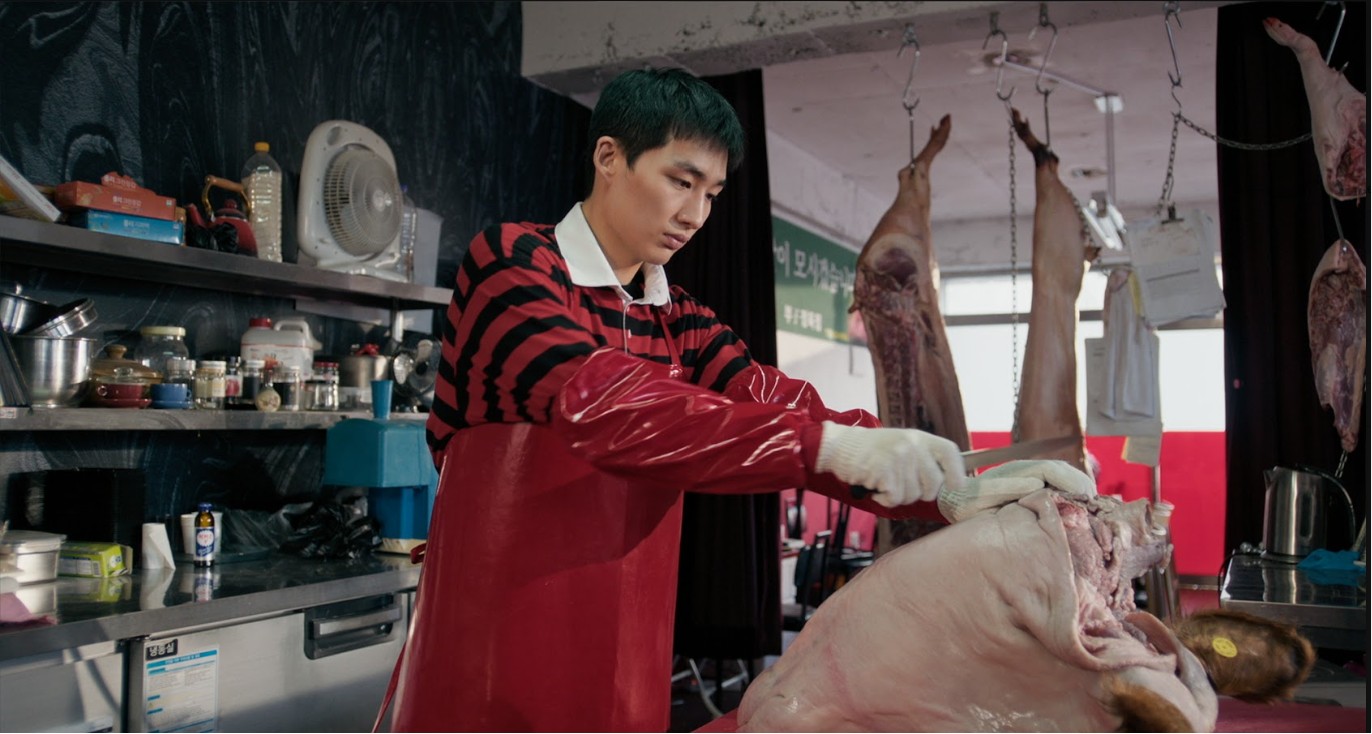
This psychological pressure of "benevolence" emerges as one of the film’s most potent thematic elements. Tae-seop is technically free to leave, yet he remains emotionally and financially tethered to the butcher shop. His guardian has successfully ingrained the belief that being raised within the household necessitates surrendering his right to define his own future. Consequently, the shop transcends its function as a workplace, becoming both a physical and metaphorical prison. The act of butchery itself, rather than a chosen profession, becomes an imposed identity, stripping him of agency and self-determination.
Beyond individual struggle, the narrative subtly reflects the broader difficulties of sustaining relationships and achieving stability in contemporary Korean society. The film implicitly critiques the societal pressures where housing, marriage, and financial security are inextricably linked. Tae-seop’s initial desires are not rooted in wealth or revenge; he simply yearns for the financial means to build a life with his partner. However, his economic dependence becomes an insurmountable barrier to progress, and the frustration stemming from this systemic entrapment gradually transforms an otherwise ordinary young man into an amateur criminal. This resonates deeply within a Korean context where economic stability is often a prerequisite for marriage and establishing a family, and where intergenerational wealth or lack thereof can dictate life trajectories.
In this regard, "The Only Child in the Butchery" also functions as an unconventional coming-of-age story. Tae-seop’s "awakening" is not spurred by conventional means like education, romance, or a moral epiphany. Instead, it arises from the stark realization that the familial structure he once trusted has always been fundamentally unequal and exploitative. His growth entails recognizing this exploitation, yet the methods he chooses to liberate himself plunge him into a vortex of unintended consequences. Each desperate attempt to reclaim control only ensnares him further into a reality shaped by deceit, jealousy, and dangerous impulses, illustrating the complex and often brutal path to true independence.
Masterful Direction and Layered Narrative
Despite its concise 81-minute duration, the film’s narrative is impressively layered and dynamic. Yoo Hyoung-joon demonstrates remarkable confidence in his directorial style, transitioning seamlessly between genres. The film commences as an understated family drama, meticulously establishing the oppressive domestic environment, before gradually introducing elements of adultery, surveillance, and blackmail that propel it into thriller territory. The subsequent involvement of the police and the mysterious blackmailer injects both suspense and dark humor, with the director maintaining a delicate and effective balance between these contrasting tones. The unfolding situation becomes increasingly absurd, yet crucially, the characters’ underlying desperation never loses its emotional weight, ensuring audience engagement remains rooted in their plight.
The film’s intricate plot twists are handled with the precision of a guessing game. Information is rarely revealed directly, and a significant portion of the tension stems from the secrets characters meticulously guard from one another. Apparent victims morph into potential perpetrators, while those who seem to possess understanding often operate with only fragmented truths. While some developments occasionally lean towards excessive convenience, the constant shifts in perspective and revelations keep the story engaging and ensure that its short running time feels remarkably dense and impactful. Moreover, the moments of violence are thoughtfully embedded within the narrative, serving to advance the plot rather than merely shock, although the final violent act is notably abrupt, contributing to the film’s unsettling conclusion.
Outstanding Performances Anchor the Narrative
The success of "The Only Child in the Butchery" is significantly bolstered by its exceptional cast. Kwon Ji-woo delivers a compelling central performance as Tae-seop. He masterfully captures the protagonist’s initial passivity without rendering him empty, gradually allowing the audience to perceive the deep-seated resentment simmering beneath his outwardly obedient exterior. His nervous reactions and increasingly frantic demeanor as his scheme unravels are equally effective, particularly as Tae-seop struggles to maintain a facade of normalcy while growing acutely aware that almost everyone around him may know more than they let on. Ji-woo’s portrayal expertly conveys the internal conflict of a man pushed to his breaking point, navigating a moral minefield of his own making.
Jeong Hyeong-seok is equally outstanding as the man Tae-seop has been conditioned to regard as his father. His performance skillfully avoids reducing the character to a simplistic villain. Instead, it is his casual entitlement and profound lack of empathy that make him so disturbing. He genuinely appears to believe that taking in an orphan conferred upon him an indefinite right to control that person’s life and labor. This nuanced portrayal of a benevolent oppressor adds significant psychological depth to the film’s central conflict. Ahn Min-young also delivers an impressive performance, particularly in how her character reacts as the extramarital affair, the extortion attempt, and the disappearance begin to collide. Her unpredictable behavior introduces another layer of instability to an already volatile situation, further complicating the narrative and heightening the suspense.
Cinematic Craft and Symbolic Imagery
The film’s editing complements the narrative’s accumulation of misunderstandings and shifting perspectives. Each new revelation is meticulously timed, forcing the audience to revise their interpretation of prior events. The frequent changes in tone, deftly moving between mystery, suspense, and black comedy, largely work in harmony. Rather than disrupting the suspense, the comedic elements often emerge organically from the characters’ increasingly desperate and often clumsy attempts to conceal their illicit behaviors, creating a darkly humorous undertone that prevents the narrative from becoming overly bleak.
A particularly effective and recurring visual motif is the image of the cow’s head. Closely associated with Tae-seop’s unwanted existence as a butcher, it powerfully conveys the grotesque atmosphere surrounding the shop and, more profoundly, suggests how thoroughly his identity has been consumed by the work forced upon him. The animal’s head becomes a symbol of his entrapment, his metaphorical slaughter, and the dehumanizing nature of his existence. Its reappearance at the film’s conclusion provides an appropriately ironic and visually striking resolution, symbolically returning Tae-seop to the very emblem of the life from which he has spent the entire narrative desperately attempting to escape, underscoring the cyclical nature of his struggle and the heavy price of his choices.
Implications and Future Outlook
The Best Director Choice award at BIFAN for "The Only Child in the Butchery" positions Yoo Hyoung-joon as a formidable new voice in Korean cinema. This recognition from a prestigious festival like BIFAN can be a crucial catalyst for an independent film, potentially opening doors for wider distribution, international festival appearances, and enhanced critical attention. For K-Arts, the award further solidifies its reputation as a leading institution for film education, showcasing its ability to cultivate directors with distinctive artistic visions and the technical prowess to execute them.
Industry observers suggest that Yoo Hyoung-joon’s unique background in animation combined with his live-action directing skills could lead to innovative storytelling approaches in future projects. His debut demonstrates a keen understanding of complex character psychology, narrative tension, and thematic depth, hinting at a promising career ahead. The film’s exploration of socio-economic pressures and the dark underbelly of familial obligations resonates deeply within contemporary Korean society, suggesting its potential to spark broader conversations among audiences and critics alike. "The Only Child in the Butchery" stands as an engaging and layered debut that expertly uses crime and black comedy to dissect the ambiguous and often destructive obligations created within families, marking a confident and compelling entry for Yoo Hyoung-joon into the directorial spotlight.