The wind, a relentless force, often symbolizes the unseen currents that shape destiny, scattering seeds of change or, in Ha Gil-jong’s seminal 1972 feature debut, the pollen of flowers, foreshadowing an inevitable tragedy. This metaphorical tempest forms the narrative and thematic core of a film that, despite its initial controversies and commercial failure, has been critically re-evaluated as a groundbreaking work in South Korean cinema. Released just prior to the full implementation of the repressive Yushin system, The Pollen of Flowers stands as a visually radical and politically conscious statement, a testament to a brief period of artistic freedom before the onset of severe governmental censorship.
Ha Gil-jong: A Visionary Auteur and His Collective
Ha Gil-jong emerged from a unique educational background for a Korean filmmaker of his era. After completing his studies at the prestigious University of California, Los Angeles (UCLA), a hub of avant-garde filmmaking and critical theory in the late 1960s, Ha returned to South Korea in the early 1970s. His time abroad exposed him to international cinematic movements, including European art cinema and the New Hollywood aesthetic, shaping a distinct vision that diverged sharply from the mainstream commercial productions prevalent in Korea.
Upon his return, Ha co-founded "The Visual Age Group" (시각시대, Sigak Sidae), a collective of young, ambitious filmmakers who shared a desire to push the boundaries of Korean cinema. Their aim was to create films that were not only aesthetically innovative but also deeply engaged with social and political commentary, often challenging the conservative norms and veiled authoritarianism of the time. The group represented a nascent avant-garde movement, seeking to inject intellectual rigor and artistic experimentation into a film industry largely dominated by melodramas, historical epics, and government-mandated anti-communist propaganda. The Pollen of Flowers was the collective’s ambitious first major production, embodying their manifesto for a new cinematic language.
The Genesis of "The Pollen of Flowers"
Ha Gil-jong’s film draws its inspiration from Lee Hyo-seok’s 1939 novel of the same name. Lee Hyo-seok, a prominent figure in Korean literature during the Japanese colonial period, was known for his lyrical prose and often sensuous exploration of human nature, frequently against the backdrop of changing social mores. His novel, published during a time of intense cultural suppression, subtly explored themes of desire, societal constraints, and the awakening of consciousness. Ha Gil-jong’s adaptation, however, transposed these themes to a contemporary 1970s South Korean setting, amplifying their political and social resonance.
The film’s narrative centers on a secluded household, metaphorically dubbed "The Blue House," a name that directly evokes the presidential residence of South Korea. Within this isolated microcosm live Hyun-ma (Namkoong Won), the authoritarian patriarch; Se-ran (Choi Ji-hee), his compliant concubine; Mi-ran (Yoon So-ra), Se-ran’s younger sister on the cusp of adolescence; and Ok-nyeo (Yeo Woon-kai), the ever-present housemaid. Their insular existence is dramatically disrupted by the arrival of Dan-ju (Ha Myung-joong), Hyun-ma’s new secretary, who is also his secret male lover. Dan-ju’s presence acts as a catalyst, a "breath of fresh air from the outside world," shattering the fragile equilibrium and exposing the repressed desires and hypocrisies simmering beneath the surface. This introduction of an external element into a seemingly stable, albeit stifling, environment is a classic dramatic device, but in Ha’s hands, it becomes a powerful vehicle for sociopolitical critique.
A Storm of Controversy: Plagiarism Accusations and Initial Reception
Despite its artistic ambitions, The Pollen of Flowers was met with immediate and harsh criticism upon its release in 1972. The most damaging accusation was that Ha Gil-jong had plagiarized Pier Paolo Pasolini’s critically acclaimed 1968 film, Teorema. Pasolini’s film, a highly controversial work itself, depicts a mysterious, god-like visitor who systematically seduces every member of a wealthy Milanese family—father, mother, son, daughter, and maid—before suddenly departing, leaving them to confront their existential emptiness and societal roles.
The parallels between the two films, particularly the disruption of a bourgeois family unit by an enigmatic outsider who initiates a series of sexual awakenings and eventual disintegration, were undeniable. This led to a significant "wave of criticism" from contemporary Korean critics and industry figures. The fallout was severe: The Pollen of Flowers was disqualified from multiple prestigious awards, effectively blacklisting it from official recognition. Furthermore, its challenging themes, avant-garde style, and the plagiarism scandal contributed to its complete failure at the box office. Audiences, perhaps unprepared for such a provocative and unconventional film, largely stayed away, marking it as a commercial disaster for its time.
The accusations, however, also highlighted a broader challenge faced by Korean filmmakers attempting to engage with international cinematic trends. In an era where cultural exchange was often limited and domestic film production was heavily controlled, the lines between homage, influence, and plagiarism could become blurred, particularly when critics themselves were becoming more globally aware. While the accusation undeniably damaged the film’s initial reputation and Ha’s nascent career, later critical reappraisals have argued that despite structural similarities, Ha Gil-jong imbued The Pollen of Flowers with a distinct Korean sensibility and a specific political allegory relevant to his own national context, distinguishing it from a mere copy.
The Blue House as a Microcosm: Narrative and Political Allegory
The naming of the central residence as "The Blue House" is no mere coincidence; it serves as a potent and thinly veiled political metaphor for the state of South Korea under authoritarian rule. Each character within this isolated bubble is carefully crafted to represent a specific layer or faction of Korean society in the early 1970s, making the film a biting commentary on power, class, and the yearning for change.
Hyun-ma, the patriarch, embodies the entrenched authoritarian regime—powerful, controlling, and seemingly unchallengeable. His need to control "everyone and everything" reflects the government’s pervasive grip on public and private life. Se-ran, his submissive concubine, represents the segment of society that, through fear or complacency, adheres to the established order, accepting their assigned roles within the hierarchical structure. Her passivity, however, hints at an underlying dissatisfaction, a suppressed agency that could potentially be ignited.
Mi-ran, the younger sister entering adolescence, symbolizes the emerging generation—directionless, innocent, yet desperate for change. Her burgeoning sexuality and vulnerability represent the potential for new ideas and rebellious spirit, but also the susceptibility of the youth to manipulation or disillusionment.
Ok-nyeo, the house help, is perhaps the most critical symbolic figure. She is "the least visible yet ever-present figure," constantly observing from the periphery, representing the active lower class. This segment of society, often overlooked by the powerful, is depicted as "always observing, always ready to resist," suggesting a simmering discontent and potential for revolutionary action that could ultimately dismantle the existing power structure. Her presence, often lingering at the edges of the frame, silently reacting to the household’s collapse, steers the narrative toward its climax, signifying the pivotal role of the common people in societal upheaval.
Dan-ju, the enigmatic new secretary and male lover, represents the disruptive external force, a catalyst for change and an embodiment of forbidden desires and alternative ways of being. His "breath of fresh air from the outside world" is not just personal but also ideological, challenging the rigid conventions and moral hypocrisy of the "Blue House" and, by extension, the nation. The sexual liberation he brings, while personal to the characters, mirrors a broader societal yearning for freedom in a politically constrained environment.
The Shadow of Yushin: Cinema Under Repression
The timing of The Pollen of Flowers‘ release in 1972 is crucial for understanding its profound political significance. It premiered just months before President Park Chung-hee declared martial law and subsequently ushered in the Yushin Constitution in October 1972. This period marked a dramatic shift towards an even more authoritarian regime, consolidating Park’s power and severely curtailing civil liberties, including freedom of expression. The Yushin system (1972-1979) imposed extreme censorship across all artistic fields, particularly cinema.
Prior to Yushin, Korean cinema in the 1960s and early 1970s had experienced a brief period of relative dynamism, albeit still under government influence. While propaganda films were common, there was also room for melodramas, literary adaptations, and some social realism. However, with Yushin, the film industry became an explicit tool of state control. Scripts had to be pre-approved, themes were heavily restricted, and anything deemed critical of the government or promoting "social unrest" was swiftly suppressed. Directors faced severe penalties, and the industry entered a dark age of creative stagnation.
The Pollen of Flowers, therefore, functions as a powerful, albeit subtle, critique delivered right on the precipice of this artistic crackdown. Ha Gil-jong and The Visual Age Group managed to articulate their dissent and avant-garde vision before the full force of the Yushin system descended. Its very existence, and its daring exploration of themes like sexual liberation, political corruption, and the yearning for change, makes it a rare and valuable artifact from a fleeting moment of artistic courage in Korean history. The film’s failure at the box office and its disqualification from awards, while detrimental at the time, ironically protected it from direct governmental censorship, allowing its radical message to persist as a whisper before the roar of repression.
A Radical Vision: Aesthetic and Sonic Landscape
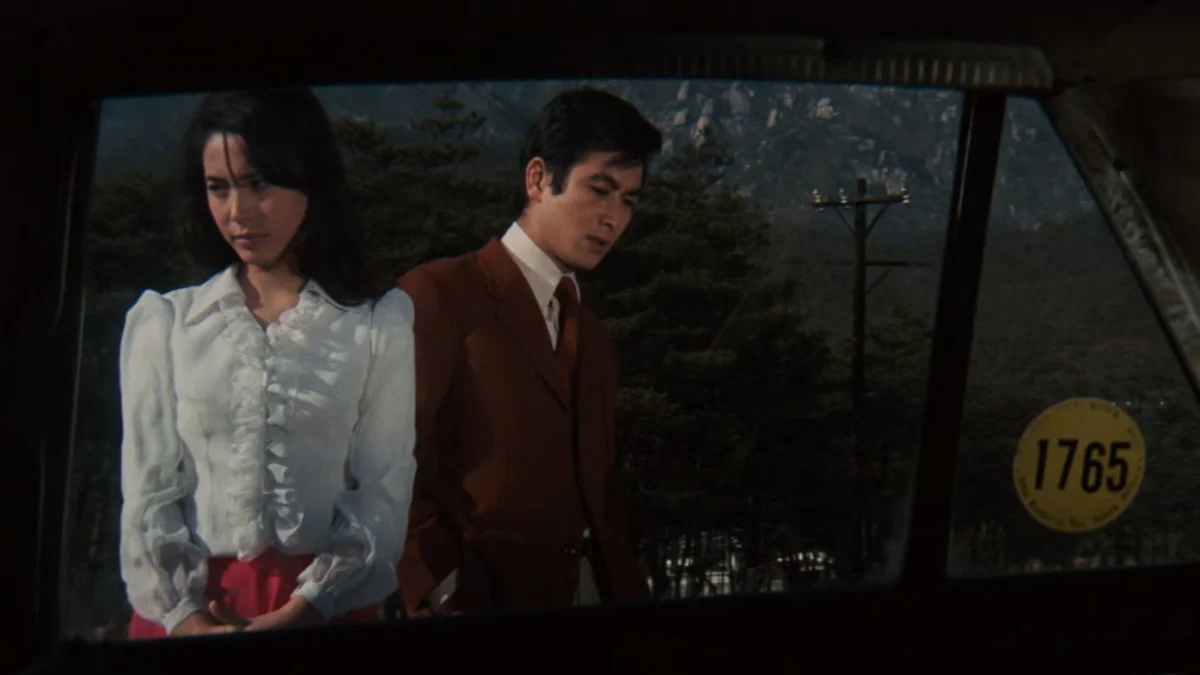
Beyond its narrative and political depth, The Pollen of Flowers distinguishes itself through its groundbreaking visual language and atmospheric sound design. Cinematographer Yoo Young-gil, a frequent collaborator with Ha Gil-jong and later a celebrated director himself, employed a style that actively engages and disorients the viewer. His camera movements often frame scenes from a distance, through windows, or via mirror reflections, creating a sense of voyeurism and exclusion. This technique "refus[es] the viewer entry into the house," suggesting that the inner workings of this "Blue House" are perhaps best observed from a critical, detached perspective, or that its secrets are not easily revealed. This visual distancing enhances the film’s metaphorical power, emphasizing the isolation of the characters and the opacity of power.
The editing further amplifies this discomfort. Sudden silences, abrupt cuts, and disjointed sequences contribute to an unsettling atmosphere, mirroring the psychological fragmentation and suppressed tensions within the household. This avant-garde approach to filmmaking was a stark contrast to the more conventional narrative structures prevalent in Korean cinema at the time, positioning Ha Gil-jong as a true innovator.
Completing this immersive and unsettling atmosphere is the distinctive soundtrack designed by Shin Jung-hyun, famously known as the "Godfather of Korean Rock." Shin Jung-hyun’s music, characterized by its psychedelic and blues-infused rock sound, adds another layer of visceral discomfort and a sense of growing sexual tension and impending chaos. His innovative use of electric guitars, unconventional melodies, and often hypnotic rhythms transcended the typical film score, embedding the emotional and psychological turmoil directly into the film’s sonic fabric. The psychedelic quality of his music underscores the film’s challenging of conventional realities, blurring the lines between sanity and madness, repression and liberation.
Performances: Symbolic Depths
While the film’s atmosphere and politics often take precedence, the acting in The Pollen of Flowers is crucial in embodying the symbolic roles of the characters. The cast, though not always commanding individual attention, effectively conveys the complex dynamics and underlying tensions.
Namkoong Won, as Hyun-ma, delivers a performance of "genuine ferocity," projecting the authoritarian control and rigid patriarchal power that defines the "Blue House." His portrayal captures the essence of a leader desperately clinging to authority, whose outward strength masks inner vulnerabilities. Choi Ji-hee, as the submissive concubine Se-ran, skillfully conveys a nuanced passivity. While outwardly compliant, her character’s presence in the narrative is far more significant than mere obedience, hinting at the silent suffering and suppressed desires of those trapped within the system.
Ha Myung-joong, as the disruptive Dan-ju, brings a "detached, almost nihilistic presence" to the role. His calm demeanor amidst the ensuing chaos makes him a potent catalyst, his very presence holding the unstable household in a precarious balance. Yoon So-ra, as Mi-ran, embodies youthful innocence and vulnerability, allowing the emotional and sexual awakening of her character to resonate profoundly within the film’s allegorical framework. Her performance highlights the tragic loss of innocence in a corrupt world.
However, it is Yeo Woon-kai as Ok-nyeo, the house help, who leaves the most lasting impression. Her character, often "lingering at the edges of the frame, silently observing and reacting," becomes the moral compass and the silent witness to the household’s collapse. Her understated yet powerful presence steers the narrative toward its inevitable climax, symbolizing the enduring spirit and potential for resistance within the marginalized lower class, who ultimately bear witness to and are impacted by the unraveling of power.
Beyond the Box Office: Legacy and Reappraisal
Despite its initial commercial failure and the cloud of plagiarism accusations, The Pollen of Flowers has undergone a significant critical re-evaluation in subsequent decades. It is now widely recognized as one of Ha Gil-jong’s most original and important films, not only for its avant-garde form but also for its groundbreaking narrative and audacious political critique.
The film’s daring portrayal of queer characters was particularly revolutionary for its time in Korean cinema. While not the absolute first to feature such themes, it stands out for depicting a same-sex relationship not as inherently demonic, perverse, or deserving of punishment, but as a catalyst for deeper societal introspection. This nuanced approach to queer representation was decades ahead of its time in a culturally conservative society, making it a pivotal work in the nascent history of queer cinema in South Korea.
Its sensational portrayal of physical desire and shifting intimacy, coupled with its open and unashamed criticism of the political situation, solidified its status as a "groundbreaking, sensational, and deeply shocking" film. These descriptors, first used in 1972, remain remarkably accurate today, underscoring its enduring power to provoke and challenge. The film’s ability to weave together personal drama with national allegory, using the intimate collapse of a family to mirror the impending crisis of a nation, demonstrates Ha Gil-jong’s profound artistic vision.
"Celluloid Fever": A Contemporary Revival
The enduring relevance of The Pollen of Flowers is highlighted by its inclusion in contemporary film retrospectives. The film is currently screening as part of "Korean Cinema’s Celluloid Fever: The 1970s," a significant series co-presented by Film at Lincoln Center (FLC) and Subway Cinema. This series aims to shed light on a turbulent yet creatively rich decade in Korean filmmaking, showcasing works that often defied or navigated the severe political repression of the Yushin era.
Such retrospectives are crucial for rediscovering and re-evaluating films like The Pollen of Flowers, which were suppressed or misunderstood in their own time. They allow new generations of critics and audiences to engage with these historical artifacts, appreciating their artistic merits, historical context, and ongoing relevance. The series provides an opportunity to understand the unique challenges and triumphs of Korean cinema during a period of immense national transformation, offering insights into how artists used their craft to comment on, resist, or simply survive authoritarian rule.
Conclusion: An Enduring Echo
In the final analysis, The Pollen of Flowers transcends its initial controversies to stand as a landmark achievement in South Korean cinema. It is a film that bravely confronted the political and social anxieties of its time, using a visually daring and narratively complex approach to dissect power, desire, and the yearning for liberation. Ha Gil-jong’s debut, though failing at the box office and facing critical backlash, achieved something far more significant: it planted seeds of dissent and artistic innovation that, like the pollen carried by the wind, spread beyond control, influencing future generations of filmmakers and contributing to a deeper understanding of Korean cinematic history. Its audacious spirit and profound insights continue to resonate, proving that even in the face of censorship and commercial failure, true artistic vision can leave an indelible mark.