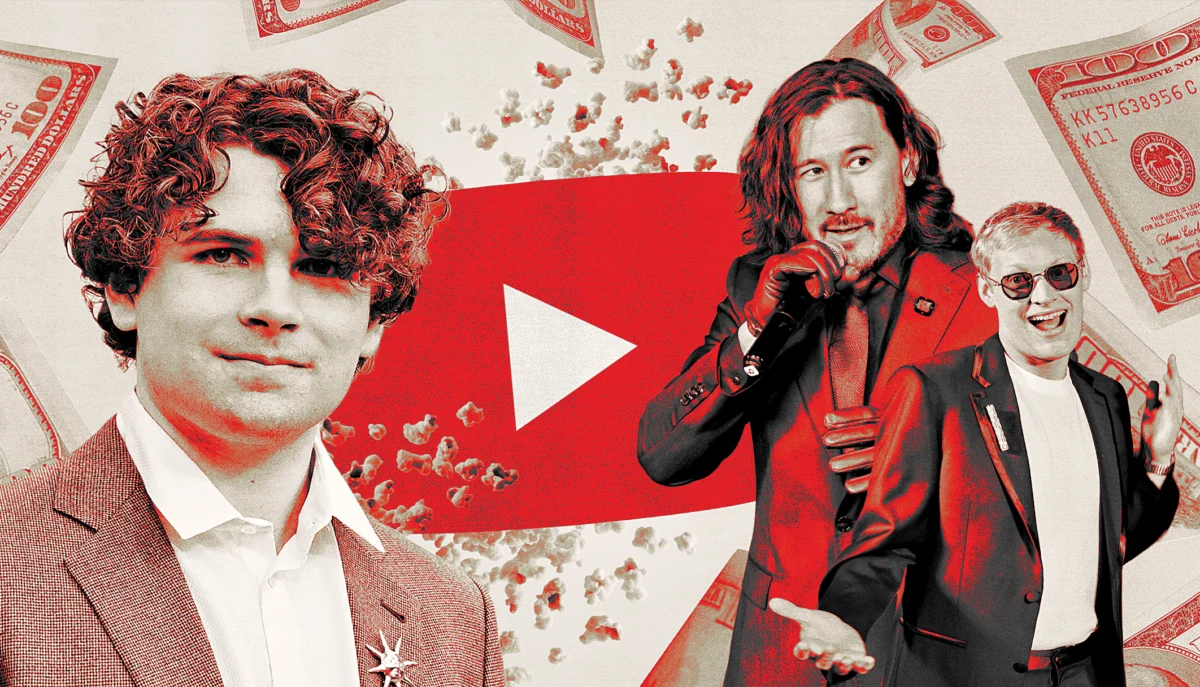
The landscape of the global entertainment industry underwent a seismic shift this past week as traditional Hollywood powerhouses found themselves overshadowed by a new vanguard of digital-native filmmakers. In an unprecedented turn of events, the narrative of the weekend box office was defined not by legacy franchises or established studio heads, but by a group of creators who honed their craft on YouTube. Kane Parsons, the visionary behind the viral "Backrooms" phenomenon, saw his creative influence outpace established intellectual properties like Star Wars, while filmmaker Curry Barker achieved a rare statistical anomaly: his latest feature film, Obsession, drew a larger audience in its third weekend of release than in its second, defying the standard decay curves of theatrical distribution.
Adding to this momentum, Mark Edward Fischbach, known globally as Markiplier, bypassed traditional theatrical windows entirely to debut his highly anticipated winter hit on YouTube. As one of the platform’s most prolific figures with a subscriber base exceeding 38 million, Fischbach’s move to offer a premium cinematic experience directly to his digital audience signaled a maturing of the creator economy. These developments—centered on the success of films like Backrooms, Obsession, and Iron Lung—have forced a reckoning within the industry, leaving traditional executives scurrying to understand the mechanics of this "New Hollywood."
At the center of this transition sits Fede Goldenberg, YouTube’s Head of Film and TV Partnerships. Operating out of the company’s Playa Vista headquarters—housed within the historic "Spruce Goose" hangar built by Howard Hughes—Goldenberg reflects a sense of calm that contrasts sharply with the anxiety currently permeating the legacy studio system. For Goldenberg, the sudden dominance of these creators is not an overnight fluke but the culmination of a decade-long evolution in how stories are told and consumed.
The Architect of the Creator-to-Cinema Pipeline
Fede Goldenberg’s career at Google has spanned 15 years, a period during which he has witnessed the transition of YouTube from a video-sharing site to a primary engine of global culture. A Brazilian immigrant who arrived in Los Angeles nearly two decades ago with aspirations of working in the entertainment industry, Goldenberg has spent the last decade building the infrastructure that allows digital storytellers to scale their operations.
"It’s a particularly great feeling—two movies leading the box office and Markiplier on the platform too," Goldenberg stated during a recent briefing. While the industry at large expressed shock at the weekend’s performance, Goldenberg maintains that the success was predictable. He notes that these creators have had years to "perfect the craft of entertaining audiences" in a high-stakes, data-driven environment where viewer retention is measured in seconds.
The executive’s foresight was documented exactly one year ago when he addressed a streaming conference in Colorado. At that time, he explicitly labeled this cohort of digital-first filmmakers as the "New Hollywood," a deliberate reference to the 1970s revolution led by Francis Ford Coppola, Martin Scorsese, and George Lucas. Just as those directors dismantled the old studio system to prioritize directorial vision and raw storytelling, Goldenberg argues that Parsons, Barker, and Fischbach are dismantling the marketing-heavy gatekeeping of the 21st century.
A Chronology of Digital Disruption
The ascent of these filmmakers can be traced through a clear timeline of digital milestones that eventually crossed over into mainstream commercial success.
- The Genesis of Viral Lore (2021-2022): Kane Parsons, then a teenager, released "The Backrooms (Found Footage)," a short film that utilized sophisticated VFX to bring an internet "creepypasta" to life. The video garnered tens of millions of views, creating a new genre of "liminal space" horror.
- The Studio Validation (Early 2023): Recognizing the massive, pre-built audience, A24 and James Wan’s Atomic Monster announced a partnership with Parsons to develop a feature-length film based on his digital universe. This marked a significant bridge between YouTube and "prestige" indie cinema.
- The Multi-Platform Expansion (Late 2023): Markiplier began production on Iron Lung, an adaptation of a popular indie game. Rather than seeking a traditional studio deal, Fischbach utilized his own resources and fan-funded momentum to maintain creative control.
- The 2024 Box Office Realignment: The current month marks the moment these parallel tracks converged. Curry Barker’s Obsession, distributed through a hybrid model involving A24 and Focus Features, demonstrated that YouTube-born creators could maintain "legs" at the box office, growing their audience through word-of-mouth rather than traditional $50 million marketing spends.
Data-Driven Dominance: YouTube vs. Traditional Media
The financial and cultural influence of these creators is underscored by hard data. According to Nielsen’s "The Gauge" report, YouTube has consistently led as the top streaming platform on television screens in the United States for several consecutive months. In many reporting periods, YouTube’s viewership exceeds that of Netflix by more than 50 percent.
The scale of individual creator reach often dwarfs that of traditional television networks. Markiplier’s 38 million subscribers represent a dedicated audience larger than the primetime viewership of the top three American cable news networks combined. Similarly, Kane Parsons’ ability to amass 3 million subscribers in a few short years—driven solely by high-concept visual storytelling—demonstrates a level of brand loyalty that traditional studios struggle to replicate with multi-million dollar advertising campaigns.
Goldenberg emphasizes that YouTube’s role is not to act as a traditional studio. "We don’t dictate creative choices," he explained. Instead, the platform acts as an advisory system, working with creators to optimize release schedules, maximize subscriber impact, and leverage platform-specific analytics to ensure that content reaches its intended demographic without the "noise" of conventional marketing.
The Mechanics of Audience Connection
A fundamental shift in this "New Hollywood" model is the rejection of the legacy belief that marketing executives know what an audience wants better than the creators themselves. In the traditional system, a film is often shaped by committee to fit a specific demographic profile. In the YouTube ecosystem, the interface between the creator and the audience is direct and instantaneous.
Goldenberg points to the intuitive understanding creators have regarding genre-blending. He noted a recent conversation with Markiplier where the creator explained the seamless transition between horror and comedy. "Both forms are about telling the audience one thing and then surprising them with a turn of events," Goldenberg recounted. "That’s not something that would be obvious or intuitive to most of us. But they just get that instinctively."
This instinctual connection explains why a concept as abstract as "wandering through endless hallways" (the premise of Parsons’ Backrooms) could captivate millions. While a traditional executive might have dismissed the concept as lacking a clear narrative arc, Parsons recognized its resonance with a generation raised on digital exploration and "found footage" aesthetics.
Distribution Strategies: Self-Distribution vs. Studio Partnerships
The current landscape reveals two distinct paths for the digital-native filmmaker. On one side is the partnership model exemplified by Curry Barker and Kane Parsons, who have aligned with established distributors like A24 and Focus Features. This allows them to utilize traditional theatrical infrastructure while bringing their massive digital fanbases to the cinema.
On the other side is the self-distribution route taken by Markiplier. By debuting his latest work exclusively on YouTube, Fischbach retains a higher percentage of the revenue and maintains a direct link to his community. Goldenberg asserts that YouTube is indifferent to which path a creator chooses. "We want to support each of these creators’ journeys wherever they want it to go," he said.
This hands-off approach is rooted in the confidence that YouTube remains the "primary spark" for all these ventures. Even when creators move into the theatrical space, they often return to YouTube to post behind-the-scenes content, trailers, and community updates, thereby feeding the platform that launched them. The ecosystem is self-reinforcing; success in the theater translates to more subscribers on the platform, and more subscribers lead to higher box office potential for the next project.
Future Implications and the Expansion of Genres
While horror has been the primary entry point for YouTube creators into the film industry—due to its high ROI and viral potential—Goldenberg believes this is only the beginning. He anticipates a wave of digital-native creators entering the realms of science fiction, mystery, and high-concept comedy.
Furthermore, the influence of YouTube is beginning to permeate the traditional awards circuit. The company has made significant strides in the Emmy space, hosting Los Angeles events for homegrown hits such as Hot Ones (Sean Evans), HUGE If True (Cleo Abrams), and Royal Court* (Brittany Broski). The platform is also attracting established traditional talent, such as Trevor Noah and Alex Cooper, who are utilizing YouTube to reach audiences that have largely abandoned linear television.
The long-term implication for Hollywood is a necessary integration of these two worlds. Goldenberg suggests a future where A-list filmmakers may choose to debut significant portions of their work on YouTube or use the platform as a primary distribution hub after a limited theatrical run.
As the industry looks toward the next decade, the success of Parsons, Barker, and Fischbach serves as a proof of concept for a new era of entertainment. The "New Hollywood" is no longer a theoretical disruption; it is a documented reality, backed by viewership data and box office receipts that challenge the century-old hegemony of the studio system. In the words of Goldenberg, the beauty of the current era lies in its flexibility: the platform now has room for every kind of creative journey, whether it ends on a smartphone screen or a 70mm IMAX theater.