The recent greenlighting of a feature film adaptation of the internet-born horror character Siren Head by Warner Bros. marks a significant evolution in the landscape of horror filmmaking, signaling a potential new era where online folklore directly fuels mainstream cinematic productions. This development follows the considerable success of other internet-originating horror projects, most notably The Backrooms, which demonstrated the potent appeal and commercial viability of digitally native scares. The Siren Head film, slated to be co-written by Zach Cregger and Brian Duffield, with Duffield also taking the director’s chair, represents a bold move by a major studio to tap into this burgeoning source of creative content.
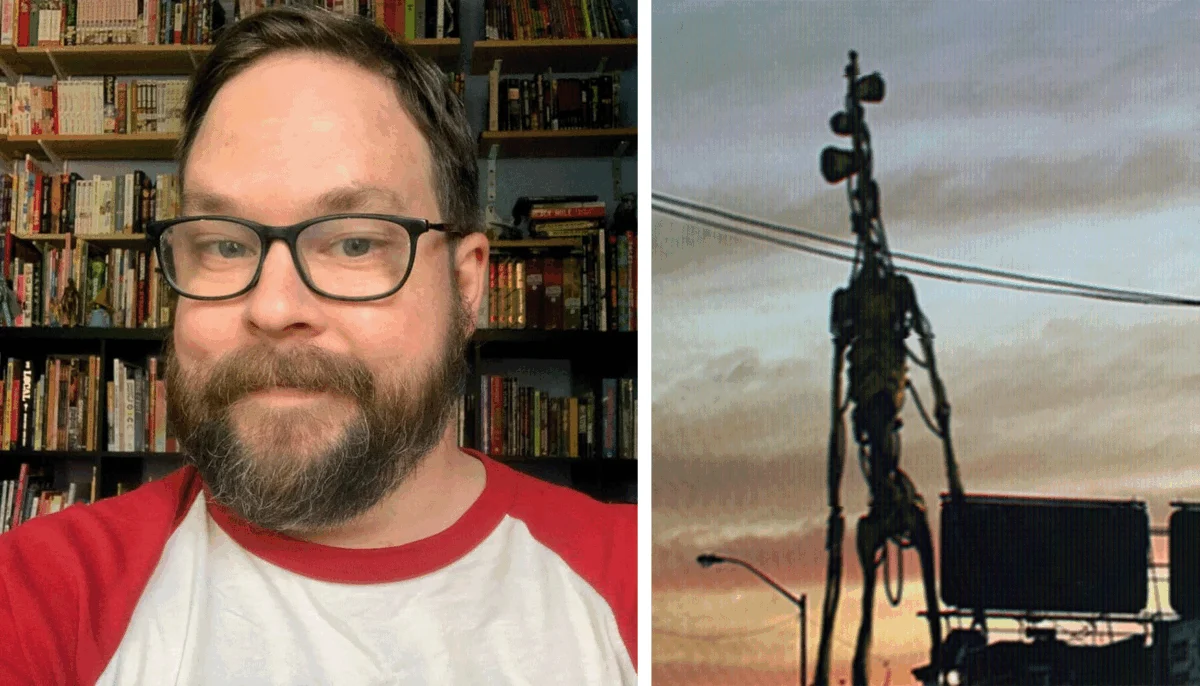
For many, the upcoming film will serve as their introduction to Siren Head, a towering, unsettling entity characterized by its lanky, humanoid frame and a head composed of megaphones that emit a cacophony of ominous, often nonsensical phrases. However, for years, this creature has been a fixture in the darker corners of the internet, cultivating a dedicated following through a sprawling tapestry of user-generated stories, unsettling imagery, independent video games, and viral videos. Like many cryptids and urban legends, Siren Head’s lore is fluid and ever-evolving, with details regarding its exact dimensions, age, capabilities, and motivations varying from one telling to another.
The singular, undeniable origin of Siren Head lies with artist Trevor Henderson, who first introduced the creature to the digital world in 2018. Henderson shared an initial drawing of Siren Head on social media, accompanied by a brief, chilling narrative that laid the foundation for its legend.
The Genesis of an Internet Legend
Henderson’s original description paints a vivid picture: "She was on vacation with her husband and they were scoping out graveyards on the way, as you do, when she saw it. Rising out of the old cemetery, big as an old (macabre) telephone pole. Was this some kind of bizarre art piece the authorities hadn’t gotten wise to yet? Even as she stepped out of the car, the megaphones on it’s ‘head’ screeched to life. ‘NINE. EIGHTEEN. ONE. CHILD. SEVENTEEN. REMOVE. VILE.’ A buzzing, doubled voice screamed random words at her. At this point, it jerked into motion, striding down the hill towards her."
This foundational narrative, with its juxtaposition of the mundane (a graveyard visit) and the terrifyingly inexplicable (a colossal, sound-blasting entity), resonated deeply with online audiences. The years since its creation have witnessed Siren Head’s meteoric rise in popularity, a trajectory that has surprised even its creator. In a recent interview, Henderson reflected on Siren Head’s journey, the impending adaptation, and the broader implications of this "internet-to-Hollywood" horror pipeline.
The Rapid Ascent to Hollywood
Henderson described the adaptation process as a whirlwind, noting the significant impact of The Backrooms‘ success. "My rep is a guy named Josh Dove who has been with me since 2020 or 2019 even," Henderson explained. "So it’s been over half a decade we shopped around a pitch of the general artwork, the world, and some of the characters. Then, when Siren Head blew up, it became more of a Siren Head-specific pitch. We had people who were interested, but when Backrooms did so well, the demand became overwhelming. Everything with the movie announcement came together in like two weeks. It was boom, boom, boom. All the way through it was like, ‘Okay, first this studio is interested. Now it’s a bidding war. Now Zach Cregger has a pitch and wants to be involved.’ It just happened incredibly fast."
This accelerated timeline underscores the studios’ newfound eagerness to capitalize on pre-established online horror brands. The success of The Backrooms, which began as a series of AI-generated images and evolved into a full-fledged cinematic universe with A24, has undoubtedly served as a powerful catalyst. Henderson believes this trend is more than a fleeting moment. "I think it’s hard to overstate how intrinsic Backrooms doing so well, and it being such a singular vision from a young, independent creative person, was to the wave we’re just sitting at the start of right now," he stated. "I think we’re going to see a lot of films made from online horror and specifically younger people’s online creative products."
The Appeal of Singular Vision and Ambiguity
Henderson attributes this shift to a growing appreciation for "competent, singular, specific vision" in filmmaking. He highlights Kane Parsons, the creator of The Backrooms, as an example of a young artist who meticulously refined his concept into a distinct and compelling entity. The successful translation of Parsons’ vision to the big screen, maintaining its unique tone and ambition, has paved the way for other internet-born creations.
A key element of Siren Head’s enduring appeal, and a concern for its adaptation, is its inherent ambiguity. The creature’s lack of a defined origin story, clear motivations, or even discernible features like eyes contributes significantly to its unnerving presence. Henderson expressed his hopes that this mystique will be preserved in the film. "I hope that a lot of that is retained," he said. "I think a lot of the stuff people enjoy about Siren Head are things like how it can blend into the background and be this large imposing figure that is also somehow very stealthy and strange. The fact that it has no clear origin… that it’s something that shouldn’t exist and the incongruous nature of that, and that it spouts nonsense words and strange signals. At least for me, that’s a lot of the appeal of the character."
He drew a parallel to the Backrooms film, which he noted also avoids detailing the origins of its central concept, suggesting that audiences are receptive to such mysteries. "I would certainly hope there’s no, ‘Here is the origin of the character, here’s where…’ because that’s completely not the point and it won’t do anything to help," Henderson emphasized. "But I am confident that will be maintained. I don’t think they’re going to do that."
Deconstructing the Fear: Why Siren Head Resonates
The intrinsic fear Siren Head evokes, often described by fans as difficult to articulate, stems from a confluence of unsettling design choices. Henderson elaborated on these elements: "I think that for me, so many elements of it just do not make sense, and that is really scary. It looks like a rotten human being, sort of. It has these rusted metal elements that are fused with it, but not in a way that would make any logical sense. Then there’s the fact that it’s spewing pure surreal, abstract nonsense and tornado sirens."
He further explained the psychological impact of the creature’s lack of eyes, a design choice he credits to H.R. Giger’s work on the Xenomorph in Alien. "That’s carried over from Giger’s design for the Xenomorph, where he insisted on it not having any eyes because you lack that connection," Henderson noted. "Any time something has eyes, you can read intent. You have this level of understanding. You remove the eyes from anything, and it becomes completely ambiguous in terms of its intentions or goals. That goes a long way to make the character scary for me, and I think people respond to that."
The Power of Found Footage and Collective Storytelling
Henderson’s artistic approach, particularly with his photo-based creature designs, deliberately leans into a "found-footage" aesthetic. This technique, reminiscent of the early viral success of The Blair Witch Project, imbues his creations with a sense of verisimilitude. "That’s a quality I try to have with every piece of art that I do with the photo-based stuff," he explained. "It’s all supposed to capture one moment from a found-footage horror movie that was never made. Kind of the one big money shot with a little bit of text underneath. On a brain level, you know it’s fake because you’re seeing impossible things. But by getting rid of a lot of the movie-making conventions, you trick your hindbrain a little bit into believing a little bit more."
This approach, combined with Siren Head’s ambiguous nature, has fostered a unique dynamic where the audience actively participates in constructing its narrative. "When I made Siren Head, I was pumping out these photobash drawings and drawing different creatures into photos that were donated to me or that I took myself," Henderson recalled. "It was almost an art-making exercise of creature design and seeing how well I could hone the skills of blending a character into a photo through lighting, texture, and color to make it look like it was there when it was taken… Having people keep returning to it over many years and having it resonate in that way, with people telling their own stories and creating their own versions of the design and fan art and everything, there’s something there that obviously clicked with people on a deep level."
The Siren Call of Internet Horror
The current surge in interest from Hollywood in internet-originating horror can be seen as a reflection of evolving audience tastes and the democratization of content creation. Platforms like YouTube, TikTok, and various online forums have become fertile grounds for burgeoning talent, allowing creators to bypass traditional gatekeepers and build direct connections with their audiences.
Henderson’s own inspiration for Siren Head stemmed from an unlikely source: number stations. "I’ve said this before, but I’m obsessed with the idea of number stations," he revealed. "I don’t know if you’re familiar, but they’re these strange, anomalous signals that actually exist on the radio waves. They’re just voices saying weird words over and over again. At the time, I was like, ‘What if that was coming from a thing? A creature instead of a radio station somewhere? What would that look like?’ That’s where Siren Head came from."
This fascination with the uncanny and unexplained has clearly resonated with a generation that grew up immersed in digital culture and a constant influx of new information and stories. The collaborative nature of the internet has allowed Siren Head’s legend to grow organically, with fans contributing their own interpretations and narratives, transforming the character into a modern-day cryptid.
A New Era for Horror Storytelling
The success of Siren Head and The Backrooms highlights a broader trend: the increasing recognition of the power of viral, community-driven content. This phenomenon is not limited to horror; similar trends are emerging in other genres as well. The ability of these online creations to capture the zeitgeist and resonate with a large audience before even reaching the development stage of a major film production offers a compelling new model for content acquisition.
Henderson sees this as an unprecedented time for "weirdo work." He acknowledges the dual nature of the internet’s embrace of a creation: "It’s a bit of a double-edged sword because you have to make peace very quickly with the internet as a whole. When it embraces something, there’s a degree to which it stops being yours, and you have to be okay with interpretations." He notes the early proliferation of "clickbaity YouTube stuff with the character specifically to appeal to children," which was initially jarring. However, he recognizes its role in the character’s enduring popularity, particularly among younger audiences. "I don’t think it would have endured the last eight years if there hadn’t been that wild fan response. Especially with kids. So it’s two things at once. It’s really weird."
He proudly points to Siren Head’s status as a "legitimate schoolyard boogeyman," passed down through oral storytelling, a testament to its organic cultural penetration. This organic growth, he believes, "outweighs any possible negatives."
The Enduring Appeal of Scary Stories for All Ages
Henderson’s perspective on children’s engagement with horror is particularly insightful. He argues that studios may have previously underestimated this appetite. "Kids love monsters, and they love being scared," he asserted. "Especially with stuff that’s made for kids but doesn’t condescend. I think it’s so important to have kids’ horror media and gateway horror media that also has stakes and isn’t talking down to them." He cites the Scary Stories to Tell in the Dark book series with Stephen Gammell’s illustrations as a formative influence, a "dark, wonderful cloud that looms over everything I’ve done for the last twenty-five years."
This notion of "gateway horror" is crucial. These stories, when crafted with genuine artistic merit and a lack of condescension, can become foundational elements of a person’s creative development. Henderson believes that for each generation, such impactful and genuinely frightening experiences serve as potent sparks for creativity.
Siren Head as a Modern Folk Monster
Reflecting on Siren Head’s role as a contemporary folk monster, Henderson connects it to historical anxieties. "For me, it’s always represented a general ambiguous sense of oncoming doom," he explained. "The fact that it’s an announcement siren that is traditionally associated with tornado sirens makes it feel like a walking portent. A walking portent of both decay and disaster." He sees it as a symbol of "ongoing doom and disaster," often depicted in rural settings, which further enhances its connection to primal fears of isolation and vulnerability.
The Future of Internet-to-Hollywood Horror
As this "internet-to-Hollywood" pipeline solidifies, the question arises: what other digital creations might be poised for cinematic translation? Henderson offers a recommendation: "Off the top of my head, there’s a newer series I really love called ‘The Glendale Archives.’ It’s about a guy who wakes up in a world where everyone is gone. It’s just him and these really upsetting entities or monsters. So it’s him trying not to go insane by himself. But it lets the series be very human-focused and character-driven. It’s mostly him talking about his worries and anxieties. And it’s also sometimes a cooking show because he’ll just go through a recipe. It feels like such a breath of fresh air for the analog horror scene."
Ultimately, Henderson hopes for a symbiotic relationship between the Siren Head movie and its online origins. "I think it’s a really great opportunity because, purposefully, the character has stood on its own without a ton of lore or narrative surrounding it," he concluded. "So I think it’s a great opportunity to build that out in a really interesting way. I don’t think it can ruin any of the art or the atmosphere or the world-building I’ve done beforehand. It can just use it as a jumping-off point. I hope a lot of that mood is preserved in the film version. But at the same time, I’m unbelievably excited to see the take on the material that Brian Duffield and Zach Cregger have internally. I hope to find out about that soon. I think both things are going to be able to coexist. I hope they will inform and help each other."
The Siren Head film represents more than just another horror movie; it signifies a cultural shift, where the collective imagination of the internet is increasingly shaping the narratives that captivate and terrify us on the grandest cinematic scale.