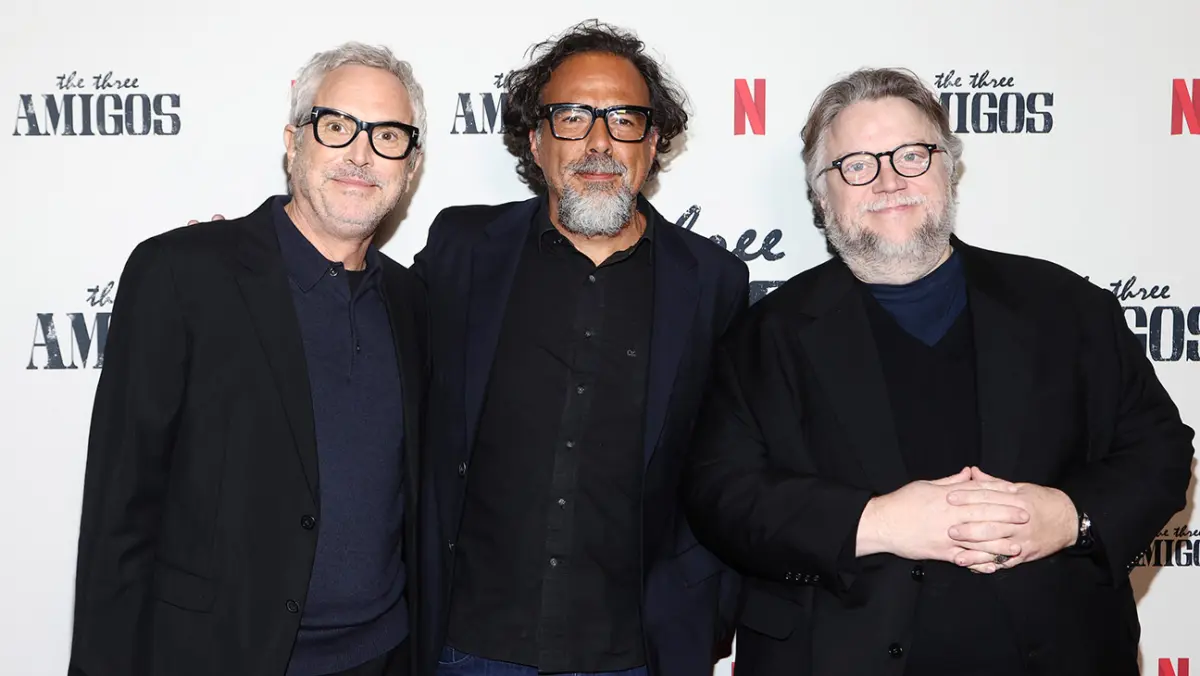
As Alejandro G. Iñárritu’s latest ambitious project, Digger, encounters a significant box-office downturn, the film industry has witnessed a rare display of solidarity from two of cinema’s most respected figures. Guillermo del Toro and Alfonso Cuarón, the long-time collaborators and close confidants of Iñárritu, have stepped forward to defend the project, underscoring a deep-seated professional and personal alliance that has spanned three decades. Their intervention serves as a poignant reminder of the "Three Amigos"—a trio of Mexican filmmakers who collectively transformed the landscape of modern Hollywood.
A Public Stand for Artistic Ambition
The defense of Digger began when Guillermo del Toro publicly criticized an IGN opinion piece that advised audiences to forgo a theatrical viewing of the Tom Cruise-led production in favor of waiting for a streaming release. Del Toro characterized the sentiment as "entirely petty," arguing that the film represents a rare example of grand-scale, ambitious filmmaking that demands the immersive environment of a cinema. By highlighting the $180 million budget—a figure that positions the movie as a high-stakes blockbuster—del Toro emphasized that such projects are increasingly endangered in a market dominated by safer, franchise-based content.
Simultaneously, Alfonso Cuarón utilized his digital platform to provide historical context for the harsh reception of Digger. He shared a series of historical critical pans for films that were initially dismissed by critics but later cemented their status as foundational masterpieces, including Stanley Kubrick’s 2001: A Space Odyssey, Ridley Scott’s Blade Runner, Fritz Lang’s Metropolis, and Stanley Kubrick’s The Shining. The message was clear: immediate box-office or critical reception is an imperfect metric for determining the long-term cultural value of a film.
The Origins of a Creative Triumvirate
The bond between Iñárritu, del Toro, and Cuarón is rooted in a shared history that predates their rise to global superstardom. In the late 1980s, Cuarón and del Toro began their professional trajectories within the orbit of Mexican television, specifically through the anthology series La Hora Marcada. This period of creative incubation also featured the early work of cinematographer Emmanuel "Chivo" Lubezki, who would go on to win three consecutive Academy Awards for Best Cinematography.
Iñárritu’s path was distinct, emerging from a successful career in Mexico City radio and commercial advertising before transitioning into feature filmmaking. His introduction to Cuarón in the mid-1990s marked a pivotal turning point. Cuarón, already gaining traction in Hollywood, became a mentor to Iñárritu. The trio’s collaborative synergy truly crystallized around the release of Iñárritu’s 2000 debut, Amores Perros. Following Cuarón’s advice, Iñárritu shared a rough cut of the film with del Toro. The resulting feedback—which included a candid early-morning phone call during which del Toro praised the film as a masterpiece while simultaneously critiquing its length—led to an intensive, hands-on editing process in Mexico City.
This dynamic of "private critics" became the standard operating procedure for the group. Throughout the 2000s and 2010s, they acted as unofficial editors, script doctors, and strategic advisers on one another’s projects, ranging from the gritty realism of Amores Perros and Y Tu Mamá También to the technical marvels of Gravity, Birdman, and Crimson Peak. In 2007, they formalized this relationship by founding Cha Cha Cha Films, a production company that secured a significant multi-year deal with Universal Pictures, signaling their arrival as a collective power force in the industry.
The Golden Age of the Amigos: Data and Dominance
The economic success of the Three Amigos during the 2010s was nothing short of historic. By balancing intensely personal narratives with massive production scales, they consistently defied the traditional Hollywood binary of "art-house" versus "blockbuster."
- Birdman (2014): Produced on a lean $18 million budget, the film grossed over $100 million worldwide, proving that high-concept storytelling could achieve significant ROI.
- The Shape of Water (2017): Del Toro’s dark fantasy project, budgeted at roughly $20 million, earned nearly $200 million globally, further validating his singular vision.
- Gravity (2013): Cuarón’s technical feat, with a budget exceeding $100 million, pulled in roughly $700 million at the box office, setting a benchmark for the commercial viability of auteur-driven spectacle.
- The Revenant (2015): Iñárritu’s grueling, $135 million production generated over $530 million, demonstrating that even the most difficult, uncompromising shoots could find a massive audience.
This string of successes culminated in an unprecedented era of Academy Award recognition. Between 2014 and 2019, the three friends collectively won the Oscar for Best Director five times in six years. Cuarón claimed the honor twice, Iñárritu twice, and del Toro once. This streak effectively made them the most influential voices in contemporary American cinema, holding a near-monopoly on the industry’s highest honors.
Digger and the Shifting Winds of Studio Logic
Digger represents Iñárritu’s first major studio foray since The Revenant. The project was born from a decade-long development cycle that began shortly after his 2015 success. After a detour to direct the more intimate, Spanish-language Netflix production Bardo in 2022, Iñárritu pivoted back to the grand scale of Digger. Collaborating with playwright Sabina Berman, he began drafting the script in 2017. The involvement of Tom Cruise was essential to securing the green light for the project’s substantial budget.
However, the film’s current struggle at the box office suggests a changing landscape in how major studios view risk. The failure of Digger arrives closely on the heels of the underperformance of Bong Joon Ho’s Mickey 17, another $100 million-plus Warner Bros. investment in a high-profile, Oscar-winning auteur.
Industry analysts point to a "correction" in how studios evaluate high-budget bets. With the media landscape shifting—exemplified by the recent consolidation of major studios like Paramount and Warner Bros.—there is a growing aversion to "nine-figure gambles" on original properties. The era that allowed the Three Amigos to flourish may be receding, replaced by a more conservative approach focused on proven intellectual property and lower-risk financial models.
Implications for the Future of Auteur Cinema
The defense offered by del Toro and Cuarón for Digger is not merely an act of friendship; it is an ideological statement regarding the necessity of the theatrical experience. Their careers have been built on the premise that a director’s vision should dictate the scale of the production, not the other way around.
If studios continue to shy away from the type of high-stakes, auteur-driven cinema that Iñárritu, Cuarón, and del Toro have championed, the industry may face a period of homogenization. The "Three Amigos" have spent nearly three decades serving as the final line of defense for each other’s creative choices, providing the brutal, honest feedback that turns good films into cultural milestones. With Digger, they have once again assumed this role, signaling that regardless of the box-office outcome, the pursuit of ambitious, singular filmmaking remains a cause worth defending.
Whether Digger will undergo a critical and cultural reappraisal in the coming years, as the films cited by Cuarón did, remains a matter of historical precedent. For now, the film stands as a testament to the risks inherent in the auteur model—and the enduring loyalty of a group of filmmakers who redefined the parameters of Hollywood success.