In a landscape often dominated by established franchises and colossal production budgets, "The Toymaker’s Key," an independently produced British animated feature, emerges as a singular and often perplexing artistic endeavor. Described by its creators as a "motion comic film," this ambitious project is a testament to the power of a small, dedicated team, with its end credits revealing a core group of just over a dozen individuals, including a notable six who contributed to the film’s closing musical score. The film’s narrative, while borrowing heavily from familiar fantasy and science fiction tropes, presents a unique visual and thematic tapestry that challenges conventional animation paradigms.
A Visual Tapestry of Eclectic Influences
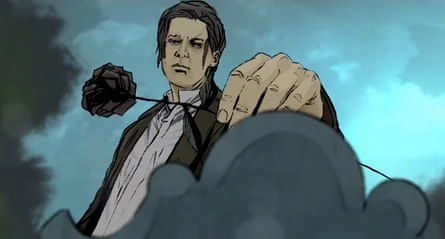
The visual aesthetic of "The Toymaker’s Key" is as striking as it is unconventional. The filmmakers have synthesized a range of influences, resulting in a distinctive "motion comic" style. This approach blends elements of traditional animation with techniques that evoke the static panels of comic books, enhanced by dynamic camera movements and strategic close-ups. The animation itself is a carefully curated blend of animatics, employing limited character movement, and moments of startlingly realistic facial animation. These hyper-realistic expressions, often achieved through advanced CGI rendering akin to digital rotoscoping, create a fascinating juxtaposition with the more stylized elements of the film.
The film’s visual vocabulary draws inspiration from a wide array of sources. Characters exhibit a classic fantasy archetype with "chiselled-cheeked heroes," while supporting figures feature "duplicitous helpers with parti-coloured hair," a common trope in anime. The world-building incorporates fantastical elements such as "purple-skinned butterfly people," whose female inhabitants are depicted with a distinctive, anatomically idealized form. Furthermore, the inclusion of "Metropolis-like robot workers" hints at a retro-futuristic sensibility, while a strong undercurrent of "steampunk futurism," filtered through the lens of Japanese anime, further enriches the film’s visual identity. This deliberate amalgamation of disparate visual styles, while potentially disorienting for some viewers, underscores the film’s experimental nature and its ambition to forge a new path in animated storytelling.
Narrative Complexity and Thematic Undercurrents
The narrative structure of "The Toymaker’s Key" is characterized by its intricate, often non-linear, progression. The plot weaves together multiple storylines, employing flashbacks and flashforwards that, while contributing to the film’s thematic depth, can occasionally lead to a sense of narrative fragmentation. At its core, the story follows Tommy Hargreaves, a soldier returning home from the Second World War. His homecoming is met with tragedy: the death of his mother and the mysterious disappearance of his father, Charles.
Charles Hargreaves is revealed to be a gifted toymaker, deeply attached to an object of profound significance – the titular "key." His disappearance is not a simple vanishing act, but rather a deliberate passage into a self-created realm, accessible through an ethereal portal. This fantastical dimension is not a singular entity but a series of interconnected worlds, each with its own unique inhabitants and characteristics. Among these are the aforementioned butterfly people, a society of formidable "butch-looking ice ballerinas," and the domain of the film’s primary antagonist, who resides in a formidable "castle in the sky."
The driving force of the plot becomes Tommy’s quest to locate both the missing key and his father. This arduous journey, compressed into a running time of approximately 70 minutes, feels significantly longer due to the film’s often "overwrought dialogue." The screenplay, while ambitious in its scope, has been noted for its derivative nature, drawing from established narrative frameworks within the fantasy and science fiction genres.
Production Background and Independent Spirit
The production of "The Toymaker’s Key" represents a significant achievement for a micro-budget independent film. The dedication of its small team is evident in every frame, showcasing the potential of modern digital tools to empower independent creators. The film’s production timeline, while not explicitly detailed in available information, can be inferred to span several years, a common characteristic of projects undertaken by small teams with limited resources. The commitment to a distinctive visual style, rather than attempting to mimic mainstream animation, suggests a deliberate artistic choice to explore alternative avenues of cinematic expression.

The filmmakers’ self-description as a "motion comic film" is crucial to understanding their artistic intent. This label suggests a deliberate departure from the fluid, continuous motion typically associated with traditional animation. Instead, the film likely embraces a more episodic, panel-driven aesthetic, utilizing sophisticated digital techniques to imbue these static elements with dynamism and life. This approach allows for a unique storytelling rhythm, potentially offering a more intimate and visually striking experience for the audience.
Artistic Merit and Future Implications
Despite its narrative and stylistic eccentricities, "The Toymaker’s Key" has garnered a degree of admiration for its sheer audacity and its commitment to an independent vision. While the film is described as "almost entirely humourless," its unique approach to animation and storytelling sets it apart from more conventional fare. For aspiring animators and filmmakers, the film offers a valuable case study in what can be achieved with "modern tech" when coupled with creativity and perseverance. It suggests a potential future for filmmaking that prioritizes innovative artistic expression over the often risk-averse, IP-driven strategies of the mainstream industry.
The film’s reception among critics and audiences, while varied, highlights its polarising nature. Some viewers may find the derivative script and unconventional animation off-putting. However, others are likely to appreciate its bold experimentation and its departure from formulaic storytelling. The "car crash of storylines" mentioned in initial descriptions, while potentially indicative of narrative challenges, also points to a willingness to take risks and explore complex thematic territories.
The film’s success, in its own right, lies in its ability to spark conversation and inspire a new generation of filmmakers to consider alternative production models. In an era where the cost of entry for digital filmmaking continues to decrease, projects like "The Toymaker’s Key" serve as powerful examples of what can be accomplished with passion, ingenuity, and a clear artistic vision. The independent animation scene, often a breeding ground for groundbreaking ideas, finds in this British feature a compelling addition that pushes the boundaries of what is possible.
Broader Impact and The Future of Independent Animation
The emergence of "The Toymaker’s Key" in the independent film circuit carries significant implications for the future of animation. It challenges the notion that high production values and extensive budgets are prerequisites for compelling storytelling. By embracing a "motion comic" aesthetic, the film demonstrates how innovative techniques can be employed to create visually distinctive and engaging narratives even with limited resources. This democratizing effect of technology is crucial for fostering a diverse and vibrant filmmaking landscape.
Furthermore, the film’s commitment to a unique artistic identity, rather than conforming to established industry trends, resonates with a growing audience seeking original content. In a market saturated with sequels and reboots, independent films that offer a fresh perspective and a distinct voice are increasingly valuable. "The Toymaker’s Key," with its blend of ambitious storytelling and experimental visual design, exemplifies this trend.
The film’s potential impact extends to educational institutions and aspiring animators. It serves as a tangible example of how modern digital tools can be harnessed to create professional-quality animated features without the need for massive studio infrastructure. The ability to experiment with different animation styles, character designs, and narrative structures, as demonstrated by "The Toymaker’s Key," empowers creators to push creative boundaries and define their own artistic paths.
While "The Toymaker’s Key" may not achieve mainstream commercial success, its artistic merit and its pioneering spirit are undeniable. It stands as a beacon for independent filmmaking, illustrating that compelling narratives and innovative visual experiences can be crafted by dedicated teams working outside the traditional studio system. As digital technology continues to evolve, the lessons learned from projects like "The Toymaker’s Key" will undoubtedly shape the future of animated storytelling, encouraging a more diverse, experimental, and ultimately, more exciting cinematic future. The film’s very existence is a testament to the enduring power of independent vision in the face of overwhelming industry conformity, offering a glimpse into a future where creative ambition, rather than financial might, dictates the boundaries of cinematic possibility.