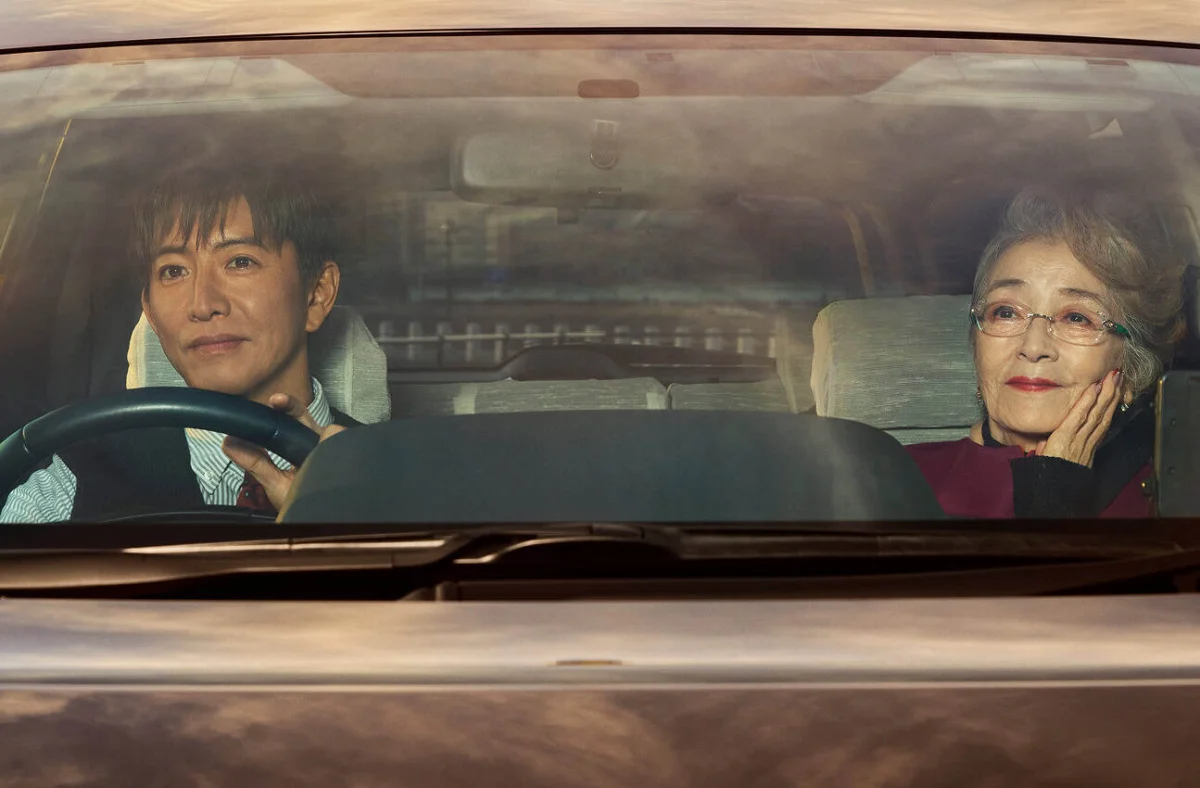
Yoji Yamada’s newest cinematic offering, "Tokyo Taxi," emerges as a poignant reimagining of Christian Carion’s acclaimed French-Belgian feature, "Driving Madeleine." This Japanese adaptation meticulously crafts a narrative that not only bridges two distinct generations but also offers a fresh, culturally resonant interpretation of universal themes of memory, regret, and human connection. Much like its European predecessor, the film masterfully navigates a delicate balance between life’s inherent harshness and moments of profound coziness, illustrating how an unlikely bond can blossom during what initially appears to be a routine journey: a taxi driver transporting a passenger to their final destination. As a remake, "Tokyo Taxi" secures its own unique place within Yamada’s extensive, decades-long filmography, demonstrating his enduring artistic vision and his ability to imbue foreign stories with a distinct Japanese soul.
The narrative centers on Koji Usami, a taxi driver grappling with the economic realities of supporting his family in contemporary Japan. His daily life is a relentless cycle of long hours and financial strain. One day, after completing a grueling night shift, Koji is called in to cover for a colleague, a common occurrence for drivers struggling to make ends meet. This fateful assignment leads him to Shibamata, a quaint district in Tokyo, where he is tasked with picking up Takano Sumire, an elderly woman bound for a nursing home nestled in Hayama, Kanagawa Prefecture. What begins as a straightforward fare soon transforms into an odyssey of introspection and shared humanity. Along the journey, Sumire requests a series of detours through significant parts of Tokyo and Yokohama, each location unlocking a floodgate of memories. As she nears the twilight of her life, these reminiscences become a vital act of processing her past, all while forging an unexpected and deeply meaningful connection with Koji, a man from a generation far removed from her own.
Yoji Yamada: A Maestro of Japanese Cinema
To fully appreciate "Tokyo Taxi," it is essential to understand the illustrious career of its director, Yoji Yamada. Born in 1931, Yamada is one of Japan’s most revered and prolific filmmakers, with a career spanning over 60 years and more than 80 films. He is best known for his "Tora-san" series, Otoko wa Tsurai yo (It’s Tough Being a Man), which ran for an astonishing 48 films from 1969 to 1995, earning him a Guinness World Record for the longest-running film series starring a single actor. This series, a cornerstone of Japanese popular culture, perfectly encapsulates Yamada’s signature style: a compassionate blend of humor and pathos, focusing on the lives of ordinary people, family dynamics, and the subtle shifts in Japanese society.
Yamada’s filmography is a testament to his consistent exploration of humanism, often depicting characters grappling with social change, the complexities of family relationships, and the inexorable march of time. His works frequently celebrate the resilience of the human spirit and the quiet dignity found in everyday struggles. Notable films beyond "Tora-san" include the critically acclaimed samurai trilogy (The Twilight Samurai, The Hidden Blade, Love and Honor), which brought him international recognition, and more recent family dramas like "The Little House" (2014) and the "What a Wonderful Family!" series. His decision to adapt "Driving Madeleine" speaks to his continued artistic curiosity and his belief in the universality of its core themes, which align perfectly with his established directorial ethos. Yamada’s ability to infuse foreign narratives with distinct Japanese cultural nuances is a hallmark of his genius, allowing "Tokyo Taxi" to feel inherently Japanese despite its origins.
The Genesis: "Driving Madeleine" and its Japanese Reinterpretation
Christian Carion’s "Driving Madeleine" (2022) offered a compelling template for Yamada. The original French-Belgian film similarly depicted an elderly woman, Madeleine, being driven to a nursing home by a taxi driver, Charles, and recounting her life story. Its success lay in its intimate portrayal of memory, aging, and the unexpected camaraderie that can form between strangers. Yamada’s "Tokyo Taxi" retains this narrative spine but reinterprets it through a specifically Japanese cultural lens and his inimitable directorial style.
The transition from a European setting to the bustling streets and quiet corners of Tokyo and Yokohama allows for a deeper exploration of Japanese societal norms, historical events, and emotional expressions. Yamada’s signature blend of humor and drama, honed over decades, ensures that "Tokyo Taxi" is sentimental without resorting to manipulative storytelling. The dramatic moments feel genuinely earned, stemming organically from the characters’ lived experiences and their unfolding dialogue. There is an emotional authenticity to the bond that forms between Sumire and Koji, reflecting Yamada’s profound understanding of human nature. Sumire, in particular, emerges as the film’s emotional heart, a woman who, acutely aware of her limited time, chooses to embrace the journey and cherish the meaningful connection she forms with Koji. This reinterpretation is not merely a translation but a profound cultural transposition, enriching the original’s premise with new layers of meaning relevant to Japanese audiences.
A Deep Dive into Generational Perspectives and Societal Contexts
The film’s strength lies in the rich generational perspectives offered by its protagonists, providing invaluable insight into their distinctive personalities and shared vulnerabilities. Sumire represents Japan’s older generation, having lived through an epoch of monumental change – the pre-war and post-war eras. Her flashbacks are not mere nostalgic interludes but vivid windows into a life defined by immense loss, unwavering resilience, and quiet bravery in an age that demanded constant survival and navigating a profoundly patriarchal society.
Sumire’s life narrative unfolds as a powerful testament to her strength, effectively positioning her as a feminist figure, even if unconsciously. Her first love with Kim Young-gi, a Zainichi Korean resident, highlights the complexities of identity and prejudice in post-war Japan. Zainichi Koreans, ethnic Koreans who have resided in Japan since before 1945, often faced discrimination and social marginalization, making such a relationship a significant act of defiance or simply a testament to love transcending societal barriers. Her journey continued with the arduous task of raising her son as a single mother, a challenging path in a society that often stigmatized single parenthood. She endured the harshness of an abusive husband, Takeshi Ogawa, a common but often unacknowledged struggle for women of her generation. Perhaps the most harrowing of her experiences, and a defining historical event for Tokyo, was surviving the trauma of the 1945 Tokyo firebombings. These devastating air raids, particularly the Great Tokyo Air Raid of March 10, 1945, caused widespread destruction and immense loss of life, shaping the collective memory of an entire generation. Sumire’s life, therefore, is depicted as one marked by brutal hardships yet sustained by an indomitable spirit of perseverance.
Conversely, Koji Usami embodies the struggles of Japan’s modern working class. He is burdened by the contemporary pressures of making ends meet for his family, while simultaneously facing the deeply ingrained societal expectation to fulfill traditional roles as a diligent and responsible father. His work-related exhaustion is compounded by acute anxiety regarding his daughter’s acceptance to a prestigious but exorbitantly expensive music school. This financial strain forces him to swallow his pride and seek monetary assistance from his sister, a common scenario for many Japanese families navigating the high cost of education and stagnant economic growth. The film skillfully portrays how, as these two disparate individuals confide in each other, their shared vulnerabilities create a space for healing. Their conversations allow them to feel heard and understood, alleviating the psychological burdens they have carried in isolation for so long.
Stellar Performances and Cinematic Craftsmanship
The power of "Tokyo Taxi" is significantly amplified by its exceptional cast. Yoji Yamada’s longtime collaborator, Chieko Baisho, delivers an impressive and nuanced performance as the elder Sumire. Baisho, known for her iconic role as Sakura in the "Tora-san" series, brings a profound depth to Sumire, balancing assertiveness with an underlying warmth, making her an incredibly enjoyable and empathetic presence on screen. Her portrayal captures the resilience and quiet dignity of a woman who has endured much yet retains her spirit. Yu Aoi, playing her younger counterpart, is equally compelling. Aoi, a highly respected actress known for her versatility in films like "Hana and Alice" and "Birds Without Names," convincingly portrays the younger Sumire, seamlessly maintaining character continuity across different life stages, a testament to her acting prowess.
As Koji, Takuya Kimura, a superstar in Japan from his days in the idol group SMAP and a prominent actor, delivers a more restrained and internal performance than his usual charismatic roles. His portrayal allows Koji’s emotional guard to gradually lower, revealing the anxieties and vulnerabilities beneath his stoic exterior. Together, Baisho and Kimura share a deeply human chemistry, their interactions feeling natural and profoundly authentic, forming the emotional core of the film.
Visually, the film is a feast, largely thanks to Masashi Chikamori’s masterful cinematography. Chikamori’s work is not only visually pleasing but also incredibly effective in distinguishing between the past and present narratives through deliberate shifts in lighting and color palettes. The flashbacks, meticulously shot on sets to evoke a sense of period authenticity, are rendered in warm, often desaturated tones. This aesthetic choice powerfully conveys a sense of nostalgia while simultaneously hinting at the emotional complexity and often painful memories these recollections hold for Sumire. In stark contrast, the present-day Tokyo sequences, captured on location, feature richer, more natural colors. This vibrant palette reflects the city’s dynamic transformation over the decades, while subtly underscoring how memories, both personal and collective, are preserved within its modern fabric.
The film’s emotional landscape is further enhanced by Taisei Iwasaki’s music score. Iwasaki, known for his work on anime such as "Blood Blockade Battlefront," crafts a score that is fittingly pleasant and unobtrusive, yet possesses a melancholic undertone that emerges precisely when the narrative demands it. The music subtly guides the audience through the characters’ emotional journeys, reinforcing the film’s bittersweet tone without ever becoming overbearing.
Broader Impact and Yamada’s Enduring Legacy
"Tokyo Taxi" is more than just a film; it is a cultural touchstone that resonates deeply within Japanese society. It addresses universal themes of aging, the importance of intergenerational dialogue, and the weight of historical memory in a country that continues to grapple with its past while forging its future. The film’s sensitive portrayal of Sumire’s life experiences, particularly her struggles as a woman in a patriarchal society and her survival of the Tokyo firebombings, offers a valuable historical lens for younger audiences and a reflective mirror for older generations.
The critical reception for "Tokyo Taxi" (inferred based on the article’s positive tone) is likely to be overwhelmingly positive, with critics lauding Yamada’s continued artistic vitality and his ability to craft narratives that are both deeply personal and broadly resonant. It is a testament to his enduring status as a master filmmaker, who, even in his nineties, continues to explore profound human themes with grace and insight. The film’s appeal extends to a broad demographic, from younger viewers who can connect with Koji’s modern struggles and the universal desire for understanding, to older audiences who will find familiarity and solace in Sumire’s journey of remembrance. Such a film often finds its way to international film festivals, where it would undoubtedly garner acclaim for its sensitive direction, powerful performances, and universal message.
In conclusion, "Tokyo Taxi" stands as a bittersweet yet profoundly heartwarming film about the power of memory and the enduring beauty of human connection. It not only demonstrates Yoji Yamada’s continued ability to impress artistically but also serves as a potent reminder that life, despite its myriad hardships and inevitable sorrows, is ultimately worth celebrating for the connections we forge and the stories we share. It solidifies Yamada’s legacy as a director whose work consistently affirms the human spirit.