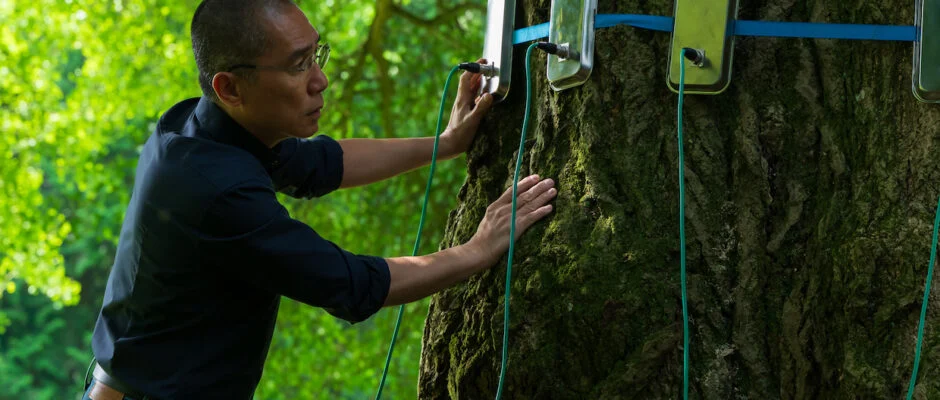
Hong Kong cinema luminary Tony Leung Chiu-wai, renowned for his nuanced performances and captivating screen presence, has recently captivated audiences in Hungarian filmmaker Ildikó Enyedi’s latest feature, Silent Friend. The film, which opened in US theaters on May 8 via 1-2 Special, casts Leung as a neuroscientist in its concluding segment, navigating a world grappling with the profound isolation of the COVID-19 pandemic while forging an unexpected bond with a venerable German ginkgo tree. This role, emblematic of Leung’s career-long pursuit of complex characters and deep thematic exploration, underscores his enduring appeal and artistic evolution.
A Journey Through Time and Consciousness: Silent Friend
Silent Friend unfolds across three distinct time periods—1908, 1972, and 2020—each featuring characters whose lives intersect with a singular, nearly 200-year-old ginkgo tree. Leung’s segment is set in the near-present of 2020, where his character, a dedicated neuroscientist, finds his critical research into newborn brain activity abruptly halted by the global health crisis. Confined and contemplative, he develops a profound fascination with the ancient tree, embarking on an introspective quest to discover a neurological link between his own consciousness and that of the ginkgo. This premise delves into nascent scientific theories surrounding plant intelligence and sentience, a field that has gained increasing traction in recent decades. Researchers globally are exploring complex communication networks in plants, their ability to remember, and their sophisticated responses to environmental stimuli, challenging anthropocentric views of consciousness. Leung’s character embodies this curiosity, seeking evidence of a shared, deeper awareness beyond the human realm.
For Leung, the film’s narrative resonated deeply with his personal experience of the pandemic. He recounted being isolated in Tokyo, a city he knew sparingly, during the initial lockdowns. The eerie quiet of deserted streets, a stark contrast to the city’s usual vibrancy, mirrored the desolate urban landscape depicted in Silent Friend. This shared experience allowed him to bring an authentic layer of solitude and introspection to his character, bridging the gap between fiction and his lived reality, albeit with the film offering the solace of nature that his urban confinement lacked.
The Unrivaled Legacy of a Cinematic Icon
Tony Leung Chiu-wai’s career trajectory is a testament to his versatility and commitment, spanning over four decades and cementing his status as one of Asia’s most revered actors. His journey began in 1982 as a co-host on a children’s television show, a humble start that quickly propelled him into leading roles in Hong Kong television dramas and subsequently, film. He has traversed an extraordinary array of genres, from poignant romances and laugh-out-loud comedies to intense thrillers, speculative sci-fi, and deeply psychological dramas, consistently delivering performances that resonate with critics and audiences alike.
His collaborations with some of cinema’s most acclaimed directors have defined pivotal chapters of his career. His iconic partnership with Wong Kar-wai, beginning with Days of Being Wild (1990) and culminating in masterpieces like Chungking Express (1994), Happy Together (1997), and the universally celebrated In the Mood for Love (2000), has yielded some of the most indelible images in contemporary film history. In the Mood for Love, which earned him the Best Actor award at the Cannes Film Festival, showcased his ability to convey profound longing and unspoken emotion through minimal dialogue and exquisite physical presence. This film alone cemented his international reputation and became a benchmark for romantic drama.
Beyond Wong Kar-wai, Leung has lent his talent to a pantheon of cinematic visionaries. He starred in John Woo’s seminal action films Hard Boiled (1992) and Bullet in the Head (1990), demonstrating his prowess in high-octane sequences without sacrificing character depth. His work with Hou Hsiao-hsien in A City of Sadness (1989), which won the Golden Lion at the Venice Film Festival, was a crucial early career highlight, offering a powerful portrayal of a family caught in the aftermath of Taiwan’s White Terror. Ang Lee’s Lust, Caution (2007) saw him delve into a morally ambiguous spy thriller, while Zhang Yimou’s Hero (2002) presented him in a visually stunning wuxia epic. Johnnie To, another frequent collaborator, has utilized Leung’s abilities in genre-bending crime thrillers like The Longest Nite (1998) and Infernal Affairs (2002). The latter, a Hong Kong box office phenomenon, received critical acclaim and was famously remade by Martin Scorsese as the Academy Award-winning The Departed, underscoring the enduring impact of Leung’s original portrayal of an undercover cop. These roles, alongside his work in A City of Sadness and In the Mood for Love, stand as cornerstones of his extensive and decorated filmography, earning him numerous accolades including multiple Hong Kong Film Awards and Taiwan’s Golden Horse Awards for Best Actor.
Beyond the Script: Leung’s Meticulous Craft
Leung’s distinctive acting style is often characterized by an unparalleled commitment and empathy he brings to every role, from a reporter to a policeman, a smuggler, or a neuroscientist. His "penetrating gaze" is frequently cited as one of his most distinctive attributes, capable of conveying volumes of unspoken emotion and inner turmoil. Director Ildikó Enyedi echoed this sentiment, remarking on the profound expressiveness of his eyes, which Leung himself attributed to a difficult childhood that necessitated learning to internalize and conceal feelings. This early life experience, according to Enyedi, cultivated a deep well of introspection that now informs his on-screen intensity.

Enyedi specifically sought "the person behind Tony" for the role in Silent Friend, drawn by what she perceived as a gentle yet strong attentiveness to the world, akin to a monk or a dedicated scientist. She recalled an interview for Shang-Chi and the Legend of the Ten Rings where, despite the highly structured nature of a Hollywood press junket, Leung genuinely sought to engage in real conversation, displaying an inherent curiosity rather than relying on pre-prepared answers. This authenticity, his natural inclination to explore and understand, was precisely the quality Enyedi desired for her character, a scientist driven by a similar insatiable quest for knowledge.
Leung’s preparation for Silent Friend exemplifies this dedication. He embarked on an intensive, six-month research period before production even began, driven by a desire to inhabit his character as unconsciously as possible. Lacking extensive character information in the initial script, he immersed himself in the world of neuroscience, studying early cognitive development and engaging with real neuroscientists from various universities. His ambition extended to experiencing EEG studies on children, though practical limitations prevented this. Simultaneously, he delved into plant intelligence and the philosophy of consciousness, building a comprehensive intellectual framework for his role. This rigorous academic immersion, coupled with hiring a British accent coach to subtly hint at an Oxford or Cambridge background for his character, underscores his meticulous approach to embodying a persona. This contrasts sharply with the often more constrained environment of Hollywood productions, where, as Leung noted, improvisation is limited, and every word is typically pre-scripted, unlike the greater flexibility he experienced in Silent Friend or the collaborative, less structured process of a film like Tran Anh Hung’s Cyclo.
His experience on Cyclo, filmed in Vietnam amidst challenging censorship conditions where the cinematographer couldn’t review footage until after leaving the country, further illustrates his adaptability. Leung maintained that the censorship issues did not impede his performance due to his deep understanding of the script and an exceptionally close working relationship with director Tran Anh Hung and co-star Trần Nữ Yên Khê. Spending a month in Vietnam prior to shooting, sharing accommodations, listening to curated music, and engaging in continuous discussions with the director fostered an intimate understanding of the film’s vision and allowed him to internalize the narrative. This instinct-driven approach to choosing collaborators, prioritizing the director’s vision and personal connection over the script itself, remains a cornerstone of his artistic philosophy.
Embracing the Darker Hues: A Shift to Antagonism
In recent years, Tony Leung has broadened his artistic palette by embracing a series of antagonist roles, a departure from many of his more romantic or heroic characters. This shift includes his compelling portrayal of Xu Wenwu, the complex and powerful villain in Marvel’s Shang-Chi and the Legend of the Ten Rings (2021), a role that introduced him to a new generation of global audiences. He also recently embodied the ruthless real estate tycoon Henry Ching Yat-yin in The Goldfinger (2023) and a corrupt Hong Kong policeman in Where the Wind Blows (2022).
Leung expressed a keen interest in exploring these darker mindsets, viewing them as opportunities to delve into characters he rarely gets to portray. His portrayal of Sam, the menacing policeman in Johnnie To’s The Longest Nite, remains one of his darkest and most memorable performances. He recalled the unique experience of working with To on that film, noting the director’s unconventional approach of shooting without a full script, allowing for a more fluid and improvisational creative process. This freedom to explore the unknown, to inhabit a character far removed from his own reality, proved immensely enjoyable for him.
For The Goldfinger, Leung took on the role inspired by the real-life, enigmatic figure of George Tan, the mastermind behind the notorious Carrian Group financial scandal of the 1980s. Having only heard whispers of Tan in his youth, Leung was given the book The Joker’s Downfall (also known as Carrian: a True Story of Murder, Mystery and Mayhem) by writer-director Felix Chong. The book unveiled a shadowy world of financial deception and even murder, prompting Leung to wonder how such events could transpire in Hong Kong with such impunity. Despite extensive research into Tan’s associates, the man himself remained a mystery, forcing Leung to rely on the book’s narrative and his own interpretive instincts to craft a portrayal of a figure whose true nature remains elusive even today. This exploration of the morally grey and the outright villainous showcases his continuous drive to challenge himself and push the boundaries of his acting repertoire.
Global Recognition and Future Horizons
Tony Leung’s recent promotional tour for Silent Friend brought him to New York, marking his first time promoting a film in the city in nearly 25 years. This visit coincided with a prestigious retrospective of his work at Film at Lincoln Center, a testament to his enduring impact on global cinema. These events, alongside his appearance at the Busan International Film Festival, underscore his continued relevance and international appeal. The retrospective, a curated journey through his extensive filmography, allowed audiences to revisit the breadth and depth of his performances, reaffirming his status as a living legend.
Looking ahead, Leung has confirmed plans to reunite with Johnnie To for another film, with the script currently in development. This highly anticipated collaboration is tentatively scheduled for late 2027, following his commitments to two other projects. The prospect of these two cinematic titans joining forces again, especially given their history of pushing creative boundaries, signals an exciting chapter in Leung’s illustrious career. His dedication to exploring diverse roles, collaborating with visionary directors, and continually refining his craft ensures that Tony Leung Chiu-wai remains a vital and evolving force in international cinema, continuing to captivate audiences with his profound talent and unwavering commitment to his art.