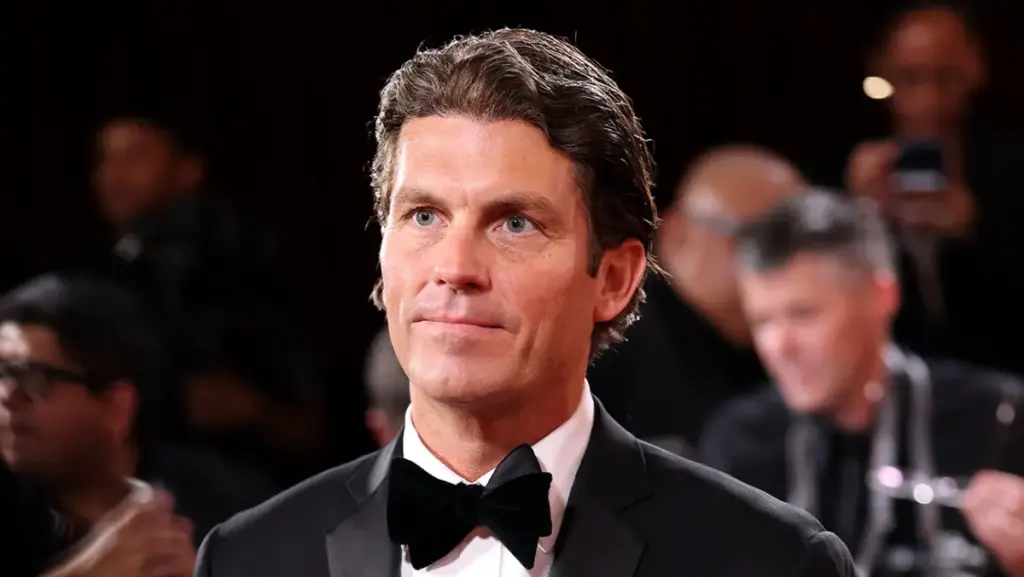
The long-standing tension between legacy television studios and emerging digital media platforms has reached a new boiling point as Warner Bros. Television (WBTV) has officially challenged Fox News Media and production house Lionsgate over the marketing tactics used for the upcoming reality series The Vow. The conflict centers on allegations of trademark infringement and unfair competition, specifically concerning the promotional materials for the new dating show hosted by Chris Harrison, the longtime former face of ABC’s The Bachelor franchise.
According to legal correspondence dated September 18, Warner Bros. Television contends that the marketing campaign for The Vow is an overt attempt to trade on the intellectual property and goodwill of its multi-billion-dollar Bachelor franchise. The studio claims that the promotional assets, which include visual motifs and terminology synonymous with the ABC series, are intended to confuse potential viewers and capitalize on the established brand identity of a competitor.
Chronology of the Dispute
The escalation of this legal battle follows a specific timeline of events that began last month:
- August 2024: Fox Nation officially announces the development of The Vow, a new reality dating series hosted and produced by Chris Harrison, marking his first foray back into the dating genre since his departure from the ABC network in 2021.
- Early September 2024: Promotional materials, including trailers and social media teasers, are released to the public. These materials feature imagery—such as falling rose petals and tuxedo-clad participants—that WBTV claims are iconic to its flagship reality series.
- September 18, 2024: Warner Bros. Television issues a formal cease and desist letter to Fox News Media and Lionsgate. The letter demands an immediate cessation of the use of specific imagery and language, citing violations of state and federal trademark and copyright laws.
- September 24, 2024: Fox News Media formally responds to the cease and desist, categorically denying any wrongdoing. The network characterizes the legal challenge as an act of bad faith intended to stifle competition in the reality dating landscape.
The Core of the Legal Argument
The central complaint from Warner Bros. hinges on what it describes as a "plain attempt to capitalize on and ride on the coattails" of its intellectual property. The legal documentation highlights several specific elements of the marketing campaign that the studio argues are derivative of its own brand. These include the use of falling rose petals—a staple visual element in The Bachelor since its inception in 2002—and the explicit use of the term "the bachelor" in promotional text.
WBTV clarifies in its letter that it does not object to the existence of a dating show hosted by Chris Harrison. Rather, the studio’s grievance is rooted in the strategy of the promotion. "To be clear, though, we have no objection to Fox and Lionsgate releasing a dating show hosted by Chris Harrison in and of itself," the letter states. "But thus far, Fox and Lionsgate have promoted the Series entirely on the back of the Franchise, not on its own merits."
Fox News Media’s Rebuttal
In a swift and sharp response, Fox News Media has dismissed the accusations as "myopic" and "malicious." The network’s legal counsel emphasized that the studio’s claims regarding the "falling roses" motif and the colloquial use of the term "the bachelor" are legally tenuous.
"While FOX Nation respects the intellectual property rights of others, you wrongly assume that Warner Bros. holds any rights whatsoever in a falling roses motif or in the words ‘The Bachelor’ when used colloquially to describe a single man," the response read. Fox further argued that the promotional materials were designed to illustrate that The Vow provides a distinct alternative to current dating programming, specifically by emphasizing "meaningful relationships, commitment, and building a life together."
The network concluded its response by suggesting that the legal pressure from Warner Bros. is an attempt to restrict market competition. "It is unfortunate that Warner Bros. is targeting Mr. Harrison in this malicious and vindictive manner," the statement added, concluding with a pointed remark: "The Vow exhorts its participants and viewers to ‘Choose Love.’ We trust Warner Bros. will do the same and drop its pursuit of these meritless claims."
Industry Context and Economic Stakes
The Bachelor franchise has been a cornerstone of the unscripted television industry for over two decades. Produced by Warner Bros. Unscripted Television in association with Next Entertainment, the franchise has expanded into multiple spin-offs, including The Bachelorette and Bachelor in Paradise. The brand’s influence is significant, generating hundreds of millions of dollars in advertising revenue and spawning a massive social media ecosystem.
For Fox Nation, the launch of The Vow is a strategic move to capture a slice of the lucrative reality television market. By leveraging the return of Chris Harrison—who maintains a dedicated, albeit polarized, fan base following his high-profile exit from ABC—Fox is attempting to disrupt the traditional dominance of the Big Three networks in the dating genre.
The conflict highlights the fragility of brand identity in the digital era. In an increasingly crowded media landscape, studios are becoming more aggressive in protecting the "look and feel" of their intellectual property. Trademark law, particularly in the context of "trade dress" (the visual characteristics of a product or service that signify its source to consumers), is frequently litigated when a new entrant enters a genre with a style that closely mimics an established incumbent.
Potential Implications for Future Productions
Legal experts suggest that this case could set a precedent for how networks market reality shows within the same genre. If WBTV successfully proves that the use of roses and specific linguistic cues constitutes trademark infringement, it could force other production companies to significantly alter how they market their own reality content to avoid litigation.
Conversely, if the court finds that the elements in question are generic to the reality dating genre—meaning they cannot be claimed as the exclusive property of one studio—it would provide significant flexibility for networks looking to produce "competitor" shows. The outcome of this dispute will likely depend on whether the court views the promotional materials as a clear attempt to mislead consumers into believing that The Vow is affiliated with the ABC franchise, or whether the marketing is simply using industry-standard tropes.
As it stands, The Vow is still scheduled to debut on Fox Nation next month. The legal impasse leaves both parties in a position of potential further litigation should the promotional materials remain unchanged. For Warner Bros., the goal is to protect the integrity of a long-standing asset. For Fox and Lionsgate, the priority is to maintain their creative vision and capitalize on the momentum of their host’s return to the screen.
While the rhetoric between the two media giants remains heated, the resolution will likely unfold in the quiet chambers of intellectual property attorneys and, potentially, the court system. Until then, the battle over the "rose" remains one of the most intriguing industry stories of the season, serving as a reminder that in the high-stakes world of television, imagery and branding are as valuable as the content itself. Whether this leads to a settlement or a protracted legal war remains to be seen, but the industry is watching closely as the premiere date approaches.