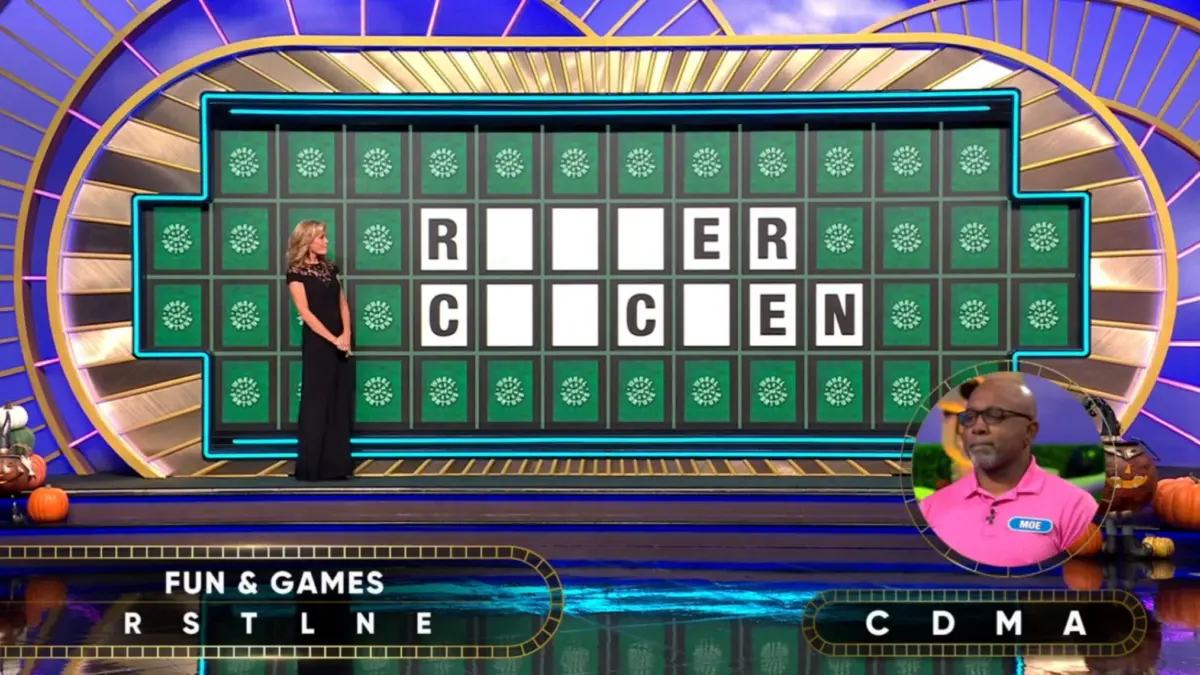
The October 29 broadcast of the long-running syndicated game show Wheel of Fortune featured a standout performance by Wilmington, North Carolina native Moe Moultrie, who successfully navigated a series of challenging puzzles to secure a total cash and prize winnings of $76,724. The episode, which highlighted both strategic gameplay and a poignant personal narrative, saw Moultrie triumph over fellow competitors Adam George and Caroline Rogers. His journey through the competition culminated in a bonus round victory that resonated with both the studio audience and host Ryan Seacrest, as Moultrie dedicated his success to the memory of his grandfather, a lifelong fan of the program.
Chronological Breakdown of the Competition
The gameplay began with a swift display of puzzle-solving prowess. Moultrie established an early lead by correctly identifying "Demons, Dragons, and Dracula" within the "Same Letter" category, netting $3,800. This initial success set the tone for a competitive match characterized by shifting fortunes among the three contestants.
As the game progressed into the second round, the narrative stakes increased. Adam George, a Boston, Massachusetts resident who shared an anecdotal connection to horror novelist Stephen King during his youth, secured the game’s "Wild Card." George demonstrated strong command of the board, successfully revealing a majority of the letters required to solve the puzzle. However, a sudden landing on the "Bankrupt" wedge shifted momentum, handing control to Caroline Rogers of Philadelphia, Pennsylvania. Rogers, noted for her interest in Halloween-themed trivia, successfully capitalized on the opportunity by solving "Do Do That Voodoo That You Do So Well," adding $3,500 to her total.
The turning point for Moultrie occurred during the subsequent round. Leveraging the "Express Train" feature, he navigated the board with precision to solve "That Sounds Exhilarating!" The victory earned him not only a significant cash increase but also an additional prize in the form of a trip to Mexico, bringing his running total to $24,624.
The "Triple Toss-up" segment followed, providing an equalizing opportunity for the contestants. All three participants successfully solved their respective puzzles, with each earning an additional $2,000. Moultrie’s final contribution during this phase—solving "Professional Magician"—solidified his lead with a score of $31,724, while Rogers concluded with $5,500 and George with $5,000.
The Bonus Round Dynamics
Entering the final phase of the competition, Moultrie selected the "Fun & Games" category. The atmosphere in the studio remained lighthearted, marked by a brief moment of levity between Moultrie and host Ryan Seacrest. As Seacrest prepared the contestant for the final challenge, he remarked on Moultrie’s visible distraction as the contestant looked toward his wife, Jessica, in the audience. Seacrest’s quip regarding the "business" of the game served to refocus the room before the high-stakes final puzzle commenced.
With the standard allotment of letters—R, S, T, L, N, and E—provided by the game show, Moultrie was invited to choose four additional letters: C, D, M, and A. The resulting puzzle display read "R ER C _C_EN." Leveraging his composure under pressure, Moultrie quickly identified the phrase as "Rubber Chicken." The reveal of the $45,000 prize envelope brought his final total to $76,724, marking one of the most successful individual performances of the current season.
Contextual Significance and Audience Impact
The emotional weight of the victory was evident in the closing moments of the broadcast. As the final dollar amount was revealed, Moultrie was visibly moved, acknowledging the influence of his late grandfather. He explained that his grandfather’s affinity for Wheel of Fortune had been a constant throughout his life, framing his own appearance on the show as a tribute to that legacy.
Host Ryan Seacrest acknowledged the sentiment with a brief, supportive response, noting that his grandfather was likely "watching after him." This interaction highlighted the cultural endurance of the program, which has remained a staple of American television for over four decades. The show, which continues to maintain high ratings under the stewardship of Seacrest, often serves as a focal point for multigenerational family viewing, a fact underscored by Moultrie’s personal testimony.
Analytical Perspective on Game Show Strategy
From a strategic standpoint, Moultrie’s performance exemplifies the high-variance nature of modern game show competition. His success was not merely a result of letter selection but of consistent navigation of the board’s hazards. The "Express" round, in particular, remains a high-risk, high-reward element of the show’s mechanics. Statistics indicate that players who utilize the Express feature effectively often secure the highest totals of the evening, provided they can avoid the pitfalls that caused George to lose his position earlier in the same episode.
Furthermore, the "Triple Toss-up" segment, introduced to increase the pace of the game, provided the necessary cushion to ensure the game remained competitive until the final moments. For participants, the ability to maintain concentration—as evidenced by Seacrest’s lighthearted redirection of Moultrie—is often cited by production staff as the most difficult aspect of filming in front of a live studio audience.
Broader Implications for the Program
The October 29 episode serves as a case study for the current direction of the Wheel of Fortune brand. Since the transition to Ryan Seacrest as host, the program has balanced the introduction of new, faster-paced elements with the traditional, long-standing format that appeals to a diverse demographic. The inclusion of personal narratives, such as Moultrie’s tribute, serves to humanize the contestants, transforming the broadcast from a simple quiz show into a televised event that resonates on a personal level with the viewership.
The financial impact of such wins remains a significant draw for contestants, with the $76,724 total reflecting the substantial prize pools currently offered. These winnings can have a transformative effect on the lives of participants, a reality that adds a layer of genuine tension to the final bonus round. As the show looks toward future seasons, the combination of high-stakes play and human-interest stories appears to remain the core formula for its sustained popularity.
Conclusion
Moe Moultrie’s performance on Wheel of Fortune serves as a reminder of the unique intersection of luck, strategy, and personal narrative that defines the genre. His success, fueled by a blend of careful letter selection and quick thinking, was ultimately framed by the personal connection he shared with his late grandfather. As the show continues to integrate such personal moments into its competitive structure, it reinforces its position as a cultural touchstone. For viewers interested in the intricacies of the gameplay, the bonus puzzle—"Rubber Chicken"—remains a classic example of the type of lateral thinking required to succeed at the highest level of the competition.
Wheel of Fortune continues to air on weekdays, with listings varying by local market. The episodes are available for streaming the following day on platforms including Hulu and Peacock, providing a consistent reach for an audience that spans multiple generations. Whether through the lens of strategic analysis or the emotional resonance of a tribute win, the program maintains its status as a cornerstone of the American game show landscape.