The long-awaited fourth-season premiere of Showtime’s critically acclaimed survival drama Yellowjackets has officially arrived, bringing viewers back into the claustrophobic, psychologically fractured world of the Wiskayok High School varsity soccer team. Titled Hivemind, the season opener deftly bridges the gap between the haunting aftermath of the Canadian wilderness and the paranoid reality of contemporary suburban New Jersey. With the series hurtling toward its definitive conclusion across a streamlined ten-episode arc, the premiere establishes a complex three-tier chronology that examines the enduring cost of trauma, societal surveillance, and the inescapable gravitational pull of group psychology.
Main Facts of the Season 4 Premiere
The episode wastes no time thrusting audiences back into the harrowing aftermath of the team’s rescue. Following Natalie’s desperate transmission over a repaired satellite phone in the previous season, the primary narrative focus centers on the survivors’ initial processing at a Canadian medical facility. Core characters including Shauna, Taissa, Van, Natalie, Misty, and Lottie are joined by surviving peers such as Melissa, Travis, and Akilah. However, the absence of peripheral researcher Hannah and the conspicuous silence surrounding her fate immediately introduce an undercurrent of institutional suspicion.

In the contemporary timeline set four weeks after the events of the season three finale, the psychological warfare among the adult survivors escalates. Taissa, grappling with the grief of losing Van—who was killed by Melissa in the prior season—deploys Misty on a covert assignment to surveil and evaluate Shauna. Meanwhile, Melissa attempts to forge a semblance of normalcy with her wife, Alex, only to relocate directly next door to Shauna, effectively setting the stage for an explosive confrontation between former allies turned adversaries.
Chronology and Structural Complexity
Yellowjackets continues to utilize its signature multi-timeline storytelling structure, now expanding into a sophisticated three-pronged chronology that deepens the narrative stakes.
The first timeline revisits the immediate aftermath of the rescue in late 1998, depicting the survivors arriving at a Canadian hospital under intense scrutiny. Investigators from the Canadian Transportation Safety Board, notably Investigator Kundla (portrayed by guest star Alessandro Juliani), quickly identify inconsistencies in the survivors’ synchronized, rehearsed testimonies. Medical examinations compound the tension; an attending obstetrician notes physiological evidence consistent with recent childbirth in a shellshocked teenage Shauna, though she fiercely refuses to acknowledge her pregnancy or the loss of her child.

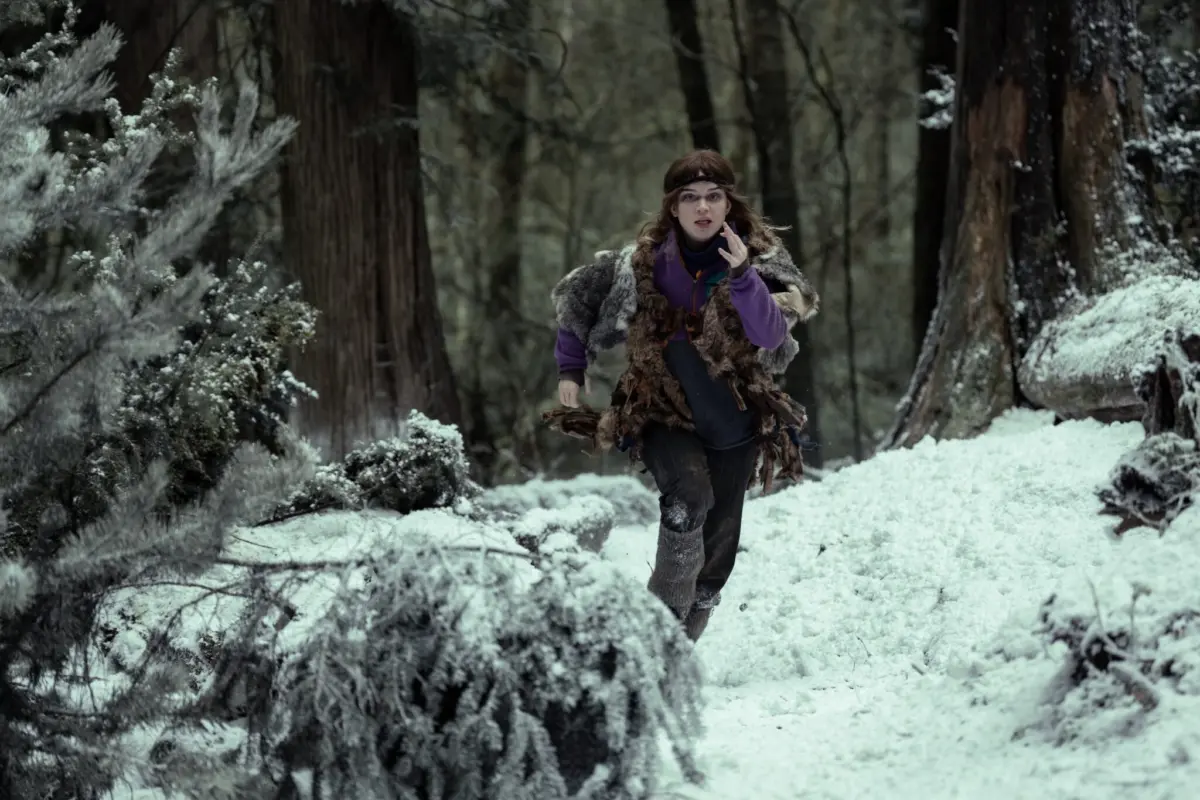
The second timeline examines the final, grueling weeks prior to the rescue in the remote Canadian wilderness. The premiere concludes with a sharp transition back to 1998, capturing Natalie as she rushes down the mountain following her successful contact with the outside world. Her sudden, horrified halt at the camp threshold establishes a high-stakes cliffhanger that recontextualizes the desperation and physical trauma visible upon the girls’ eventual arrival at the hospital, including Misty’s fractured finger and Shauna’s defensive wounds.
The third and final timeline anchors the narrative in the present day, roughly a month following the cataclysmic events of the season three finale. This contemporary arc highlights the erosion of modern legal and social boundaries as the adult survivors struggle to suppress the mythology and behavioral conditioning forged during their nineteen months of isolation.
Supporting Data and Production Context
As one of Paramount+’s flagship dramatic properties, Yellowjackets has maintained a robust viewership and critical reception since its 2021 debut, earning multiple Primetime Emmy Award nominations for its cast, including standout performances by Melanie Lynskey, Christina Ricci, and Tawny Cypress. Season four represents a critical milestone for creators Ashley Lyle and Bart Nickerson, who designed the series with a planned five-season trajectory, positioning this current run as the penultimate chapter in the overarching narrative.

The production values remain a cornerstone of the series’ appeal. Directors and cinematographers continue to contrast the sterile, fluorescent-lit institutional environments of Canadian hospitals and suburban New Jersey homes with the earthy, suffocating claustrophobia of the northern wilderness. The integration of guest stars such as Alessandro Juliani and the ongoing prominence of the ensemble cast underscore the series’ ability to attract prestige talent, reinforcing its standing within contemporary television landscapes.
Official Responses and Cast Dynamics
While formal promotional statements from network executives have focused on the overarching momentum of the series’ final acts, the cast has frequently spoken on the psychological toll required to portray characters perpetually haunted by their adolescent choices. In promotional interviews leading up to the season four rollout, the actors emphasized the shifting power dynamics between the adult iterations of the survivors.
The introduction of Hilary Swank’s character, Melissa, as a primary antagonist in the adult timeline has added a critical focal point for the ensemble. Melissa’s decision to move her family adjacent to Shauna’s suburban residence has been characterized by the creative team as a deliberate tactical maneuver rather than a coincidence—a modern manifestation of the territorial dominance established around the wilderness cabin. This geographical proximity forces both characters into a psychological stalemate, neutralizing Shauna’s capacity to operate under the anonymous guise of the Antler Queen persona.

Broader Impact and Narrative Implications
The premiere of Hivemind raises significant structural questions regarding how the series will successfully resolve its myriad narrative threads within a compressed ten-episode order. By multiplying the timelines and intensifying the paranoia within a domestic setting, the narrative asks whether suburban environments can sustain the same level of Gothic horror and psychological dread traditionally associated with the wilderness.
The implications of the Canadian Transportation Safety Board investigation in the 1998 timeline also point toward looming legal and societal reckonings. As parents, medical professionals, and federal investigators begin to uncover the medical anomalies and narrative discrepancies surrounding the rescue, the survivors’ collective pact of silence faces unprecedented external pressure.
Furthermore, the psychological exploration of trauma in season four shifts away from simple survival mechanics toward a more cynical examination of assimilation. The adult characters are no longer merely running from their past; they are actively attempting to reconstruct their tribal hierarchies within a modern society that has evolved around them. Whether the Wiskayok survivors can contain the fallout of their shared history—or if they will ultimately consume one another in a final suburban hunt—remains the central question driving what promises to be a tense, unrelenting penultimate season.