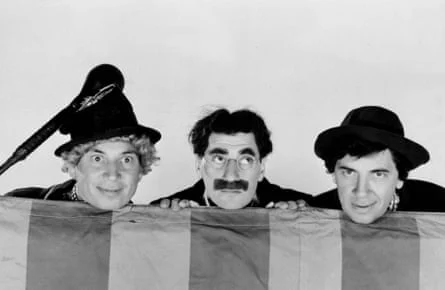
The enigma of Harpo Marx, the silent, harp-playing whirlwind of the Marx Brothers, has been illuminated by the discovery of a remarkable audio recording from 1964, capturing the legendary comedian speaking to a live audience. For decades, Harpo was defined by his mute persona, a choice born from stage fright that evolved into a signature element of his comedic genius. While his brothers Groucho, Chico, and Zeppo delivered rapid-fire dialogue, Harpo communicated through a symphony of honking taxi horns, the eloquent strumming of his harp, and a captivating physicality that transcended words. This newly unearthed recording offers a rare glimpse into a dimension of Harpo Marx that remained largely hidden from public view, revealing a man who, by choice, rarely uttered a sound on stage but possessed a speaking voice, and a penchant for storytelling, that captivated those fortunate enough to hear it.
The Silent Maestro’s Secret Voice
Born Adolph Marx in New York in 1888, Harpo Marx became synonymous with his iconic character: the tattered raincoat, the wild curly wig, and the mischievous, childlike demeanor. His musical talent, particularly his self-taught mastery of the harp, was a central pillar of his act. However, the very instrument that gave him his stage name also represented a refuge. By 1915, Harpo had consciously cultivated his silent persona, a decision that proved so effective that he famously turned down an offer of $50,000 to utter a single word – "Murder!" – in the 1946 Marx Brothers film, A Night in Casablanca. This commitment to his mute character underscored the depth of his artistic choices and the profound impact of his silent performances on generations of filmgoers.
A Glimpse Behind the Mute Facade
While Harpo’s on-screen persona was strictly silent, historical accounts and the recollections of those close to him reveal that he did, on occasion, break his vow of silence for his live audiences. Historian Robert Bader, author of Four of the Three Musketeers: The Marx Brothers on Stage, explains that these moments were reserved for special circumstances. "If the audience was good, or if he thought it was a great show, or the mood struck him, he would come out and do this speech," Bader notes. These impromptu monologues, affectionately known as "Red’s Speech," were often a departure from Harpo’s usual comedic chaos. In the 1920s, renowned wit Alexander Woollcott penned bespoke, elaborate speeches for Harpo, filled with "very loquacious, crazy" language that stood in stark contrast to Harpo’s typically understated delivery. Harpo would unfurl an oversized scroll, a prop in itself, and deliver these verbose passages with a surprisingly "soft-spoken way of speaking," as remembered by his son, Bill Marx. This practice, Bill Marx recounts, offered a window into his father’s "great joys was returning to his childhood, and it comes out in the way he speaks."
These speaking engagements, whether for general audience engagement or for charitable causes, were unfortunately never formally recorded, leaving a void in the historical record of Harpo’s unique vocal presence. "He had a lovely voice," Bader laments. "He should have done more." Harpo’s own reasoning for his consistent silence, even when opportunities arose, was rooted in his dedication to his meticulously crafted character: "I don’t want to tear down a character that it took me decades to build." His infrequent speaking appearances were therefore reserved for moments when he felt compelled to connect with an audience on a more personal level, often for philanthropic endeavors.
The Riverside Symphony Concert: A Fateful Performance
The recording that has now surfaced stems from a charity event held in March 1964 at the Riverside Symphony Orchestra in Southern California. Harpo Marx, then 75 years old and having officially retired from performing multiple times due to health concerns, found himself drawn back to the stage, often seeking loopholes in his retirement that allowed for charitable appearances. Advertisements for this particular fundraiser specifically highlighted the extraordinary prospect of Harpo speaking. The billing promised: "Harpo Marx will narrate Prokofiev’s Peter and the Wolf in a version written by himself and Groucho." This announcement alone was enough to generate significant public interest, given Harpo’s decades-long commitment to his silent persona.

The evening’s program included musical selections, such as the Toy Symphony and songs arranged by Bill Marx, before Harpo took the stage. His opening words, captured on the recording, were a deliberate acknowledgment of the rarity of the moment: "Believe it or not… I’m going to talk." To an audience, notably including many children, Harpo then delivered his narration of Peter and the Wolf. As Bill Marx explains, this choice of story held deep personal significance: "That’s his return to childhood. He loved the story." The narration was not merely a recitation but a deeply personal engagement with a narrative that resonated with his own sense of wonder and joy.
Beyond his narration, Harpo also delivered a version of his "Red’s Speech." This particular rendition included personal touches, mentioning two of his sons who were present that evening. Intriguingly, the speech also incorporated topical references to the ongoing Republican primaries, a nod, according to Bader, to the political inclinations of his brother Groucho. "Harpo never wore his politics on his sleeve, but Groucho did," Bader observes, suggesting a subtle influence from his more outspoken sibling. The recording also reveals Harpo’s adeptness at responding to his audience, weaving in improvisational elements that demonstrate his enduring comedic instincts, even in a spoken format.
A Discovery Against All Odds
The most poignant aspect of this recording is its near-loss to history. The microphone was intentionally present to capture Harpo’s voice, a decision that would prove to be his final public performance. Harpo Marx passed away just six months later, in September 1964. "What was not advertised was that this time there would be a microphone to record Harpo’s voice," Bader reveals. "And of course, one knew that it would be his final public performance." The tapes were discovered serendipitously, unearthed from a box mislabeled as containing recordings of an entirely different show. "I was almost in tears," Bader confesses. "It was just so special for me."
The process of restoring and clarifying these recordings was a significant technical undertaking. Harpo, unaccustomed to sustained speaking into a microphone, occasionally drifted out of its optimal range. However, the painstaking efforts have paid off, allowing the performance to be experienced today much as it was in 1964. "You know, we try to keep the Marx Brothers alive every way we can," Bader states. "The people who were longtime Marx Brothers fans are going to see a side of him that they just weren’t aware of." This discovery offers a vital new dimension to the understanding of Harpo Marx, moving beyond the silent mime to reveal a nuanced and articulate individual.
A Legacy Endures
Bill Marx describes the recording as "a joy to listen to… a slice of comedic and film and stage history that should endure." Though he was not present at the Riverside concert, Bill’s own introduction to the world of show business came when he was a mere 12-year-old propman at the London Palladium in 1949, tasked with filling his father’s oversized coat pockets with toys and instruments. "It was my introduction to show business and what he did and how he did it. And the fact that people adored this man. As I do, still," he reflects, underscoring the enduring affection and admiration for his father.
The implications of this unearthed recording are significant for scholars, fans, and historians alike. It provides concrete evidence of Harpo’s spoken delivery, his vocal timbre, and his storytelling prowess, offering a more complete portrait of the man behind the legend. It challenges the long-held perception of him as solely a silent comedian and adds a rich layer to his already celebrated legacy. The recording serves as a powerful reminder that even the most iconic and seemingly unchanging artistic personas can hold hidden depths, waiting to be discovered and appreciated. In the realm of comedy history, where silence often speaks loudest, Harpo Marx’s voice has finally been heard, adding a resonant new chapter to the story of the Marx Brothers.