Unveiling the Narrative: Yoko’s Double Life and Societal Pressures
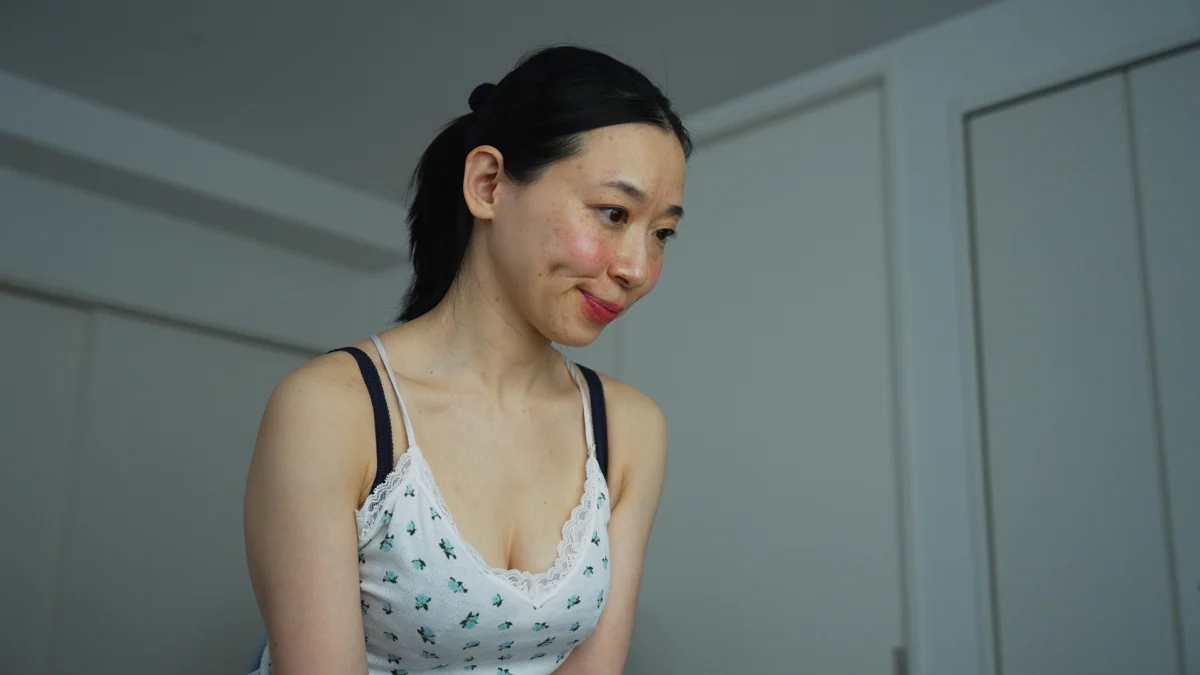
The narrative centers on Yoko, a young woman residing in Tokyo with her husband, Mutsuo, while simultaneously shouldering the demanding responsibility of caring for her bedridden father-in-law. Yoko harbors a profound dislike for former Prime Minister Shinzo Abe, a sentiment that becomes a pivotal, if unconventional, catalyst for her actions. Following an unspecified incident, the details of which are meticulously withheld until closer to the film’s denouement, Yoko embarks on a clandestine life, fulfilling clients’ sexual desires during the mornings while her husband is away at work. Mutsuo remains blissfully unaware of his wife’s covert activities, a tension that underpins much of the film’s domestic drama.
Adding another layer of complexity to this already intricate setup is Tamami, a housewife living next door. Tamami, through auditory clues rather than direct observation, appears to have become acutely aware of Yoko’s morning engagements. The sounds emanating from Yoko’s apartment push Tamami to the precipice of a nervous breakdown, transforming her into an unwitting, and increasingly agitated, witness to her neighbor’s secret life. This dynamic sets the stage for a compelling exploration of privacy, perception, and the often-unseen struggles beneath the veneer of suburban tranquility. The revelation of the "unspecified incident" near the film’s conclusion is crucial, providing essential context for Yoko’s radical choices and transforming a seemingly inexplicable narrative into a poignant character study.
Thematic Intersections: Eroticism, Politics, and Everyday Absurdity
Yamauchi’s directorial style in "A Unique Country in Asia" exhibits a striking kinship with the pinku eiga genre, primarily through the frequent inclusion of erotic scenes. These scenes are strategically placed at specific intervals, echoing the structural conventions of Japanese softcore pornography, which often required a certain number of sex scenes within a given runtime. However, Yamauchi artfully diverges from mere titillation. The presence of two individuals in most of these scenes, coupled with a dialogue-heavy approach, subtly nudges the film towards the aesthetics of a stage play – a recurring characteristic in Yamauchi’s cinematic oeuvre, underscoring his roots in theatre.
To further distance the film from conventional erotic exploitation, Yamauchi meticulously crafts Yoko’s character not as an oversexualized figure but as a seemingly "normal" housewife. Furthermore, the majority of the sexual encounters involve Mr. Kimura, an equally ordinary middle-aged man. This deliberate choice underscores that sex in "A Unique Country in Asia" is not primarily a tool for titillation, though a palpable sensualism certainly permeates the atmosphere. Instead, it serves a deeper narrative and thematic purpose, often acting as a medium for release, rebellion, or simply a transaction in a life marked by unspoken desires and political frustrations.
The political dialogue, a consistent thread throughout the film, is predominantly channeled through Yoko’s candid, often impassioned, discussions about her intense dislike for Shinzo Abe. Her monologues delve into the profound impact she believes this political antipathy has had on her personal life. This integration of a deeply personal, almost obsessive, political grievance within the intimate, often transactional, context of her morning encounters lends the narrative a surrealistic tone that is both unexpected and amusing. Shinzo Abe’s tenure as Prime Minister of Japan (2006-2007, 2012-2020) was marked by significant economic policies ("Abenomics"), efforts to revise Japan’s pacifist constitution, and a conservative social agenda. His leadership was highly polarizing, drawing both fervent support and strong opposition, particularly from segments of the liberal and intellectual populace who viewed his policies as eroding democratic norms or militarizing Japan. Yoko’s visceral reaction is thus rooted in a real-world political landscape that deeply divided Japanese society.
This surrealism is amplified when a client dares to contradict Yoko’s political opinions. The ensuing scene, and the client’s subsequent fate, culminates in what is arguably the funniest moment in the movie. This darkly comedic confrontation highlights Yamauchi’s skill in weaving political commentary into the fabric of everyday absurdities, using the intimate space of sexual encounters to expose deeper societal fissures and individual frustrations. It forces the audience to confront how personal politics can bleed into the most private aspects of life, and how an individual’s worldview, however seemingly outlandish, can become a driving force for their actions.
Psychological Undercurrents: Neurosis and Repression in Urban Japan
The character of Tamami, the neighbor, and her escalating descent into neurosis triggered by Yoko’s erotic sounds, offers a profound commentary on the psychological toll of repression and societal expectations in urban Japan. Yamauchi implicitly suggests that the perceived "lack of sex" or sexual fulfillment in Tamami’s own life is a significant contributing factor to her rather intense, almost manic, behavior. This element, while perhaps pushed to an extreme, functions effectively within the overarching absurd framework of the story, serving as a stark counterpoint to Yoko’s chosen path of sexual expression.
Japanese society, historically, has often maintained a complex and sometimes paradoxical relationship with sexuality. While erotic imagery can be pervasive in certain media, open discussion or expression of personal sexuality, especially for married women or within traditional family structures, can be highly constrained. This societal context provides a fertile ground for the kind of repression that Yamauchi explores through Tamami. Her breakdown, therefore, can be interpreted not just as an individual eccentricity but as a symptom of broader societal pressures and unaddressed desires.
The reasons behind Yoko’s actions, initially shrouded in mystery, are meticulously unveiled closer to the film’s conclusion. This crucial scene, while possessing the potential for greater narrative complexity, nevertheless succeeds in eloquently capturing all the necessary context and illuminating her motivations. Her actions transcend simple economic need or sexual desire, hinting at a deeper quest for agency, a form of rebellion against perceived political injustices, or a desperate attempt to reclaim a sense of control in a life burdened by caregiving and domestic monotony. The film skillfully portrays how seemingly disparate elements—personal politics, financial need, and emotional release—converge to shape a character’s extraordinary choices.
Broader Societal Reflections and the Middle-Class Predicament
The very last scene of "A Unique Country in Asia" stands out for its somewhat disconnected and inherently absurd conceptualization. Yet, it serves as a powerful concluding statement, bringing to the forefront a series of nuanced comments on how middle-class, middle-aged individuals perceive their country and the wider world. This segment transcends the individual narratives of Yoko and Tamami, offering a broader sociological lens on contemporary Japan.
One compelling interpretation suggests that Mr. Kimura’s unusual, almost child-like, happiness, especially considering his capacity as a client in Yoko’s transactional encounters, stems directly from his regular sexual activity. This state of contentment places him in direct antithesis to Tamami, the neurotic neighbor, whose life appears devoid of such intimate fulfillment. This stark contrast highlights a fundamental question posed by the film: in a society often characterized by conformity and unspoken desires, what constitutes genuine happiness or satisfaction, and through what means do individuals seek it?
The film subtly critiques the various forms of escapism and coping mechanisms employed by the Japanese middle class. Whether it is Yoko’s transgressive acts, Tamami’s descent into anxiety, or Mr. Kimura’s quiet satisfaction, each character represents a different facet of navigating life’s challenges within a specific cultural and political context. Yamauchi suggests that beneath the calm surface of ordinary lives, there often lies a complex interplay of political grievances, personal desires, and the quiet desperation to find meaning or pleasure in a world that can feel increasingly disorienting. This final scene, despite its initial ambiguity, leaves the audience pondering the unspoken narratives and the diverse ways individuals strive for fulfillment in a "unique country" grappling with its own identity.
Crafting the Cinematic Experience: Direction, Cinematography, and Performances
Kenji Yamauchi’s directorial vision for "A Unique Country in Asia" is defined by his masterful ability to blend disparate genres, creating a cinematic experience that defies easy categorization. His background in theatre is evident in the film’s reliance on compelling dialogue and its intimate, often confined, settings, giving many scenes the feel of a stage play brought to the screen.
Yuichiro Watanabe’s cinematography plays a crucial role in realizing Yamauchi’s vision. Employing a predominance of close shots, Watanabe immerses the audience in the characters’ immediate environments, particularly within the small rooms where much of the film unfolds. This stylistic choice enhances the sense of realism, at times lending certain moments a documentary-like quality, emphasizing the raw, unvarnished nature of the characters’ lives and interactions. The presentation of the sex scenes also adheres largely to this realistic approach, portraying intimacy with an almost clinical detachment that avoids sensationalism. However, a montage of different sexual positions near the end of the film deviates slightly, admittedly aiming more at titillation. This dual approach in depicting eroticism further underscores the film’s complex relationship with the pinku eiga genre – acknowledging its tropes while simultaneously subverting them for deeper thematic resonance.
Watanabe also serves as the film’s editor, orchestrating the various "vignettes" of Yoko’s life with a mid-tempo approach that allows the narrative to flow organically without feeling rushed or disjointed. The film’s lean 77-minute runtime is another nod to the conventions of pinku cinema, which historically operated under tight production schedules and strict runtime requirements for theatrical exhibition. This efficient pacing ensures that the movie never overstays its welcome, maintaining a concise and impactful narrative arc.
The ensemble cast delivers performances that are integral to the film’s success. Ami Cheng, in the demanding role of Yoko, is exceptionally nuanced. She portrays Yoko as a character who is at once somewhat naive, deeply absurd, yet undeniably endearing. Her long, often rambling, talks about Shinzo Abe are one of the movie’s undisputed focal points, providing both comedic relief and profound insight into her character’s internal world. Kenji Iwatani, as Mr. Kimura, perfectly embodies the archetype of the "regular" middle-aged man. His performance highlights the ordinariness of his character, which in turn makes the film’s premise darkly humorous and relatable in its portrayal of human desires. Eri Iwamoto, in contrast, delivers a performance of remarkable gusto as Tamami, the noisy and increasingly manic neighbor. Her heightened portrayal effectively conveys the character’s unraveling mental state, serving as a vibrant foil to the more restrained performances of her co-stars. Indeed, with the notable exception of Iwamoto’s deliberately exaggerated portrayal, the overall acting in "A Unique Country in Asia" is characterized by a subtle restraint, a choice that fully aligns with and reinforces the director’s overarching approach to storytelling.
A Complex and Rewarding Cinematic Statement
"A Unique Country in Asia" ultimately emerges as a truly singular cinematic experience – a film that is undeniably weird but unequivocally pleasant. Its daring and successful navigation between the often-disparate realms of erotic cinema, poignant family/social drama, and sharp political commentary is what truly sets it apart. Kenji Yamauchi skillfully weaves these elements into a cohesive and thought-provoking tapestry, demonstrating his prowess as a filmmaker unafraid to tackle complex themes through an unconventional lens.
The film’s exploration of hidden desires, political frustrations, and the quiet desperation for connection or release resonates deeply within the context of contemporary Japanese independent cinema. It offers a fresh perspective on societal pressures, gender roles, and the often-unspoken anxieties that permeate modern life. "A Unique Country in Asia" is more than just a film; it is a complex, multi-layered statement that invites audiences to look beyond the surface, to question norms, and to find humor and pathos in the most unexpected corners of human experience. Its lingering impact lies in its ability to provoke thought on sensitive social and political issues, all while maintaining a unique artistic integrity that is both challenging and deeply rewarding.