Elliot Tuttle’s debut feature, Blue Film, emerges as a compelling and challenging work that delves deep into the complex interplay of identity, trauma, and the historical connotations of its titular color. Premiering to significant discussion, the film not only introduces Tuttle as a formidable new voice in transgressive cinema but also meticulously deconstructs the multivalent associations of "blue" within cinematic and socio-political contexts, extending beyond its common understanding as a euphemism for explicit content. This ambitious narrative explores the historical repression of art and thought, leveraging these contexts to frame a deeply unsettling and psychologically rich encounter between two damaged men.
The Historical Tapestry of "Blue" in Cinema and Censorship
The color blue, as it pertains to the material and sociopolitical histories of cinema, is steeped in legend, conjecture, and etymological ambiguity. Its journey from a simple hue to a loaded term reflecting moral and political control provides a crucial backdrop for Tuttle’s film. During the zenith of the Hays Code era in Hollywood, a period defined by heightened moral panic and puritanical tyranny from 1934 to 1968, blue grease pencils became an infamous tool of censorship. Censors wielded these pencils to mark film stock, designating sequences deemed obscene, sexually suggestive, or ethically dubious for mandatory excision. This practice often undermined artistic integrity, forcing directors into eleventh-hour cuts and extensive reshoots, irrevocably altering their original visions to conform to the strict moral guidelines of the Motion Picture Production Code. The Code, enforced by the Motion Picture Producers and Distributors of America (MPPDA), aimed to ensure that films would "improve rather than lower the morals of the audience," effectively stifling creative expression for decades. Historical data indicates that thousands of scenes were altered or removed, with entire film projects sometimes abandoned due to the stringent demands of censors, demonstrating the profound impact of this "blue" marking.
Concurrently, across the Atlantic, the lápis azul (blue pencil) was deployed by the authoritarian Estado Novo dictatorship in Portugal. This instrument of state control was used to omit words, sentences, or entire passages from texts, broadcasts, and films deemed politically subversive or morally objectionable. International films arriving in Portugal faced a rigorous pre-screening process, with the lápis azul ensuring that only content aligning with the regime’s ideology and moral standards reached Portuguese audiences. This systemic censorship, which lasted from 1933 to 1974, profoundly shaped the cultural landscape, limiting access to diverse ideas and artistic expressions. The phrase "blue pencil" thus became a global symbol of suppression, linking the color directly to the suppression of inconvenient truths and challenging art.
Beyond these official acts of censorship, other sources suggest a more colloquial origin for the term "Blue Movie." While "blue" had been connected to ribaldry and profanity since at least the 1860s, the phrase "Blue Movie" likely became synonymous with early pornographic content due to technical limitations. Many of the clandestine "stag films" of the early 20th century were shot on low-grade, often expired, film stock. This inferior material, coupled with rudimentary lighting techniques, frequently imparted a distinctly bluish pallor to the carnal proceedings, inadvertently cementing the association between the color and illicit adult entertainment. Tuttle masterfully embraces these diverse, yet interconnected, historical and etymological affiliations of blue, transforming them into a conceptual bedrock for his debut.
Elliot Tuttle’s Vision: Blue as a Liminal Space
Elliot Tuttle, often described as a young provocateur, directly engages with these multivalent affiliations and gradients of blue in Blue Film. He asserts, "That color was used to signify anything that was culturally taboo, especially at the time. There’s the obvious pornographic reference, but it was important to me that these different uses of the term felt linked." This statement underscores Tuttle’s intention to craft a narrative that is not merely sexually explicit but deeply resonant with the historical weight of its chosen motif.
In Blue Film, the titular color transcends its political and historical connotations, functioning akin to the visceral red fades that punctuate Ingmar Bergman’s seminal 1972 film, Cries and Whispers. Bergman’s use of crimson served as a jarring, yet profoundly intimate, transition into the characters’ raw emotional interiority, a liminal space where suppressed desires and anxieties surfaced. Tuttle employs blue in a similar fashion: not just as a visual aesthetic, but as a gateway into the characters’ psychological landscapes. "Bergman’s filmography is predicated on the dissonance between our assumed self and our true self, which is so much of what the narrative engine of Blue Film is sustained by," Tuttle explains. Indeed, the aesthetic and conceptual concerns of Bergman, particularly his unflinching exploration of psychological torment and fractured identities, ripple throughout Blue Film. The film unfolds as a relentless evening of queasy revelation and psychosexual despair, where two damaged men exchange philosophical musings, destabilized identities, and seminal fluids, all bathed in the spectral glow of blue.
The Destabilized Identities of Aaron and Hank
The narrative core of Blue Film revolves around the fraught encounter between its two central figures: Aaron Eagle (Kieron Moore) and Hank Grant (Reed Birney). Aaron Eagle is introduced as a gay FinDom (Financial Dominance) camboy, trapped in a feedback loop between his "authentic" self and his meticulously "invented" online persona. The film opens in the buffering depths of cyberspace, immersing the audience in Aaron’s digital domain. Here, the rugged, tattooed Aaron barks commands at an unseen throng of "worthless paypigs," ordering them to drain their digital wallets while he performs an erotic routine steeped in hypermasculine toxicity. This initial portrayal immediately establishes the theme of performativity and the commodification of identity, a prevalent issue in contemporary digital culture.
The catalyst for the film’s central confrontation is a mysterious elderly client, recognizable only by a ski mask, who frequently visits Aaron’s chatroom. This client, after promising a substantial sum of $50,000 for his services, persuades Aaron to meet him at a rented AirBnB home in Hancock Park, Los Angeles. As the night progresses, the client’s identity is chillingly revealed to be Hank Grant, a disgraced pedophile and, more disturbingly, Aaron’s former middle school teacher. Hank confesses to having believed himself to be in love with Aaron since Aaron was a twelve-year-old boy named Alex.
Within the suffocating confines of this transactional reunion, Aaron/Alex and Hank engage in a perpetual dance around the personas they’ve constructed for themselves and for each other. The film meticulously blurs the lines between memory, fantasy, and manipulation, rendering any semblance of objective truth illusory. Information is diffracted through multiple lenses of subjective experience, mutually consented upon for a fleeting moment, only to be abruptly flagged for excision as the characters’ narratives clash and shift. This dynamic establishes a profound sense of psychological uncertainty, forcing the audience to question the reliability of perception and the nature of their transactional intimacy.
The Path of Transgressive Cinema: Influences and Intent
Tuttle navigates these complex moral and psychological terrains through amorphous roleplay and unreliable narration, deliberately eschewing convenient trajectories towards redemption or repair. He observes, "Both characters feel uneasy about the answers they find and have to forge a path forward. It complicates their own perception of themselves. Aaron fully believes himself to be this alpha-male character, and it’s not until that is interrogated that the slip happens around who he considers himself to be." This statement highlights Tuttle’s commitment to portraying characters in a state of flux, challenging fixed notions of self.

Reverently operating within a distinct mode of transgressive cinema, Tuttle draws inspiration from a lineage of filmmakers who dared to explore uncomfortable truths. His work echoes Catherine Breillat’s extreme depictions of adolescent sexual agency in films like A Real Young Girl (1976) and 36 Fillette (1988), which unflinchingly portray the nascent, often brutal, desires of young women. Another significant influence is Agustí Villaronga’s frigid traumatophilia in In a Glass Cage (1987), a film notorious for its chilling exploration of a former Nazi doctor’s psychological torment and his interaction with a young boy.
Tuttle’s development of Blue Film mirrored Breillat’s early process, beginning as a fusion of pubescent smut fantasy and an existential treatise on the nature of desire. These preliminary writings eventually manifested into an intimate hall of mirrors, replete with fragmented perspectives and melodramatic edges, all serving to amplify the psychological intensity of the narrative. "I’m interested in the way that sex informs so much of how we live our life," Tuttle adds. "It’s not this conceptual thing. It’s actually really rife with danger or potential or possibility." This philosophy underpins the film’s unflinching gaze into the darker corners of human sexuality and its profound impact on identity and relationships.
International Klein Blue: A Spectral Continuum of Queer Mourning
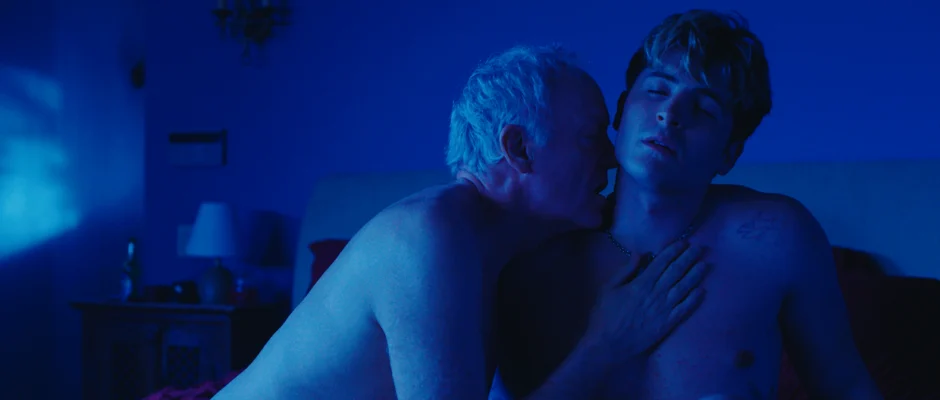
In a striking visual and thematic choice, Tuttle gestures towards the threshold between risk and arousal by employing International Klein Blue (IKB) during a climactic final sex scene between Aaron and Hank. IKB, a highly luminous, matte shade of blue, was famously created by French artist Yves Klein in 1960. Klein patented this specific hue, seeing it as embodying the immaterial and transcending the physical.
Tuttle’s choice of IKB carries significant cinematic resonance. A variant of IKB previously filled the screen as the sole visual element in Blue (1993), the final film by British queer experimental filmmaker Derek Jarman. Jarman’s Blue was a poignant, minimalist masterpiece, with the screen saturated in blue representing the ocular degeneration and eventual blindness he suffered due to AIDS-related complications before his death. By invoking IKB, Tuttle offers yet another generative link in the storied history of cinematic blues, casting Blue Film in a spectral continuum of queer mourning. This choice powerfully evokes themes of lost innocence, the deterioration of selfhood, and the profound, often illusory, nature of bodily autonomy. It connects the film to a broader artistic and historical conversation about illness, sexuality, and identity within the LGBTQ+ community, adding layers of profound emotional depth and historical context to the intimate, disturbing encounter depicted.
The Nuances of Performance and Collaborative Craft
Tuttle emphasizes the trusting atmosphere of collaboration that characterized the set, particularly between himself and his two lead actors. This collaborative environment partially influenced his decision to include childhood home movies of himself at the beach as interstitial sequences throughout the film. These deeply personal moments serve a dual purpose: they act as a metatextual entry point into the more autobiographical elements of his characters’ internal struggles, and they provide a sobering reminder of the gravity and vulnerability inherent in the situation at hand.
Kieron Moore delivers a performance of raw physicality and bruised swagger as Aaron Eagle, a portrayal that, according to Tuttle, significantly shifted the way the character was originally perceived. Moore captures the performative aggression of the FinDom persona while subtly hinting at the profound fragility and trauma beneath the surface.
Reed Birney, as Hank Grant, makes a variety of fascinating and unsettling choices. Birney effortlessly vacillates between moments of somber self-reflection and florid feats of rationalization. These rationalizations include romanticizing the pederasty of Roman warriors and even claiming to have received the blessing of his priest to visit Aaron. What makes Birney’s performance particularly disquieting is his ability to maintain a disarming sincerity throughout, a wholesome demeanor that, paradoxically, brings to mind the seemingly innocuous presence of television personalities like Mr. Rogers. "I love Reed’s performance so much," Tuttle states. "It’s so funny how it varies between people who are either charmed by it or put off by it, or put off by being charmed by it. There is this vestigial, teacheresque quality to him, the sense that he is trying to guide Aaron in some way. There are so many interesting things that he brings to his performance that are rich and layered and demand to be picked apart." This complexity ensures that Hank is not merely a one-dimensional villain but a deeply troubled individual whose actions are rooted in a twisted, yet internally coherent, logic.
Confronting Evil: Beyond the Banality
When questioned about his preoccupation with the nature of evil in the story between Aaron and Hank, Tuttle asserted that while he does indeed characterize Hank as a person who has committed evil deeds, his artistic focus lies elsewhere. Tuttle expresses less concern with the banality of evil—a concept famously explored by Hannah Arendt and recently depicted with chilling precision in films like The Zone of Interest—and more with its emotional affect and internal landscape.
"It’s not like evil erases an inner world," Tuttle contends. "When someone has done something evil, I think we have a tendency to forget that this person has an entire brain inside of them, or an entire life. I’m interested in capturing that almost ineffable, idiosyncratic way that we respond to evil, to harm done to us and done by us." This perspective challenges conventional narratives that often flatten characters who commit heinous acts, instead inviting the audience to grapple with the complex psychological terrain of both perpetrator and victim. It suggests that understanding, rather than simply condemning, the internal mechanisms of evil can offer profound, albeit disturbing, insights into the human condition.
Broader Implications and the Future of Transgressive Cinema
Blue Film is poised to become a significant touchstone in contemporary transgressive cinema, provoking vital discussions around trauma, consent, identity formation in the digital age, and the enduring legacy of censorship. Its unflinching portrayal of difficult subjects, coupled with its sophisticated artistic and intellectual framework, positions it not merely as a shocking spectacle but as a serious artistic inquiry.
The film’s exploration of fragmented identities and the constructed self resonates deeply in an era dominated by online personas and the blurring of public and private lives. Industry observers suggest that Blue Film could catalyze a renewed critical examination of how cinema grapples with morally ambiguous characters and the psychological aftermath of abuse. Its bold aesthetic choices and narrative complexity are likely to draw comparisons to other works that push boundaries, cementing Tuttle’s reputation as a filmmaker unafraid to confront the darkest aspects of human nature. As independent cinema continues to be a crucial arena for artistic experimentation and challenging narratives, Blue Film stands as a powerful testament to the genre’s capacity to illuminate uncomfortable truths and spark essential cultural dialogue.