Chilean filmmaker Dominga Sotomayor, celebrated for her distinctive cinematic voice that meticulously frames intimate human dramas within constrained yet evocative landscapes, marks a significant new chapter in her career with the Cannes premiere of her latest feature, La Perra. Unfurling on a windswept island off Chile’s rugged southern coast, this character study represents a departure from her traditionally autobiographical works, venturing into adapted territory while retaining her signature preoccupation with the profound interplay between environment and identity. The film, a collaboration with acclaimed screenwriter Inés Bortagaray and based on Pilar Quintana’s notable 2017 novel of the same name, promises a raw, enigmatic exploration of the human-animal bond and the elusive nature of belonging.
Dominga Sotomayor’s Evolving Vision: From Memory to Adaptation
Sotomayor has carved a unique niche in contemporary Latin American cinema, with her filmography often characterized by narratives that blossom within tightly defined geographical and emotional confines. Her 2012 debut, Thursday till Sunday, masterfully confined its family drama within the claustrophobic interiors of a car journeying to northern Chilean beaches, setting a precedent for her stylistic approach. This was followed by the critically acclaimed Too Late to Die Young (2018), a festival prizewinner, which captured the nascent post-Pinochet era within the insulated world of a bohemian commune. More recently, her Netflix-produced Swim to Me (2025) honed in on the intricate dynamics within an affluent Santiago villa.
La Perra continues this thematic thread, examining how physical spaces inexorably shape individuals’ perceptions of themselves and their place in the world. However, it distinguishes itself by being Sotomayor’s first major feature not directly drawn from her own childhood memories, marking a conscious pivot toward external narratives. This shift, Sotomayor explains, has paradoxically opened doors to deeper personal truths. "It was interesting. True, I had to set aside my own stories for a change, but I think that when you move away from those private realms you often wind up finding things that are even more personal and intimate. It’s a beautiful contradiction," she stated in an interview. This "freedom and lightness" found in adaptation allowed for a "rawer, more obscure" work, an exercise in empathy rather than self-reflection.
The Narrative Core: Silvia, Yuri, and the Concept of Domestication
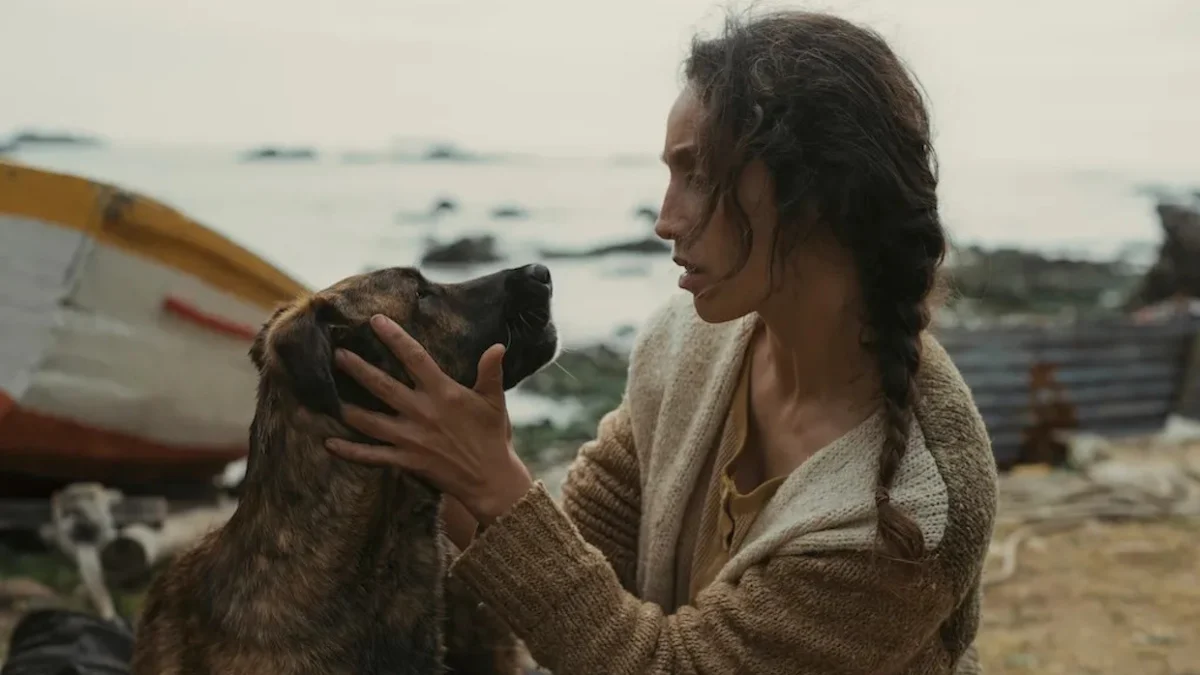
At the heart of La Perra is Silvia (portrayed by Manuela Oyarzún), a childless woman in her forties living a solitary existence on the island, earning her livelihood by selling seaweed. Her life takes an unforeseen turn when she adopts a stray puppy discovered on the shore, whom she names Yuri, in homage to the 1980s Mexican pop star whose hits subtly punctuate Clint Mansell’s evocative score. The film’s brilliance, as critics and Sotomayor herself highlight, lies in its refusal to reduce the animal to a mere metaphor or a narrative device to advance Silvia’s emotional journey. Instead, Yuri emerges as a protagonist in her own right, challenging conventional depictions of the human-animal bond.
Sotomayor elaborates on her interest: "I’m interested in the concept of domestication, the extent to which an animal can ever really be ours." This philosophical query underpins the evolving relationship between Silvia and Yuri. Initially marked by warmth and affection, their dynamic gradually morphs, echoing a recurring theme in Sotomayor’s work where the familiar can become foreign, and comfort can give way to threat. The film deliberately offers moments where cinematographer Simone D’Arcangelo shifts perspective, momentarily abandoning Silvia to follow Yuri as she roams freely across the beach, underscoring the dog’s independent agency and challenging the audience to consider the world through a non-human lens. This bold directorial choice subverts traditional character arcs, presenting a dual narrative that explores identity and freedom from both human and animal viewpoints.
Atemporal Landscapes and Invented Realities
One of La Perra‘s most compelling and disorienting aspects is its deliberate manipulation of time. The film exists in a "temporal limbo," where contemporary elements like smartphones and modern cars coexist with vintage television sets and other anachronistic props. This fusion makes it difficult for the viewer to pinpoint the exact era in which the narrative unfolds, inviting a more immersive, contemplative engagement with its enigmas. Even a crucial flashback sequence – Sotomayor’s first in her filmography – defies conventional cinematic markers for temporal shifts. There are no distinct changes in color palette, costuming, or setting that traditionally delineate past from present, blurring the lines and emphasizing the cyclical, ever-present nature of trauma and memory.
This temporal fluidity is complemented by an "imaginary geography." While filmed partly on the real Santa Maria island, the setting itself is a carefully constructed illusion. Structures like Silvia’s shack and an abandoned beachside villa were fabricated or placed elsewhere, creating a fictional territory that evokes a documentary feel without mirroring reality. "Everything about the island is fake. We shot half the film on Santa Maria and the other half elsewhere… We made up an imaginary geography, and that to me is the most fascinating thing: this idea of inventing a territory in a way that suggests a documentary but doesn’t turn the film into a mirror of reality," Sotomayor revealed. This approach aligns with her broader philosophy of "dispersed cinema," where narratives meander and diffuse, inviting viewers to luxuriate in ambiguity rather than demanding straightforward explanations.
The Genesis of the Project and Collaborative Craft

The journey of La Perra from novel to screen was characterized by spontaneity and creative trust. Sotomayor was drawn to Pilar Quintana’s novel for its inherent cinematic qualities – its unexplained elements and the mysterious rapport between the woman and the dog. While appreciating the source material, Sotomayor conveyed to producer Rodrigo Teixeira her reluctance to set the story in Colombia, as in the book, due to her unfamiliarity with its specific jungle environment. Teixeira granted her complete freedom to adapt the setting and narrative as she saw fit, a testament to the trust placed in her vision. This creative liberty allowed Sotomayor to transplant the story to the unique, windswept landscape of southern Chile, crafting an environment that, in her words, "almost feels like an Irish landscape."
The visual language of La Perra is a result of Sotomayor’s first collaboration with cinematographer Simone D’Arcangelo, renowned for his work on critically acclaimed films like Felipe Gálvez Haberle’s The Settlers (2023), which won a prize at Cannes’ Un Certain Regard, and Alessio Rigo de Righi and Matteo Zoppis’s The Tale of King Crab (2021), a Cannes Directors’ Fortnight selection. Their collaboration, though time-constrained for traditional storyboarding, involved extensive discussions and a shared visual language built from photographs, paintings, and films. Artistic references ranged from the dramatic, 19th-century landscape paintings of her grandmother, Carmen Couve, and uncle, Adolfo Couve, to the psychologically intense works of Lucien Freud and Francis Bacon. Cinematic inspirations included the stark realism of Barbara Loden’s Wanda (1970), Michael Roemer’s structurally odd Vengeance is Mine (1984), Michelangelo Antonioni’s L’avventura (1960), and the open, expressive cinematic language of Australian films like Walkabout (1971) and Storm Boy (1976). This rich tapestry of influences shaped the film’s evocative atmosphere, blending raw documentary-like moments with a deeply painterly aesthetic.
Production Realities: Independent Freedom vs. Streaming Demands
Sotomayor’s experience producing La Perra stands in stark contrast to her work on Swim to Me for Netflix, offering a valuable insight into the divergent creative freedoms afforded by different production models. While she values both projects, La Perra represents a "completely free film," a passion project made for the cinema, a space where artistic compromises are minimized. "You can’t take that creative freedom for granted," she emphasized, highlighting the trust bestowed by major producers on La Perra despite its significant scope.
Conversely, Swim to Me was a Netflix commission, accepted with the understanding that it needed to cater to a broader audience. While Sotomayor retained some liberties, such as casting, the underlying imperative was a more "straightforward film" – a departure from her preferred "diffused, meandering" style. Despite these differences, Sotomayor maintains a deep personal connection to both projects, showcasing her versatility as a filmmaker who can navigate both independent and mainstream terrains. The remarkable feat of shooting two such "polar opposites" within the same year – a process that typically takes her six to eight years for a single film – underscores her prolificacy and dedication.
Challenges and Triumphs: Filming with Animal Actors and Unpredictable Settings
The production of La Perra presented a unique set of challenges, particularly in casting and directing its canine co-star. Sotomayor insisted on using mutts, rejecting pedigree dogs, to maintain authenticity. The adult Yuri was found just a month before shooting in a Santiago animal shelter – a one-year-old, untrained dog brimming with wild energy. Her puppy counterpart was a two-month-old abandoned on a highway. This unconventional casting necessitated extensive bonding sessions between the lead actress, Manuela Oyarzún, and the dogs, and a flexible approach to filming. There were instances where Yuri would simply run off mid-scene, demanding spontaneous adjustments from the crew.
These adversities, rather than hindering the film, became integral to its "language," as Sotomayor’s colleague María Paz Grandjean observed. The unpredictable nature of working with untrained animals and the remote, imagined island setting forced Sotomayor and D’Arcangelo to adapt, embracing the spontaneous and liberating aspects of the shoot. "We showed up on set with a certain idea of how things would play out… and had to adjust to the circumstances. It was a special project – spontaneous and liberating," Sotomayor reflected. This adaptability resulted in a film that feels organic and alive, where the permeable border between human and non-human, and the constructed and natural, is not just a theme but a lived reality of its production.
Broader Impact and Legacy
La Perra‘s premiere at Cannes not only elevates Dominga Sotomayor’s international profile but also reinforces the growing critical attention on Chilean cinema. Her shift from deeply personal narratives to adapted works, while retaining her distinctive stylistic and thematic concerns, signals a maturing artistic voice capable of exploring universal themes through unique cultural lenses. The film’s audacious approach to time, space, and perspective – particularly its elevation of an animal protagonist – challenges conventional storytelling and invites audiences into a deeper, more empathetic engagement with the world.
As Sotomayor continues to push the boundaries of cinematic expression, La Perra stands as a testament to her commitment to "dispersed cinema" and her belief in the power of film to invent realities rather than merely reflect them. It positions her as a formidable force in global independent cinema, whose works are not just stories but immersive experiences that linger, inviting introspection on our own relationships with the landscapes we inhabit, the memories we carry, and the creatures with whom we share our existence. The film is expected to spark considerable discussion among critics and audiences, cementing Sotomayor’s reputation as one of the most innovative directors of her generation.