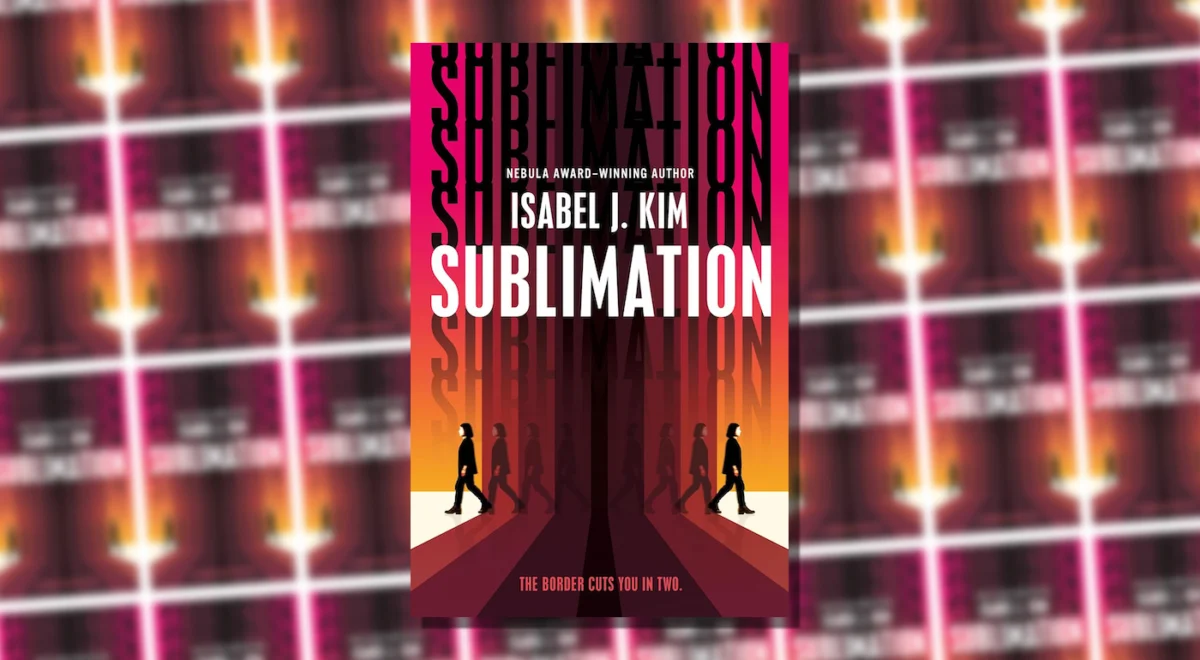
In a literary landscape increasingly captivated by speculative fiction that probes the human condition, Isabel J. Kim’s debut novel, Sublimation, emerges as a powerful and thought-provoking work. This ambitious novel reimagines the very essence of migration, positing a reality where leaving one’s home country physically splits the individual into two distinct “instances” – two physical beings, each with their own consciousness, desires, and dreams. This groundbreaking premise, where a traveler leaves behind a literal copy of themselves, or perhaps the copy is the one that journeys onward, forms the bedrock of a narrative that masterfully explores the profound psychological, social, and historical ramifications of displacement.
Kim defines an “instance” as “a duplicate self cleaved mitosis-like from the original.” Crucially, both the original and the duplicate are referred to as “instances” within the novel’s lexicon. The exact origin of this phenomenon remains a mystery, a fundamental aspect of this world’s existence, with historical records tracing its earliest mention to a Babylonian text from 1753 BC. The intricate mechanics of instancing are artfully revealed to the reader gradually, eschewing cumbersome exposition for a more immersive experience. This subtle approach allows the familiar fabric of our own world to remain intact, punctuated by this single, yet monumental, alteration, creating an uncanny resonance that compels readers to contemplate their own reality through a new lens.
The Genesis of Division: A World Shaped by Instancing
The reverberations of instancing are felt throughout the novel’s intricately crafted world, with Kim weaving in how this phenomenon has historically shaped human endeavors. The act of instancing is not presented as inherently positive or negative, but rather as a manifestation of a deep-seated desire that transcends mere wanderlust. As the novel suggests, through the character of Marco Polo, who famously did not instance: “It means that you were of two minds. It shows a desire beyond wonder. It suggests a desire for escape, an understanding that either the world outside is so beautiful it must be permanently inhabited or the world inside is so terrible that it should be escaped.” This perspective directly mirrors the lived experiences of countless individuals who have migrated, a sentiment captured in the observation that borders are “an artificial thing with practical consequences: the severing of the self from the self.” Migration, in this context, becomes a visceral act of twinning, a division that tears mind, body, soul, and memory asunder. The novel posits that instancing is the physical manifestation of “want turned so deep that it manifested in reality. Instancing was pure white-hot desire.” The fundamental question arises: did the individual consciously know they were leaving forever? The answer is no; they did not know which part of themselves yearned for departure. This leads to the poignant question of belonging upon return: is one still capable of fitting in, or has one become an alien even in their homeland?
Dual Lives, Tangled Fates: The Narrative’s Core
Sublimation centers on two distinct pairs of instanced individuals, each grappling with the complexities of their fractured existences. The first pair, Soyoung and Rose, became instances when ten-year-old Rose and her mother departed Korea for America. The second pair, Youjin and YJ, experienced instancing when YJ ventured to America for university. In Seoul, Soyoung and Youjin share a profound friendship, living seemingly content lives with a strong sense of belonging. Soyoung has never directly interacted with her instance, only encountering her when their shared grandfather passes away. In contrast, Youjin has maintained a connection with his instance, YJ. Their plan for reintegration hinges on YJ obtaining American citizenship, a move intended to circumvent mandatory military service in Korea. These four individuals, bound by complicated feelings for each other and for their own disparate lives, navigate two vastly different scenarios, all underpinned by the novel’s high-concept premise, culminating in a narrative that is both fascinating and intellectually stimulating.
The Uncanny Familiarity: Our World, Slightly Altered
The novel’s narrative unfolds within a world strikingly similar to our own, with the singular, yet profound, alteration being the perpetual existence of instancing. This phenomenon is not a recent development but is woven into the fabric of history, with the earliest recorded instance dating back to 1753 BC. Kim’s masterful approach to world-building is evident in how she slowly disseminates information about instancing, allowing readers to absorb its implications organically rather than through an overwhelming exposition. This elegant technique not only facilitates understanding but also immerses the reader by highlighting the deep familiarity of the novel’s setting. The sensation is profoundly uncanny: contemplating our own world with this single, transformative change – a change that is, in its consequences, anything but minor.
Historical Echoes: Colonialism and the Divided Self
The impact of instancing is not confined to individual lives; it has demonstrably shaped the course of history within the novel’s universe. Kim frequently references how global historical events have been influenced by this phenomenon. The novel posits that the driving force behind most instances across the globe has been the engine of colonial capitalism. This is framed as “the legacy of the west: a mitosis-like duplication of the self across lands already populated.” America, in particular, is presented as a nation born from instances migrating from Europe. The narrative starkly illustrates this: "Instancing is written into America’s blood, into the story it tells itself: Here is where instances migrate. Give us your tired, your poor, your hungry, give us your copies and let them be fruitful and multiply, let them homestead, let them become titans of industry, let them and their non-instanced children build cities and towns and railroads."
Kim’s authorial voice is unapologetic, eschewing any pandering to the reader. She presumes a certain level of historical awareness, expecting readers to be familiar with figures like Odysseus, and to understand the intricacies of citizenship laws and visa regulations. Furthermore, she anticipates a degree of empathy and a recognition that not all lives are lived with equal freedoms, underscoring that the perception of freedom itself is often dictated by power dynamics. The distinction between expatriates and economic migrants, the novel argues, is frequently determined by the color of one’s skin and/or the passport they hold. Kim’s prose does not shy away from reminding us of the myriad ways in which one’s home can be irrevocably fractured. This is powerfully illustrated when the narrative describes a worst-case scenario: “In a worst-case scenario you instance when you are ripped away from your family and your community and your life and you are trafficked across state borders when you catch a glimpse of the sign that demarcates where your country ends. Or somewhere in between, you instance because you realise that the only real choice you have in life is to leave your beloved, broken shithole, and cross the border into a different broken shithole, one with more access to capital, that you will be able to gnaw the rind from and send back the scrapings.”
The Psychological Reckoning: The Cost of Wholeness
The characters in Sublimation are united by a pervasive sense of uncertainty, struggling to define their feelings and questioning whether there is a "right" way to process their fractured realities. The desire for wholeness, for peace with the unlived life, or for the memories of that life through reintegration, is a powerful undercurrent. However, the novel emphasizes that those who leave do not return unchanged. Reintegration is presented as an act fraught with cost, demanding immense cognitive dissonance and the potential erasure of the unique experiences accumulated during the period of separation. The fundamental question of identity arises: "Who are we if not our experiences? How do we then accommodate living with someone else’s experiences that feel like ours, but aren’t?" Youjin’s chilling contemplation at the novel’s outset – "Is it like murder?" – encapsulates the profound ethical and existential dilemma at its heart.
A Shift in Genre: From Introspection to Thriller
While the novel is predominantly character-driven, punctuated by extensive introspection as the narrative shifts between its four protagonists, the final third takes a surprising turn towards the techno-thriller genre. This evolution in narrative style is likely a key factor in Universal Studios’ acquisition for a television adaptation and contributes to its positioning as ideal for fans of shows like Severance. This ambitious debut is characterized by its high-quality prose and the compelling philosophical arguments it presents through evocative imagery. Kim’s strategic use of the second-person narrative for significant portions of the novel is a particularly effective stylistic choice, placing the reader directly into the shoes of an instance. This technique feels organic rather than gratuitous, masterfully capturing moments and feelings in a "specific time and place… the heart at the moment of stepping over a border. The mind when it knows it is leaving.”
The Profound Implications: A World Undergoing Metamorphosis
What does life truly look like in a world where imperialism, citizenship laws, immigration, war, racism, and xenophobia have an immediate, tangible, physical impact? What does existence entail when one’s future can be commodified, controlled, and capitalized upon? The novel argues that instancing is far more than a simple population surge or a biological split; it represents “the cleave of one future from another. It is the psychological change as denoted through physical reality; it is metaphor made flesh. The physical effects are downstream from the higher-order changes taking place.” It is these higher-order changes that Sublimation meticulously examines. While the novel may not offer definitive answers, it profoundly succeeds in posing a wealth of relevant and urgent questions, inviting readers to engage with the complex tapestry of human experience in a world irrevocably shaped by the act of division.
Sublimation is published by Tor Books.
Read an excerpt from Sublimation by Isabel J. Kim.