
Seijun Suzuki’s 1980 masterpiece, "Zigeunerweisen," stands as a pivotal achievement in Japanese cinema, not only for its audacious artistic vision but also as a triumphant return for a director who had been controversially blacklisted by the industry for over a decade. This film, the inaugural chapter of his acclaimed Taisho Trilogy, transcends conventional storytelling to deliver a deeply personal and surreal exploration of beauty, violence, desire, and the intricate relationship between a progressive society and the indelible weight of its past. Its release marked a significant moment, signaling Suzuki’s re-emergence as an independent filmmaker unburdened by studio constraints, allowing him to fully realize the avant-garde inclinations that had previously brought him into conflict with the establishment.
A Phoenix Rises: Suzuki’s Return from the Blacklist
The journey leading to "Zigeunerweisen" was fraught with professional hardship for Seijun Suzuki. In 1967, following the release of "Branded to Kill" (Koroshi no Rakuin), Suzuki was abruptly fired by the Nikkatsu studio, where he had directed 40 films over 12 years. The studio’s president, Kyusaku Hori, famously criticized "Branded to Kill" as "incomprehensible" and detrimental to Nikkatsu’s reputation, accusing Suzuki of producing "films that don’t make sense and don’t make money." This dismissal, widely perceived as a punitive measure against Suzuki’s increasingly experimental and idiosyncratic style, effectively blacklisted him from mainstream Japanese filmmaking for the next ten years.
The Nikkatsu Conflict and Creative Suppression
Suzuki’s tenure at Nikkatsu had been characterized by a gradual pushing of boundaries within the studio’s genre film mandates, particularly in yakuza thrillers and action films. While earlier works like "Tokyo Drifter" (Tokyo Nagaremono, 1966) showcased his distinctive visual flair, kinetic editing, and subversive narratives, "Branded to Kill" represented a culmination of these tendencies, featuring a highly stylized, almost abstract narrative structure that defied commercial expectations. The backlash from Nikkatsu was severe, not only leading to his termination but also a prolonged legal battle over contract breaches, which Suzuki ultimately won in 1971 with the support of a burgeoning "Save Suzuki" movement among critics, filmmakers, and students. Despite the legal victory, the industry’s doors remained largely shut, forcing Suzuki into a period of creative exile where he primarily directed television commercials and wrote screenplays for others.
The Road to Independent Filmmaking
This decade-long hiatus, while professionally challenging, proved to be a crucible for Suzuki, enabling him to reflect on his artistic principles and appreciate the creative freedom he had long sought. As he later recounted, the experience, though difficult, deepened his commitment to independent filmmaking, away from the commercial pressures and aesthetic compromises of the studio system. The opportunity to direct "Zigeunerweisen" arose from this newfound independence, with the film being produced outside the major studios, financed primarily through Suzuki’s personal connections and independent investors. This unconventional production model granted Suzuki unprecedented control over the film’s artistic direction, allowing him to fully embrace the surreal, associative narrative style that had been simmering in his earlier works.
The Taisho Trilogy’s Genesis
"Zigeunerweisen" is not merely a comeback film; it is the inaugural installment of what would become Suzuki’s celebrated Taisho Trilogy, followed by "Kagero-za" (1981) and "Yumeji" (1991). This trilogy represents a mature synthesis of Suzuki’s thematic interests and stylistic innovations, all set against the backdrop of Japan’s pivotal Taisho period (1912-1926).
Historical Canvas: Japan’s Taisho Period
The Taisho era is often characterized as a brief but significant period of transition and paradox in Japanese history. Following the Meiji Restoration’s rapid modernization, the Taisho years witnessed a blossoming of democratic movements, a more liberal intellectual climate, and a marked increase in Western cultural influence, particularly from Europe. This era saw the rise of the "Taisho Democracy," burgeoning urban culture, and new artistic expressions that blended traditional Japanese aesthetics with Western modernism. However, beneath this veneer of progress and cosmopolitanism, traditional values remained deeply entrenched, leading to profound cultural synergies but also significant ideological tensions. The period was marked by an inherent contradiction: a society striving for modernity and individual freedom, yet still grappling with the weight of its feudal past and emerging nationalist sentiments. Suzuki masterfully uses this historical context as a fertile ground for his exploration of internal and external conflicts, mirroring the era’s complexities within the film’s narrative and visual design. "Zigeunerweisen," itself a transitional work in Suzuki’s career, thus becomes a fitting portrait of an age defined by contradiction, conflict, and transformative forces.
Unraveling the Narrative Tapestry: Plot and Characters
The plot of "Zigeunerweisen" deliberately defies linear explanation, embracing a dreamlike, highly associative structure that foregrounds atmosphere and symbolic resonance over conventional causality. The film introduces Toyojiro Aoichi (Toshiya Fujita) and Tadashi Nakasago (Yoshio Harada), former university colleagues whose lives have diverged dramatically. Aoichi has become a respected professor of German literature, a beacon of intellectualism and progressive thought. Nakasago, by stark contrast, has chosen a nomadic existence, wandering across Japan’s towns and villages, prone to heavy drinking and frequently embroiled in trouble.
The Dueling Intellectual and the Instinctive Wanderer
The narrative unfolds through a series of fragmented encounters between these two men, whose relationship serves as the central ideological duel of the film. Their first reunion is amidst an angry mob accusing Nakasago of murder, from which Aoichi secures his friend’s release. Their subsequent celebration at a local brothel introduces Koine (Naoko Otani), a captivating geisha whose beauty and charm immediately ensnare both men. Months later, Aoichi visits Nakasago, who is now married to Sono (also played by Otani, embodying a spectral duality). Despite Sono being pregnant, Nakasago mysteriously disappears again, this time with Koine. Meanwhile, Aoichi finds himself increasingly drawn to Sono, eventually succumbing to his burgeoning affections. The friends’ paths cross once more, culminating in Nakasago’s bizarre proposal: a pact that whoever dies first shall leave his bones to the other. This strange request, seemingly macabre, hints at Nakasago’s deeper, almost primal fascination with purity and the material essence of existence, contrasting sharply with Aoichi’s intellectual and societal aspirations.
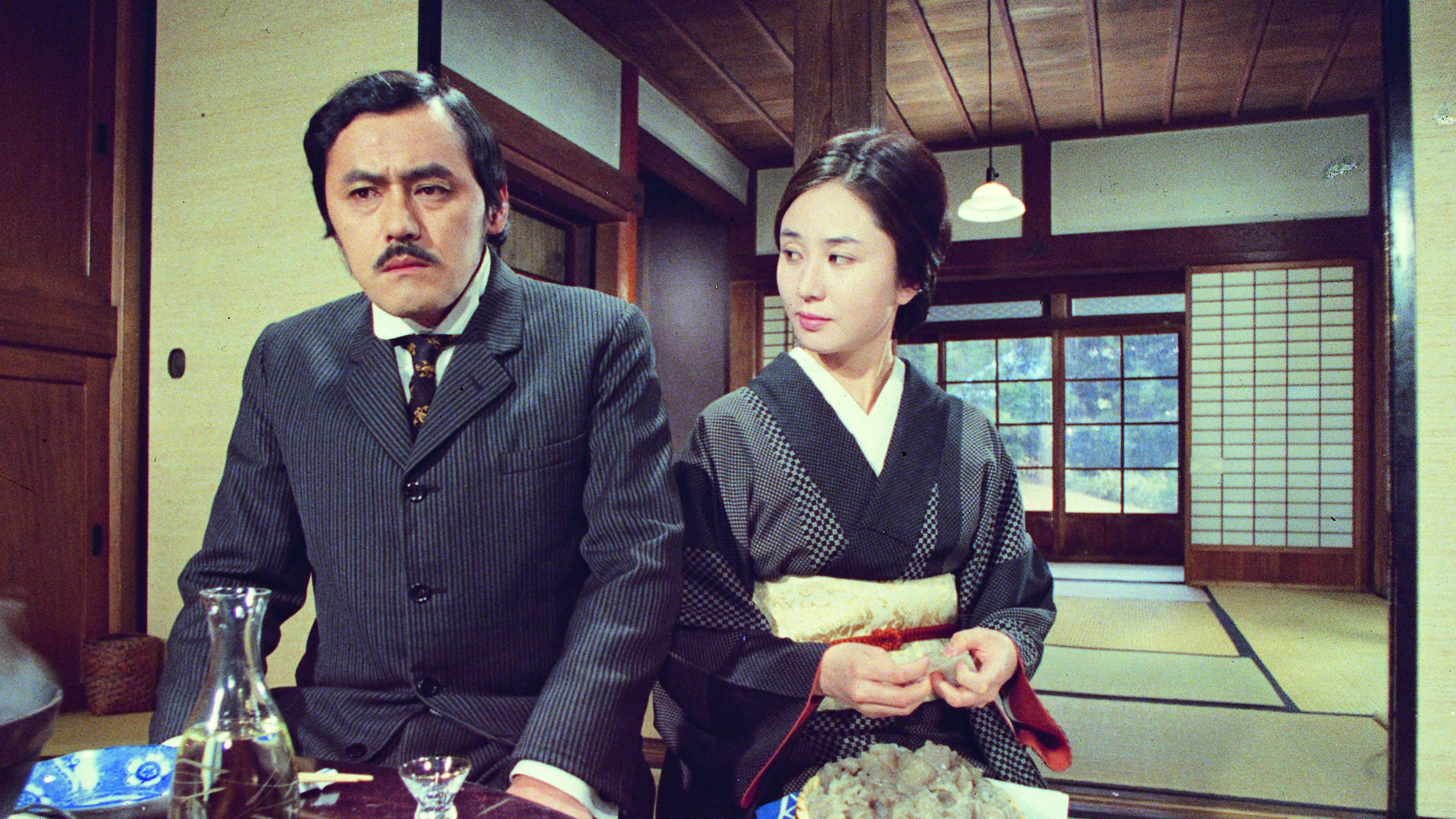
Toshiya Fujita portrays Aoichi as an educated, refined intellectual who, despite his progressive ideals and striving for civilization, is repeatedly undermined by his own desires and internal conflicts. He represents the rational mind struggling against the irrational forces of the subconscious and the past. Yoshio Harada’s Nakasago, on the other hand, is a force of raw instinct, vice, and an almost obsessive fascination with human bones, which gradually become his personal ideal of beauty and purity. He embodies a more ancient, untamed spirit, a rejection of societal norms. Both actors deliver nuanced performances that sustain the underlying tension between their characters throughout the feature, with their encounters often threatening to erupt into physical violence – a palpable echo of the conflicting forces shaping the Taisho era itself.
The Enigmatic Figure of Desire
Naoko Otani’s dual performance as Koine and Sono is crucial to the film’s hypnotic, dream-like quality. Her interchangeable presence as the object of both men’s desire blurs the lines between identity, memory, and longing, reinforcing the film’s surreal atmosphere. She is not merely a love interest but a symbolic figure representing the elusive nature of desire and the haunting persistence of past relationships.
A Dissonant Symphony: Suzuki’s Signature Style Reimagined
Suzuki extends his principle of contradiction and surrealism to every aspect of "Zigeunerweisen"’s audiovisual design, creating a cinematic experience that often feels like a deliberately dissonant symphony. The film combines exquisitely composed imagery with surreal visions that inevitably draw comparisons to masters like Luis Buñuel, yet remain distinctly Suzuki’s own.
Visual Poetry and Surrealist Echoes
The cinematography, often characterized by its lush, painterly quality, juxtaposes moments of serene beauty with jarring, dreamlike sequences. Colors are used symbolically, often vibrant and saturated, enhancing the film’s theatricality. The infamous sequence in which one character licks another’s eyeball, for instance, immediately recalls Buñuel and Salvador Dalí’s "Un Chien Andalou." However, Suzuki’s imagery, while equally shocking, feels less about destruction and more about a seductive, unsettling dream logic, inviting the viewer into a subconscious landscape rather than confronting them with pure shock. The recurrent motifs of bones, mirrors, and reflections contribute to this sense of fragmented reality, suggesting alternate dimensions and the elusive nature of truth. The use of traditional Japanese architectural settings, often decaying or imbued with a sense of melancholic beauty, further underscores the tension between the old and the new, the tangible and the spectral.
Auditory Landscapes and the Power of the Past
Abrupt shifts in tone and chronology, coupled with Otani’s dual performance, reinforce the feature’s hypnotic quality. The narrative jumps, seemingly without logical transitions, mirror the way memories and dreams unfold, defying a linear progression. Even seemingly peripheral figures, such as the traveling group of beggars, serve a vital function. They introduce moments of earthy humor, sexual innuendo, and irony that provide a striking contrast to the film’s haunting, often melancholic atmosphere. Their presence creates a certain emotional distance, preventing the film from becoming overly didactic or self-serious, injecting a raw, grounded element into the ethereal narrative. The sound design is equally deliberate, often featuring ambient noises, sudden silences, and the recurring, evocative violin composition that gives the film its name.
Themes of Contradiction and the Enduring Past
At its core, "Zigeunerweisen" is a profound meditation on the inescapable influence of the past, both on individuals and on society. This central idea is powerfully underlined by the recurring motif of Pablo de Sarasate’s violin composition, "Zigeunerweisen" (Gypsy Airs).
Navigating Modernity’s Crossroads
The film explores the profound contradictions inherent in the Taisho period itself: a nation caught between the rapid embrace of Western modernity and the deep-seated traditions of its past. Aoichi and Nakasago embody these conflicting forces. Aoichi, the German literature professor, represents the intellectual’s attempt to rationalize, to categorize, to adopt new ideas and shed old superstitions. His progressive worldview is challenged by his own primal desires and the mysterious pull of Nakasago’s more instinctual existence. Nakasago, the wanderer, lives outside societal conventions, driven by raw passion and an almost spiritual connection to the material remnants of life – bones. Their conversations, often resembling ideological duels, highlight the struggle between these two poles: reason versus instinct, civilization versus the wild, the future versus the past. Suzuki suggests that true progress is uncertain, perhaps even impossible, when the past continues to exert such a powerful, almost supernatural, hold.
The Unseen Hand of Memory
The "Zigeunerweisen" composition itself becomes a character in the film. As Aoichi and Nakasago listen to an old recording, one insists he can hear a mysterious voice in the background – a claim the other immediately dismisses. This moment is far more than simple foreshadowing; it suggests that the past is not merely historical fact but a living, haunting presence. It cannot be fully understood, definitively explained, or entirely silenced. It whispers from the shadows, shaping desires, influencing choices, and coloring perceptions, making any notion of a clear break with history an illusion. The film implies that the individual pursuit of beauty, violence, and desire is always filtered through the lens of memory and the collective unconscious of a society grappling with its own identity. The longing for purity, embodied by Nakasago’s fascination with bones, can be seen as a yearning to strip away the complexities of the present and return to a fundamental, perhaps even primordial, state, free from the contradictions of modern existence.
Critical Acclaim and Enduring Legacy
Upon its release, "Zigeunerweisen" received widespread critical acclaim and was instrumental in revitalizing Seijun Suzuki’s career. It quickly garnered significant recognition, winning the Japan Academy Prize for Best Film, Best Director, Best Screenplay, and Best Supporting Actress (Naoko Otani) in 1981. It also achieved considerable success at the box office, running for nearly a year at a single independent cinema in Tokyo, a rare feat for an art-house film, demonstrating a strong public appetite for Suzuki’s unique vision after his long absence.
Reshaping Suzuki’s Artistic Trajectory
The film’s success solidified Suzuki’s position as an independent auteur, free from the constraints that had plagued his earlier career. It allowed him to continue exploring his unique cinematic language in the subsequent films of the Taisho Trilogy, "Kagero-za" and "Yumeji," further cementing his reputation as a visionary director whose work defied easy categorization. "Zigeunerweisen" showcased a director operating at the peak of his powers, demonstrating that the forced hiatus had, in fact, deepened his artistic resolve and refined his singular voice. The film served as a powerful testament to the resilience of artistic expression against corporate suppression.
A Pillar of Japanese Art Cinema
"Zigeunerweisen" has since been recognized internationally as one of Seijun Suzuki’s most distinctive and important works, a masterpiece of Japanese art cinema. Its influence can be seen in subsequent generations of filmmakers who have explored non-linear narratives, surreal imagery, and thematic depth in their own works. The film’s enduring appeal lies in its ability to be both deeply personal and universally resonant, offering a haunting portrait of individuals grappling with profound longings and the relentless echoes of a past that continues to shape their present. Its intricate blend of historical context, philosophical inquiry, and avant-garde aesthetics ensures its place as a seminal work, inviting viewers into a hypnotic and unforgettable cinematic experience that continues to provoke thought and inspire discussion decades after its initial release.