The intersection of modern fandom and deep-seated human isolation takes center stage in Gail, a 92-minute feature-length documentary directed by filmmaker Michael Maxxis. The film chronicles the life of Gail E. Lichtman, a New York City subway station agent from the Bronx whose decades-long devotion to the Canadian alternative rock band Our Lady Peace defines her existence. Billed by early critics as the Grey Gardens of music documentaries, Maxxis’s film steps far outside the conventional promotional tropes of the genre. Instead of delivering a sanitized, hagiographic retrospective of a musical act, the documentary offers a complex, unflinching portrait of obsessive fandom, the architecture of loneliness, and the psychological mechanisms that drive individuals to forge profound parasocial relationships with public figures.
With an ensemble of high-profile producers—including members of Our Lady Peace alongside Jason Reitman and Jason Blumenfeld, the creative minds behind the 2024 feature Saturday Night—Gail achieves an unusual level of institutional access. Yet, the band purposefully recedes into the background, operating largely in dreamlike slow-motion or through the obscured perspective of the concert crowd. Propelled by a laconic, atmospheric score composed by Lesley Barber in collaboration with orchestrator Eric Rosse, the film uses its auditory landscape to amplify the underlying melancholy and hypnotic euphoria that characterize Lichtman’s extraordinary journey.
Main Facts and Production Overview
At its core, Gail examines a single, extraordinary subject across a runtime of 92 minutes. Gail E. Lichtman is not a celebrity, a music critic, or an industry insider; she is a lifelong transit worker whose professional life is spent inside a glass-walled booth in the New York City subway system. This physical enclosure serves as a powerful visual metaphor for her insular daily reality. For decades, Lichtman has channeled her emotional energy into following Our Lady Peace, a platinum-selling post-grunge band formed in Toronto in 1992.
The production scale of Gail is intimate yet ambitious. Director Michael Maxxis spent considerable time embedding himself within Lichtman’s domestic sphere in the Bronx, capturing the chaotic accumulation of decades of fan ephemera. Stored carelessly in ripped cardboard boxes, her collection of compact discs, promotional tour shirts, and signed memorabilia mirrors the frantic, magpie-like nature of her personality. The irony embedded in the band’s moniker—Our Lady Peace—serves as a constant structural counterpoint throughout the film, as Lichtman navigates her travels with a palpable mixture of compulsive obligation and performance-induced anxiety.
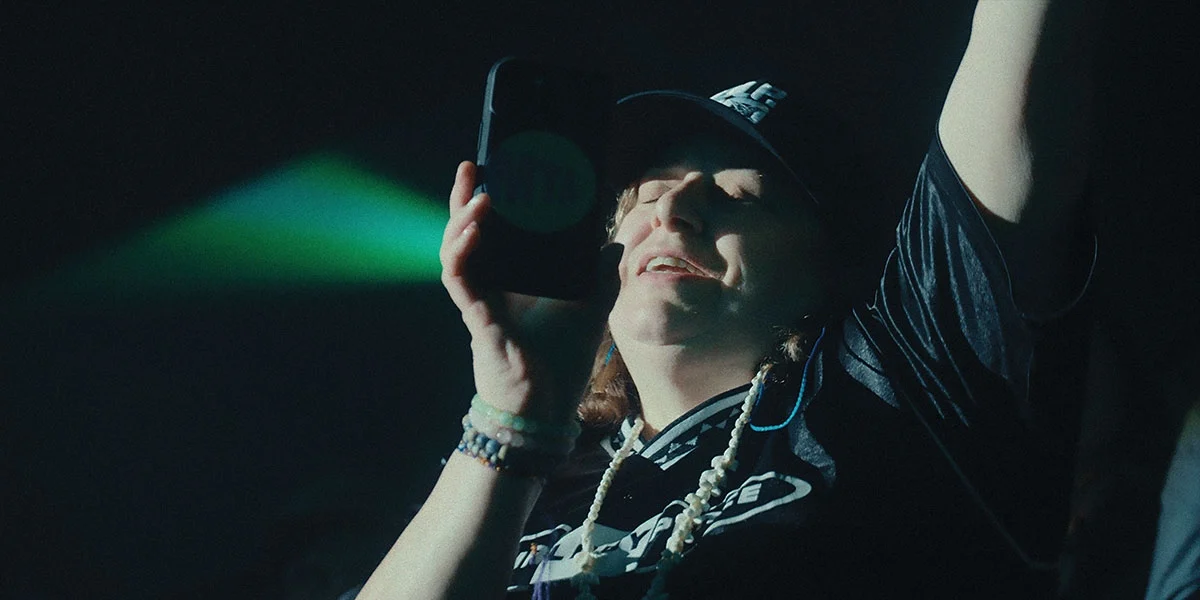
Rather than relying on talking-head interviews from music historians or industry executives, Maxxis structures the narrative around direct observation. The film captures Lichtman traversing small-town arenas across Canada and the United States, faithfully attending concerts that push her total live viewing count well past the 100-mark milestone. These sequences alternate between moments of solitary exhaustion and bursts of unbridled, transcendent joy where Lichtman loses herself completely in the crowd, mouthing lyrics with absolute abandon.
Chronology and Narrative Arc
The structural progression of Gail mirrors the cyclical nature of touring and fandom itself. The documentary opens in the predawn hours of the Bronx, documenting Lichtman’s punctuality as she arrives at her subway station assignment. This segment establishes the monotonous, solitary rhythm of her livelihood, where she observes the daily migration of anonymous commuters from behind protective glass.
As the narrative transitions from her workspace to her domestic environment, the audience is introduced to the tangible physical manifestations of her fandom. The documentary does not establish a linear historical timeline of Our Lady Peace’s discography; instead, it charts Lichtman’s personal chronology through ticket stubs, faded tour merchandise, and memories of specific shows spanning multiple decades.
The core of the film follows a rigorous touring schedule, tracking Lichtman as she leaves her transit job behind to catch the band across various venues. These scenes capture the immediate, dizzying adrenaline rush of the live performance environment, followed invariably by the stark emotional deflation that occurs when the house lights come up. Through this recurring cycle, Maxxis maps out the psychological vulnerability of the superfan, documenting the transition from innocent admiration to a demanding, complex sense of ownership and entitlement.
Supporting Data and Behind-the-Scenes Collaboration
The credibility of Gail rests heavily on the unprecedented cooperation between the subject, the filmmaker, and the musical artists at the center of the narrative. Our Lady Peace—best known for commercial and alternative radio hits during the mid-to-late 1990s and 2000s, such as Superman’s Dead and Clumsy—made the rare and courageous decision to support a project that deliberately de-centers their own legacy.
By taking on executive producing roles, band members permitted an unvarnished examination of how major touring acts interact with the ecosystem of VIP access, meet-and-greets, and dedicated fanbases. Producer credits shared with industry heavyweights Jason Reitman and Jason Blumenfeld further elevated the production standards of the non-fiction work, ensuring that the visual and auditory composition matched the psychological weight of its subject matter.
Musically, the film diverges sharply from standard concert documentaries. While authentic live performance tracks from Our Lady Peace are seamlessly integrated into the audio mix, composer Lesley Barber’s score provides the narrative glue. Barber’s minimalist, laconic compositions—enhanced by Eric Rosse’s arrangements—prevent the film from becoming a promotional vehicle for the band. Instead, the music underscores the thematic isolation experienced by individuals caught in the machinery of modern celebrity worship.
Official Responses and Collaborative Transparency
The decision by Our Lady Peace to participate in a documentary that risks exposing the darker, more uncomfortable dynamics of fan culture has drawn praise from documentary film critics and industry analysts alike. By allowing cameras to record the transactional nature of VIP access and the occasional interpersonal friction that arises when boundaries blur, the band and their management team demonstrated a high degree of transparency.
In statements surrounding the film’s festival run, collaborators have emphasized that Gail was never intended to be an exposé or an exercise in mockery. Director Michael Maxxis has repeatedly noted that the production sought to avoid both exploitation and coddling. This editorial restraint allows the audience to draw their own conclusions about the health and sustainability of extreme fandom. The subjects within the frame—both Lichtman and the members of the band navigating her persistent presence—exhibit a raw vulnerability that speaks to the basic human desire for recognition and authentic connection in an increasingly fragmented world.
Broader Impact and Sociological Implications
Beyond its immediate value as a masterclass in non-fiction filmmaking, Gail serves as a crucial sociological case study. The phenomena explored within the 92-minute runtime extend far beyond the relationship between one transit worker and a 1990s alternative rock outfit. In an era defined by social media connectivity, algorithmic echo chambers, and the commodification of personal accessibility, the boundaries between public figures and their audiences have become dangerously porous.
The film acts as an insightful cautionary tale about the perils of chronic loneliness. When individuals lack robust local support systems or meaningful interpersonal relationships in their daily routines, the vacuum is frequently filled by parasocial attachments. For Lichtman, the band provides an emotional anchor, a community of fellow concertgoers, and a sense of identity that supersedes her demanding, isolated life as a New York City subway agent. However, the documentary refuses to romanticize this coping mechanism. It demonstrates how the temporary high of a live performance can morph into an insatiable appetite, where no amount of access or merchandise is ever sufficient to fill the underlying void.
By drawing stylistic and thematic comparisons to Albert and David Maysles’ seminal 1975 documentary Grey Gardens, Maxxis positions Gail within a prestigious lineage of character studies that capture human eccentricity without losing sight of fundamental dignity. The film does not offer easy resolutions or neat moral takeaways. Instead, it challenges viewers to examine their own investments in popular culture, celebrity culture, and the universal quest for belonging.
Ultimately, Gail transcends the limitations of the traditional music documentary genre. Through rigorous direction, unflinching observation, a sophisticated musical score, and the extraordinary cooperation of its subject and musical hosts, the film delivers a shattering, beautifully rendered exploration of the human heart in all its complexity. It stands as an enduring testament to the power of documentary storytelling to reveal the profound truths hidden inside everyday lives.