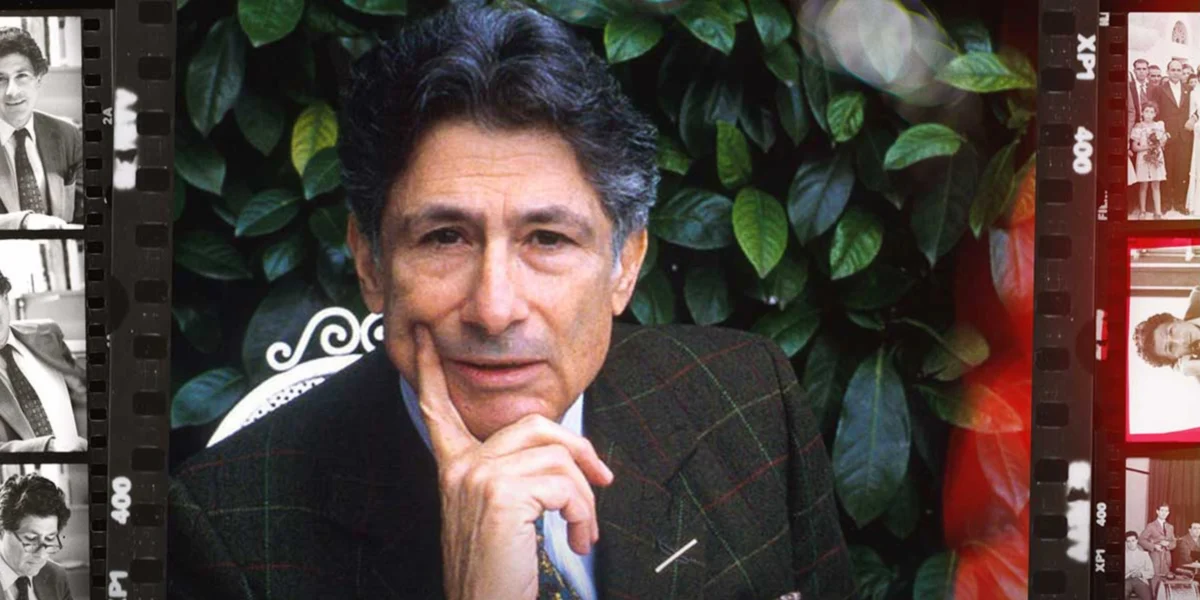
Twenty years after his death from leukemia in 2003, the intellectual footprint of Edward Said remains indelible across modern geopolitical discourse, literary theory, and Middle Eastern studies. Celebrated by his supporters as a prophetic voice and vilified by detractors as a controversial activist, the Harvard-educated Columbia University professor spent decades challenging Western narratives regarding the Middle East. Directed by Maiken Baird, the 107-minute documentary Edward Said: Between Worlds examines the life, scholarship, and enduring legacy of a man who transitioned from an affluent upbringing in Western Jerusalem to become the foremost advocate for the Palestinian cause in the United States. Utilizing a kinetic assemblage of newly digitized family archives, rare audio recordings, and behind-the-scenes footage, Baird constructs a biographical portrait that intertwines Said’s personal exile with the broader, turbulent history of Palestine.
Chronology of a Transnational Intellectual
The biographical trajectory of Edward Said is inseparable from the cataclysmic events of mid-20th-century Middle Eastern history. Born in 1935 into a prosperous Christian family in Jerusalem—then under British mandatory rule—Said’s early life was upended by the 1947–1948 Palestine War. At the onset of the conflict, his family fled to Cairo, Egypt, marking the beginning of a lifelong experience of displacement and exile.
Said was subsequently sent to the United States for his education, attending Northfield Mount Hermon School before earning his undergraduate degree from Princeton University and his master’s and doctoral degrees from Harvard University. In 1963, he joined the faculty of Columbia University as a professor of English and Comparative Literature, a position he held for four decades.
A pivotal turning point in Said’s public life occurred in the wake of the 1967 Six-Day War. The conflict galvanized his political consciousness, steering him away from purely aesthetic literary criticism toward public intellectualism. In 1979, he published his seminal essay "Zionism from the Standpoint of Its Victims" and his foundational book "The Question of Palestine." These works articulated the argument that Zionism operated as a form of colonialism, enabled and sustained by Western powers.
In 1978, Said released "Orientalism," a groundbreaking critique of Western academic and cultural depictions of the Middle East. The book argued that generations of Western scholars, writers, and policymakers constructed a homogenized, exoticized, and patronizing view of the "Orient" to justify imperialist domination. Despite facing fierce pushback from traditional academic circles, "Orientalism" revolutionized cultural studies and established the academic framework for postcolonial theory.
Throughout the 1980s and 1990s, Said emerged as the unofficial cultural ambassador for Palestine. He served as an independent member of the Palestinian National Council (PNC) from 1977 until 1991, resigning in protest against the Oslo Accords, which he accurately predicted would fail to secure genuine Palestinian statehood or sovereignty. He passed away in September 2003 at the age of 67, leaving behind a vast literary and political legacy.
Archival Insights and the Visual Narrative of Displacement
Director Maiken Baird relies heavily on an extraordinary cache of historical materials to anchor Edward Said: Between Worlds. The documentary benefits immensely from unprecedented access to the Said family archives, which include rare early-20th-century home videos captured by Said’s father—one of the first individuals in the region to own a motion-picture camera. These visual records capture a vanished world, depicting a pre-1948 Jerusalem and Levant that ceased to exist following the creation of the State of Israel.
One of the most poignant narrative threads in the film explores Said’s relationship with his personal documentation, specifically his passport. Issued during a complex geopolitical transition, his travel documents uniquely listed his birthplace simply as "Jerusalem" without designating a country, as the city did not fall under Israeli sovereignty at the time of his birth. This bureaucratic anomaly physically manifested the existential liminality that haunted Said throughout his life: an intellectual giant belonging to a nation that, on official maps, had been erased.
Baird structures the documentary chronologically, capturing Said in various stages of preparation for televised interviews and academic lectures. His natural charisma, eloquence, and intellectual rigor anchor the runtime, transforming standard biographical conventions into a dynamic masterclass in rhetorical power.
Academic Impact and Ideological Debate
While Edward Said: Between Worlds succeeds as a comprehensive biographical tribute, its methodological choices have sparked critical discussion among film critics and historians. Baird’s decision to narrate the documentary strictly through Said’s own words and perspective presents his worldview largely unchallenged by opposing viewpoints.
Supporters argue that given Said’s academic pedigree, his firsthand experience as a displaced Palestinian, and his meticulous documentation of historical injustices, centering his voice is both appropriate and necessary. They contend that the film functions as a continuation of Said’s educational mission, bringing his sophisticated analyses of imperialism and Orientalism to contemporary audiences who may be unfamiliar with his written works.
Conversely, detractors point out that the uncritical presentation of Said’s political views leaves the documentary open to criticism regarding historical objectivity. By omitting counter-arguments from Zionist historians or critics of Said’s political activism—such as his controversial public protests against Israeli policies—the film risks treating complex geopolitical debates as settled ideological terrain. Nevertheless, film analysts note that Baird’s project is fundamentally a cinematic biography of a public intellectual rather than an exhaustive academic treatise on the Israeli-Palestinian conflict.
Broader Implications and Contemporary Relevance
Two decades after his passing, the themes championed by Edward Said remain intensely relevant to contemporary geopolitical discussions, media analysis, and cultural studies. His critique of Western media framing regarding the Middle East foreshadowed modern debates over implicit bias, journalistic objectivity, and the representation of marginalized populations in global news cycles.
Furthermore, Said’s insistence on the intellectual necessity of maintaining a critical distance from state power—a concept he explored deeply in his 1993 Reith Lectures, published as "Representations of the Intellectual"—continues to serve as a moral compass for scholars and activists worldwide. He argued that the true vocation of the intellectual is to speak truth to power, to champion the cause of the dispossessed, and to resist nationalist orthodoxies, regardless of the personal or professional cost.
In Edward Said: Between Worlds, Maiken Baird captures these enduring principles, translating a complex web of history, identity, and geopolitics into an accessible narrative. By framing the history of modern Palestine through the singular lens of Said’s life, the documentary illustrates how one individual successfully bridged disparate cultural worlds, utilizing the tools of Western academia to articulate the aspirations, trauma, and humanity of the Palestinian people.