It is no secret that despite professional responsibilities covering the broader anime sector, many critics and industry analysts have found themselves increasingly detached from the overwhelming seasonal backlog of contemporary releases. Since the disruptions of the global pandemic shifted viewing habits, catching up on the relentless wave of modern anime has proven challenging. Consequently, cultural commentators frequently turn toward canonical works of speculative fiction to reexamine their lasting legacies. Seminal titles such as Mushishi, Neon Genesis Evangelion, Cowboy Bebop, and the cinematic contributions of director Satoshi Kon continue to provide a critical anchor. Revisiting these classics offers a vital perspective on how media consumption has evolved—and how anxieties surrounding technology have shifted—amidst an increasingly saturated digital landscape.
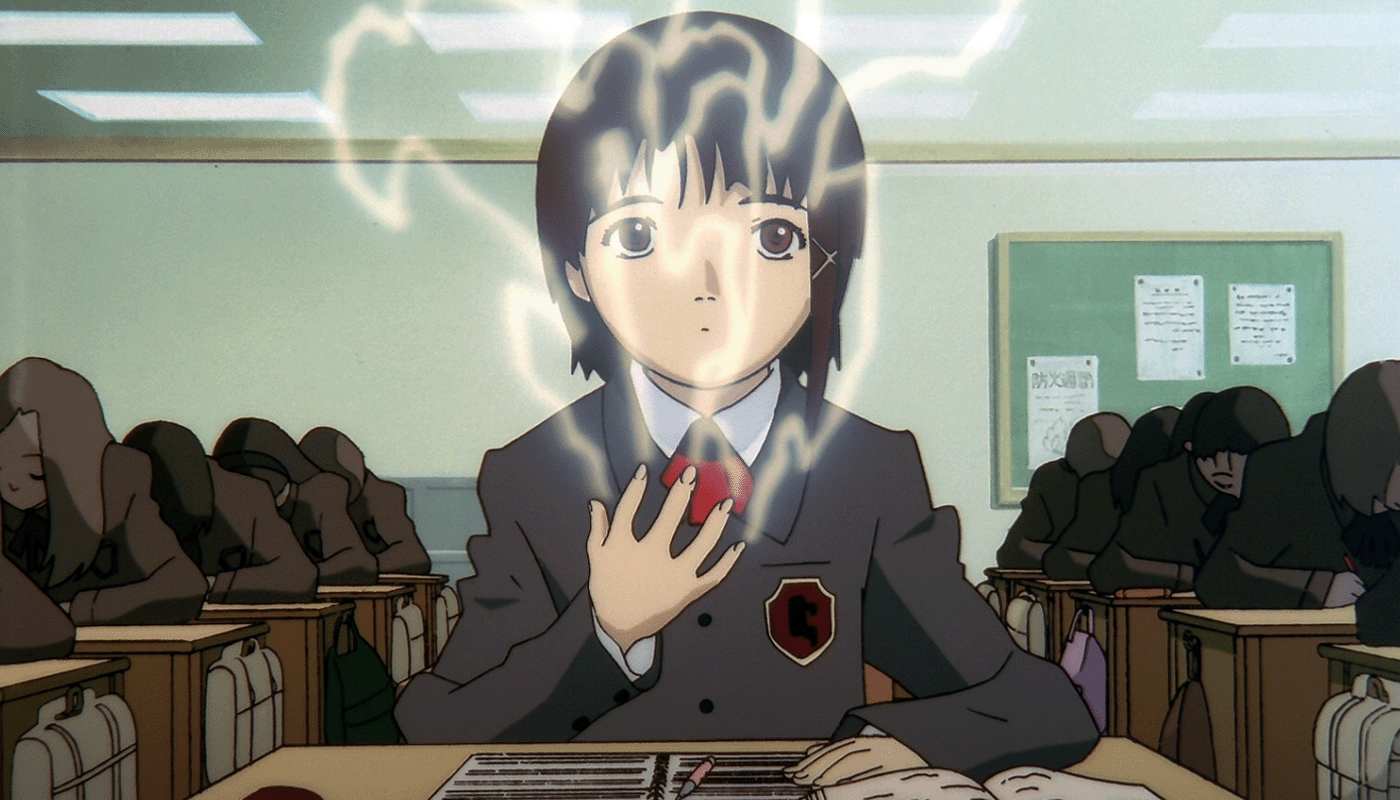
Among these foundational works, the 1998 cult classic Serial Experiments Lain holds a unique position. Viewing the series nearly three decades after its initial broadcast reveals a narrative that did not merely predict the future, but accurately foreshadowed the psychological friction of our modern, hyper-connected reality.
The World and the Wired: Convergence of Reality and Cyberspace

The intersection of humanity and digital infrastructure is a well-established trope in speculative fiction. Works such as William Gibson’s Neuromancer, the Wachowskis’ The Matrix, and Charlie Brooker’s Black Mirror have long occupied positions within the cultural zeitgeist. As populations stare into black-mirror displays daily, terminology once confined to cyberpunk fiction has entered mainstream lexicons, often accompanied by complex socio-political connotations. Corporations continue to monetize cyberspace with minimal regard for psychological fallout, leading to a profound cultural romanticization of the early internet.
For generations born on the cusp of the millennium—those who grew up alongside personal computing rather than being entirely raised by it—the late 1990s represent a distinct frontier. Before the advent of algorithmic social media, the internet functioned as an unmoderated, highly decentralized space where anonymity was standard and community-building felt exploratory rather than commercialized. Today, this era is romanticized by younger demographics through aesthetics such as vaporwave and retro-hardware appreciation, fostering a persistent belief that the digital sphere was fundamentally superior before corporate consolidation.
However, Serial Experiments Lain offers a stark antidote to this nostalgia. The series steadfastly avoids rose-tinted depictions of technology, utilizing a muted palette of blues, greens, and grays punctuated only by the harsh laser sights of surveillance devices. Rather than projecting a specific technological timeline, Lain captures the emerging seeds of paranoia, the degradation of interpersonal communication, and the friction between physical identity and online personas. Re-evaluating the series underscores a sobering reality: the psychological distress of the digital age was already taking root in the late 20th century.
Lain, Alone: Isolation and the Digital Sanctuary

The narrative centers on Lain Iwakura, a withdrawn fourteen-year-old junior high school student struggling with severe dissociation. Her domestic life is defined by emotional isolation; her mother is distant, her sister is indifferent, and her father—obsessed with digital hardware—only engages with her when she requests an upgraded terminal, known in the series as a "Navi."
The psychological catalyst of the series occurs when students receive unsettling electronic mail from Chisa Yomoda, a classmate who recently died by suicide. Chisa declares from the digital realm, “I didn’t die. I have only given up my body,” urging Lain to enter "the Wired"—the anime’s equivalent of the internet. This narrative element reflects historical anxieties of the late 1990s, echoing real-world tragedies such as the Heaven’s Gate mass suicide and the Aum Shinrikyo subway attacks, both of which highlighted contemporary vulnerabilities to extremist ideologies and fringe digital or spiritual philosophies.
As Lain navigates the Wired, she discovers that her online avatar possesses a confidence, assertiveness, and competence entirely absent from her physical existence. The show deliberately blurs the boundaries between physical reality, hallucination, and digital omnipresence. Through these early episodes, the series establishes its core thematic inquiry: when physical communities fail to provide care or connection, individuals naturally seek transcendence within technological systems.
Kids These Days: Generational Friction and Technological Exploitation

A recurring motif within Serial Experiments Lain is the integration of youth culture into technologically saturated, adult environments. Characters of varying ages navigate dangerous subterranean networks and illicit clubs equipped with portable terminals, highlighting a societal blurring of generational boundaries. While older generations frequently attribute adolescent alienation and declining attention spans to technological dependency, the narrative proposes a more complex systemic critique.
Children are routinely provided with digital tools as substitutes for parental engagement, only to be subsequently reprimanded for their reliance on those exact devices. Furthermore, the narrative reveals darker industrial exploitation. In later episodes, Lain encounters Dr. Hodgeson, a dying scientist who admits to conducting unethical neurological experiments on children decades prior. By connecting hundreds of subjects to experimental hardware, researchers attempted to harvest collective subconscious intuition—referred to as "psi"—converting human empathy and cognitive energy into a quantifiable commodity.
This plotline serves as a poignant critique of how societal institutions commodify youth psychology. Adults frequently dismiss juvenile coping mechanisms simply because they fail to comprehend the multi-dimensional identities youth construct online. When adolescents act out based on digital radicalization or alienation, parental figures often express disbelief, entirely unequipped to recognize their children as complex agents within virtual spaces.
The Haze: Structural Complexity and Existential Dread

Produced by Triangle Staff and conceptualized by writer Chiaki J. Konaka—noted for his affinity for the Cthulhu Mythos and existential horror—Serial Experiments Lain rejects conventional narrative structures. The series eschews traditional comedic relief and vibrant color grading in favor of a slow-paced, philosophical exploration of neurology, metaphysics, and information theory, drawing references from thinkers such as Vannevar Bush, John C. Lilly, and Ted Nelson.
The physical progression of Lain’s bedroom serves as an externalization of her psychological deterioration. What begins as a sparse, conventional teenager’s room gradually transforms into a claustrophobic swamp of cooling tubes, tangled cabling, and heavy processors that physically block out natural sunlight. Despite pressure from disembodied entities and digital cults insisting that physical bodies are obsolete, Lain persistently rejects this premise, asserting her physical reality with the defiant refrain, "I am me."
Ultimately, the emotional grounding of the series is anchored not by cyberspace, but by Arisu, Lain’s sole genuine human friend. In a pivotal sequence, Arisu confronts the wreckage of Lain’s room and confesses her own deep-seated fear. This admission highlights the central thesis of the work: authentic human empathy and vulnerability require corporeal existence. Without fear and physical mortality, true emotional connection is impossible.
Broader Impact and Implications

Nearly three decades after its initial broadcast, Serial Experiments Lain transcends its 13-episode container to stand as a masterclass in speculative foresight. Long before the normalization of cyber-bullying, the rise of the dark web, or contemporary discourse surrounding the mental health impacts of ubiquitous smartphone usage, the series diagnosed the fundamental alienation of the information age.
By refusing to offer neat narrative resolutions, the series successfully immerses the viewer in Lain’s cognitive overload. It challenges audiences to confront uncomfortable truths regarding humanity’s relationship with technology. As modern society continues to grapple with the fragmentation of identity and the erosion of physical community spaces, the central questions posed by Serial Experiments Lain remain as urgent and unsettling as they were in 1998. Present day. Present time.