When the production team behind Paramount+’s critically acclaimed science fiction series Star Trek: Strange New Worlds initially unveiled the episode titles for its fourth season earlier this year, a singular entry immediately captured the attention of the fandom. Positioned deliberately as the season-ending milestone, the finale was titled Tomorrow Enterprise. Even divorced from any narrative context, the nomenclature served as an unmistakable homage to Yesterday Enterprise, the legendary, critically lauded third-season installment of Star Trek: The Next Generation. Almost instantaneously, dedicated followers and franchise historians began speculating that the climactic placement of this title was far more than a mere easter egg. Instead, analysts suggested it signaled a sophisticated time-travel narrative designed to offer a premature, sideways glance into the established future of the original series, commonly referred to in franchise lore as TOS. Given the deliberate forward march of the internal chronological timeline, the introduction of temporal mechanics at this juncture felt narratively earned rather than arbitrary.
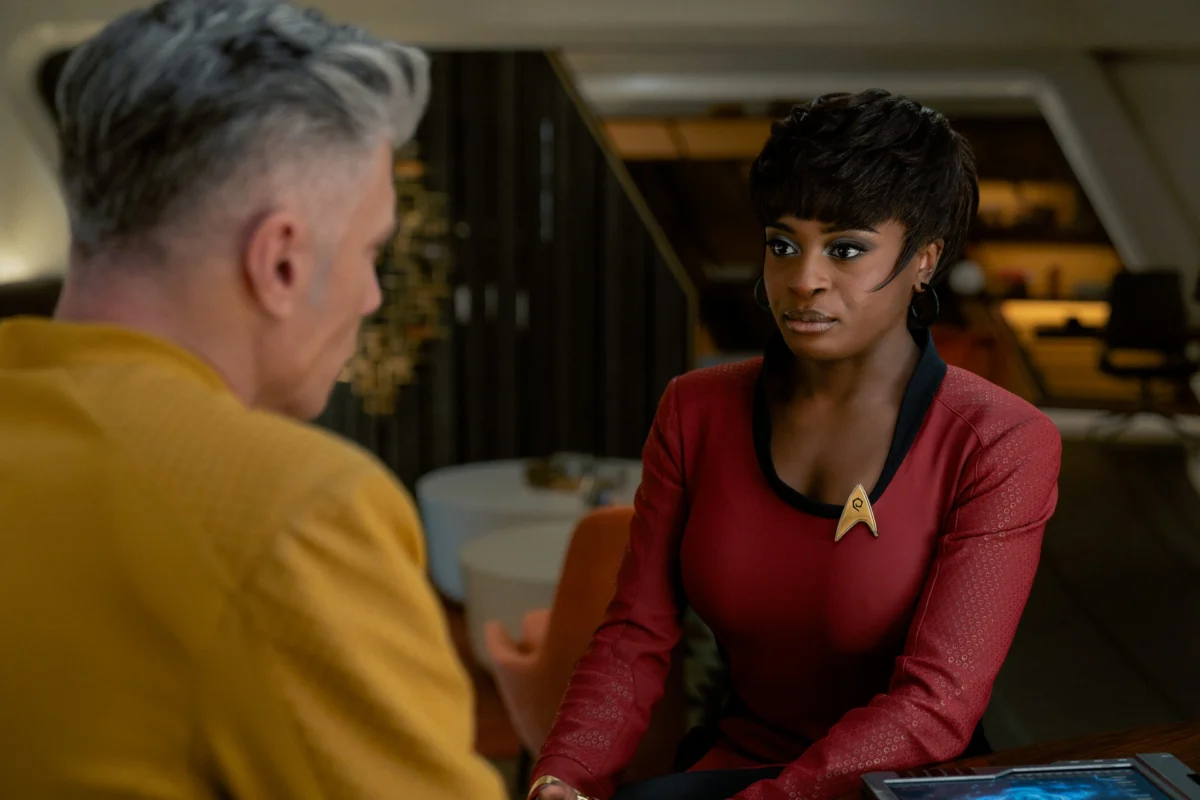
The speculation surrounding the trajectory of the series shifted from theory to concrete discussion following the release of the official promotional package for the finale. Paramount+ debuted the first official trailer, a comprehensive photo gallery, and a concise logline for the episode, confirming long-held fan hypotheses that the narrative would breach the boundaries of conventional linear storytelling. According to the network’s official logline, a catastrophic time ripple inflicts severe structural damage upon the USS Enterprise, compelling a younger iteration of Ensign Nyota Uhura to collaborate directly with an older version of herself to repair the fractured timeline. While the promotional trailer maintains a tight lid on explicit plot mechanics, the accompanying promotional stills provide substantial visual clues regarding the nature of the temporal anomaly.
Visual Evidence and Temporal Mechanics
A granular examination of the newly released promotional photographs reveals several striking departures from the standard visual continuity of Strange New Worlds. Most notably, promotional imagery highlights a distinct evolution in Ensign Uhura’s hairstyle, alongside subtle yet deliberate alterations to Starfleet uniform designs. Furthermore, production stills capture Captain Christopher Pike’s first officer, or potentially Captain James T. Kirk depending on the precise temporal displacement, actively commanding the vessel under anomalous conditions. These visual signifiers strongly imply that the temporal disturbance will bridge distinct eras within the vessel’s operational history. The narrative framing suggests a direct communicative or physical bridge across chronological distortions, forcing dual iterations of a legacy character to rectify an existential physics failure.
However, franchise analysts note that the temporal mechanics governing the episode appear significantly more complex than a straightforward crossover with classic Star Trek counterparts. While several primary legacy figures from the original series remain conspicuously absent from current promotional materials—despite network confirmations that iconic characters like Dr. McCoy, Sulu, and others are slated for official debuts by the conclusion of the upcoming fifth season—the presence of strictly modern Strange New Worlds characters complicates the scenario. The visual and narrative implications point away from a simple linear jump into the future and toward a sophisticated timeline convergence. This approach aligns closely with the foundational premise of Yesterday Enterprise, which famously constructed an alternate timeline resulting from a temporal incursion, while simultaneously fulfilling executive producer Henry Alonso Myers’ previous commitment to innovate upon the franchise’s well-established time-travel tropes.
Chronological Context and Series Trajectory
The timing of this temporal narrative arrives at a pivotal juncture in the production lifecycle of Strange New Worlds. As the series progresses toward its announced narrative destination, showrunners and writers face the delicate challenge of balancing episodic, standalone storytelling with the inexorable march toward the events of the original 1966 series. Since the show’s inception, critics and audiences have engaged in ongoing discussions regarding the series’ reliance on high-concept genre experiments, such as musical episodes, legal courtroom dramas, and comedic body-swap scenarios. While these stylistic departures have largely been praised for breathing fresh life into the episodic format, the looming horizon of the broader Star Trek timeline necessitates a gradual consolidation of long-term narrative threads.
The introduction of Tomorrow Enterprise may function as a crucial diagnostic tool for understanding the ultimate narrative direction of the series. Industry observers have noted vague indications from the production team suggesting that the final seasons of the property will pivot toward tighter continuity, addressing unresolved character arcs and the foundational questions required to seamlessly connect the prequel era to James T. Kirk’s eventual five-year mission. Consequently, the upcoming finale transcends its status as a routine high-concept adventure, raising questions regarding whether the temporal disruption will remain a contained, episodic curiosity or serve as a foundational catalyst for the overarching arc of the final season.
Implications for the Broader Franchise
The enduring legacy of time-travel narratives within the Star Trek universe cannot be overstated. From The Original Series episode The City on the Edge of Forever to The Next Generation’s All Good Things, temporal mechanics have consistently provided a thematic canvas for exploring character growth, fate, and existential philosophy. By explicitly invoking the thematic weight of Yesterday Enterprise, the creative team behind Strange New Worlds invites direct comparison to some of the finest hours in television science fiction history.
As viewers prepare for the broadcast of the season finale this week, the primary point of interest lies in the execution of the dual-Uhura dynamic and the structural integrity of the altered timeline. If the creative team successfully navigates the complex physics of time-ripple storytelling while maintaining the emotional resonance established across the first four seasons, the episode could redefine the boundaries of prequel storytelling within modern television. Ultimately, the success of Tomorrow Enterprise will be measured not merely by its utilization of nostalgic easter eggs or high-stakes action sequences, but by its ability to honor the foundational mythos of Star Trek while advancing the psychological and professional evolution of its central ensemble.