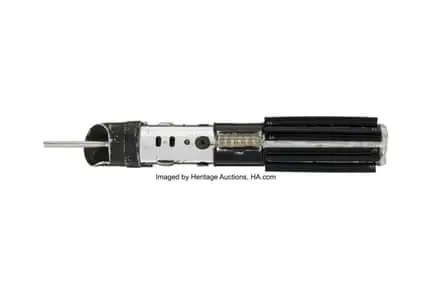
The global market for high-end entertainment memorabilia is poised to reach a monumental milestone next month when one of the most iconic cinematic artifacts in motion picture history goes under the hammer. Heritage Auctions has announced that a historic lightsaber used by the Sith Lord Darth Vader during the pivotal climax of the original Star Wars trilogy is heading to auction. Expected to command a minimum of $1 million, the artifact carries immense cultural and historical weight, tying directly into some of the most celebrated moments in the cinematic universe crafted by George Lucas.
This forthcoming sale is not an isolated event; it represents a larger, increasingly lucrative trend within the entertainment memorabilia sector. Rare props from science fiction and fantasy franchises—particularly the expansive Star Wars galaxy—have transitioned from niche collector items into institutional-grade assets. As high-net-worth individuals and specialized museums compete for culturally defining artifacts, valuations for authentic screen-used items have skyrocketed to unprecedented levels.
The Crown Jewel of the Auction
The centerpiece of the upcoming catalog is the Darth Vader lightsaber, a prop with impeccable provenance. Beyond its appearance in Star Wars: Episode V – The Empire Strikes Back, this specific hilt was also utilized during the production of Star Wars: Episode VI – Return of the Jedi. Most notably, it was carried by the towering antagonist during the emotionally charged father-and-son confrontation on Cloud City in The Empire Strikes Back, the exact setting for one of the most famous plot twists in cinematic history: the revelation that Vader is, in fact, Luke Skywalker’s father.
Heritage Auctions officials have noted that the piece exhibits the precise manufacturing characteristics of props constructed by the production team at Elstree Studios in the early 1980s. Because original props from the classic trilogy were frequently modified, damaged during stunts, or lost over the decades, surviving hero-grade lightsabers associated with primary characters are exceedingly rare. Consequently, market analysts anticipate competitive bidding that could easily push the final sale price well past the conservative $1 million baseline.
A Comprehensive Catalog Spanning the Skywalker Saga
While the Vader lightsaber dominates headlines, the upcoming auction features more than two dozen distinct lightsabers and weapon props spanning the entirety of the primary cinematic narrative, encompassing Episodes I through IX, alongside various television and anthology projects set within the Lucasfilm canon.
Among the supporting lots are dueling lightsabers wielded by Ewan McGregor as Obi-Wan Kenobi and Hayden Christensen as Anakin Skywalker during their emotionally devastating Mustafar showdown in Star Wars: Episode III – Revenge of the Sith. Each of these prequel-era hero props is estimated to fetch a minimum of $10,000, presenting a more accessible yet historically significant entry point for serious collectors.
Beyond lightsabers, the catalog delves deep into the broader visual iconography of the franchise. An EE-3 carbine blaster, famously carried by the bounty hunter Boba Fett throughout The Empire Strikes Back, carries a pre-auction estimate exceeding $100,000. For fans of practical effects and creature design, the auction includes an original Yoda puppet hand operated by master puppeteer Frank Oz during the character’s introduction in The Empire Strikes Back.

Further adding to the historical significance of the offering is a signed, personal third-draft screenplay of the original 1977 film, belonging to Anthony Daniels, the actor who brought the protocol droid C-3PO to life. Rounding out the physical artifacts is a screen-used TIE Fighter pilot helmet from the 2016 anthology film Rogue One: A Star Wars Story, demonstrating the auction house’s commitment to sourcing items from both the original trilogy and modern additions to the canon.
The Escalating Market for Star Wars Memorabilia
The timing of this auction coincides with a period of extraordinary valuation growth for Star Wars properties. Just months prior to this announcement, the memorabilia market was shaken when a unique prop package—consisting of a lightsaber alongside the prosthetic severed hand of Luke Skywalker from the same climactic duel in The Empire Strikes Back—sold for an astonishing $3.75 million at a competing auction house. According to industry records, that transaction established the absolute highest price ever paid for a single prop originating from a Star Wars motion picture.
This upward trajectory reflects a broader maturation of the pop-culture collectibles market. Items that were once treated as disposable behind-the-scenes production materials are now recognized as cultural touchstones worthy of fine-art-level preservation. Major auction houses have established dedicated entertainment departments to manage the influx of consignments from former cast members, crew, and private collectors who recognize that contemporary demand has never been higher.
Industry Perspectives and Expert Analysis
Market analysts attribute the sustained surge in memorabilia valuations to a combination of generational nostalgia and institutional interest. As the generation that grew up watching the original trilogy in theaters attains peak purchasing power—often coupled with significant disposable income—the emotional resonance of these physical objects translates directly into aggressive financial valuation.
Furthermore, the globalization of entertainment media has expanded the collector base. Bidders from Asia, Europe, and North America routinely compete for top-tier lots, driving prices far beyond historical norms. Curators and investment advisors point out that while traditional equities and real estate remain standard portfolio components, elite cultural artifacts offer a tangible connection to history coupled with strong historical appreciation.
However, experts also emphasize the critical importance of provenance. Because the market for replicas and fan-made prop reproductions is robust, authentication processes have become increasingly rigorous. Heritage Auctions and similar institutions employ forensic analysis, historical photo-matching, and direct documentation from production personnel to verify the authenticity of every lot before it enters a public catalog. The Vader lightsaber, backed by extensive archival records, represents the gold standard of verified Hollywood provenance.
Broader Implications and Preservation Concerns
As prices for cinematic history continue to scale new heights, discussions surrounding the long-term preservation of these items have intensified. While private collectors frequently secure these treasures in climate-controlled vaults, museum professionals and cultural historians increasingly advocate for public accessibility. Many high-profile acquisitions eventually find their way into temporary public exhibitions or permanent museum installations, ensuring that fans who cannot afford million-dollar bids can still experience the physical reality of cinema history.
The upcoming sale at Heritage Auctions will serve as a definitive barometer for the health and vitality of the entertainment collectibles market. Whether the Darth Vader lightsaber shatters records or simply meets its lofty expectations, the event underscores the enduring cultural footprint of a space opera that premiered nearly half a century ago. For collectors, historians, and enthusiasts alike, the auction represents a rare opportunity to witness history changing hands—one iconic prop at a time.