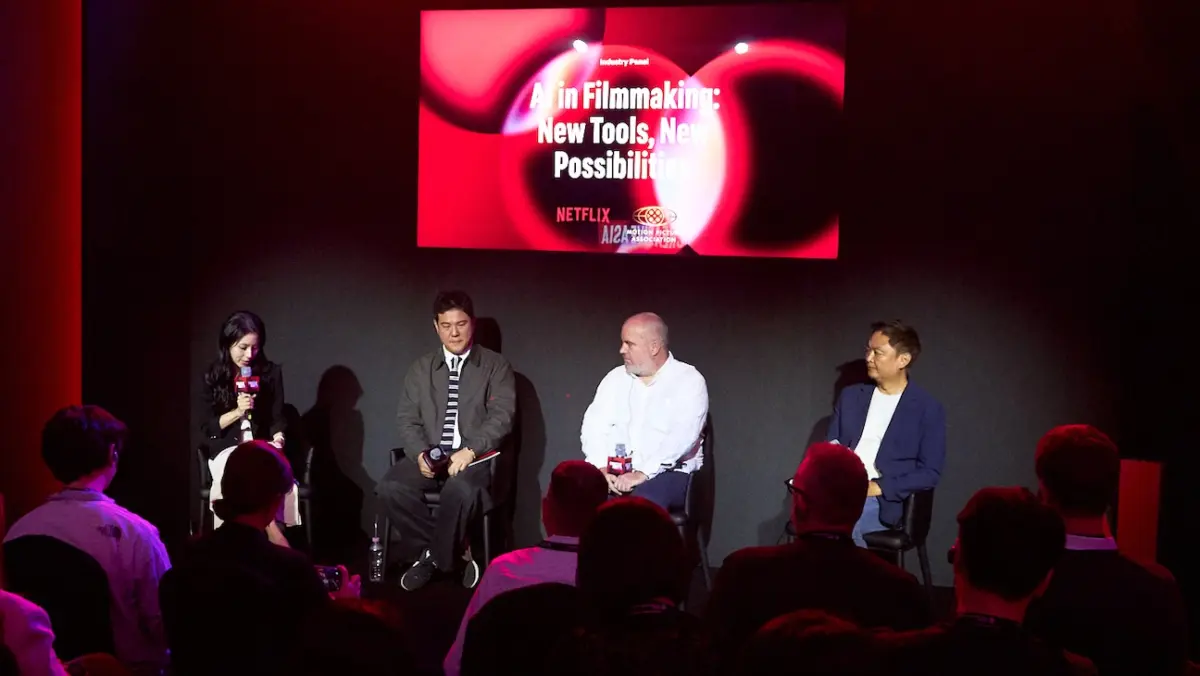
The rapid evolution of generative artificial intelligence is no longer a theoretical prospect for the global film industry; it is an active, ongoing component of studio production workflows. During a high-profile industry panel at the Busan International Film Festival (BIFF) this past Saturday, Netflix’s senior director of production for the Asia-Pacific region, Sung Q Lee, confirmed that the streaming giant has already utilized AI tools across approximately 300 of its titles. This disclosure, made during the annual Creative Asia event, highlights the deepening integration of automated technologies in everything from previsualization and set design to visual effects (VFX) and post-production editing.
The revelation from the Busan summit underscores a widening divide in how different geographic markets perceive the encroachment of automation. While the Hollywood creative community has spent the better part of two years embroiled in labor disputes and ethical debates concerning the displacement of human labor, many Asian creators and production executives are approaching the technology with a focus on democratization and economic efficiency.
A Shifting Paradigm in Production
For Netflix, the strategy is less about the total automation of filmmaking and more about what the company describes as "assistive" integration. According to Lee, the primary metric for success at the streaming platform is not the volume of AI utilized, but the degree to which AI can enhance the creative vision of the director. "The question that matters to me isn’t, ‘How much AI can we put into this title?’ but, ‘What more can this title do with AI’s help?’" Lee remarked during the panel, which was co-hosted by the Motion Picture Association.
The practical applications mentioned by Lee—previsualization, set dressing, and VFX—are already standardizing across major studio pipelines. By generating digital mock-ups of sets or rapid visual iterations of scenes, production teams can save significant time and resources, allowing directors to make informed decisions long before the first day of principal photography.
The Case Study of Kang Yun-sung and the Evolution of AI Filmmaking
The conversation at Busan was significantly bolstered by the participation of Korean filmmaker Kang Yun-sung, the director of The Outlaws. Kang serves as an essential case study in the volatile nature of early AI adoption. Last year, he collaborated with AI-specialist filmmaker Kwon Han-seul to produce Run to the West, widely cited as Korea’s first fully AI-assisted feature film.
The project faced significant headwinds. Upon release, the film garnered roughly $100,000 at the box office, hampered by negative critical reception specifically targeting its visual aesthetic. Kang candidly admitted that the pace of technological advancement made the film appear dated by the time it reached audiences. However, rather than retreating from the technology, Kang has doubled down. He is currently in production on an action feature titled The Gulf of Aden, which relies heavily on generative tools provided by the Chinese firm Kling AI.
For Kang, the primary appeal is budgetary. He estimates that utilizing AI-assisted workflows could reduce the production budget for The Gulf of Aden by as much as 40 percent. This reduction is achieved not merely by replacing manual CGI labor, but by streamlining the physical shoot, condensing production timelines, and enabling the realization of complex scenes that would have been financially unfeasible under traditional constraints. "What has been buried due to budgetary issues was able to be put back on the table," Kang noted, suggesting that for mid-budget filmmakers, AI could be a vital tool for survival in a tightening market.
Technical Perspectives: The Role of Assistive AI
Kimball Thurston, chief technology officer at Wētā FX, provided a technical counterpoint to the more ambitious aspirations of directors like Kang. From the perspective of a premier VFX house, the integration of AI is framed as a strictly technical solution to logistical bottlenecks. Thurston emphasized that Wētā FX views the technology as "assistive AI," maintaining that it is never allowed to dictate creative intent.
"It provides us—very fast—with the visual images and visualization," Thurston explained. "So from the director’s perspective or the cinematographer’s perspective, it’s very easy to identify the errors and correct them. Our goal is to reduce simple, repetitive tasks." This sentiment reflects a broader industry consensus: that the most successful implementations of AI currently occur in the "back-end" of production, where automation eliminates the drudgery of rendering and frame-by-frame adjustment, freeing human artists to focus on high-level creative problem-solving.
Historical Context and the Persistence of the "Human Touch"
The discussion at Busan also aimed to contextualize the rise of AI within the longer history of cinematic innovation. Just as the transition from silent film to "talkies," or the move from celluloid to digital cinematography, once sparked existential panic among industry veterans, many executives now argue that AI is simply the latest iteration of the tools filmmakers use to tell stories.
However, Netflix’s Lee was careful to draw a hard line between technical capability and emotional resonance. He argued that while AI can manage the "how" of filmmaking, it remains fundamentally unable to address the "why."
"Technological changes and new tools have helped a great deal with the ‘how,’ or how we make what we make better," Lee said. "But they never decided the ‘why’—why we have to tell this story." He further emphasized that the emotional core of any narrative requires a human intermediary. "When it comes to conveying emotion, ultimately, a human has to touch it. AI can get many jobs done, but does it touch human emotion? The human touch is critical and necessary."
Broader Implications: A Global Divide
The differing perspectives between the Hollywood sector and the Asian content industry represent a significant divergence in global media strategy. Hollywood’s wariness, largely driven by the fear of intellectual property devaluation and labor displacement, stands in stark contrast to the experimental, efficiency-first approach adopted by many Korean and Chinese production houses.
The economic implications are clear: if studios in the Asia-Pacific region can successfully leverage generative AI to reduce production costs by 40 percent without sacrificing narrative quality, they may gain a significant competitive advantage in the global streaming market. As Netflix and other major platforms look to diversify their content libraries, the ability to produce high-quality, mid-budget content at a fraction of the cost will likely accelerate the adoption of these tools, regardless of the ongoing cultural debate.
Future Outlook and Challenges
Looking forward, the industry must grapple with several critical challenges:
- Ethical and Legal Frameworks: The integration of AI into 300+ Netflix titles raises ongoing questions regarding copyright, the provenance of training data, and the legal status of AI-generated content.
- Standardization of Quality: As evidenced by the struggles of Run to the West, the "uncanny valley" effect remains a significant risk for films that rely too heavily on generative imagery. Achieving a consistent visual standard that does not alienate audiences is a primary technical hurdle.
- Labor Relations: While producers see efficiency, unions and guilds continue to push for protections that ensure AI remains a tool for humans rather than a replacement for them.
The Busan International Film Festival panel made it clear that the "AI era" of filmmaking is no longer approaching; it has arrived. Whether this transition leads to a renaissance of accessible, high-concept storytelling or a period of creative stagnation remains the central question for the next decade of global entertainment. For now, the consensus among those at the forefront of the shift is one of cautious optimism—a belief that, so long as the "human touch" remains at the center of the creative process, the new tools of the trade may ultimately serve to expand, rather than diminish, the reach of human imagination.